Dear Toni Morrison,
I am in the middle of love, no, Love, I mean, the book. I'm always in the middle of love. I'm lucky that way.
I wanted to talk to you about sentences. You have a power in your sentence construction. For example, just one, though I could identify so many.
"It might help the new woman convert her own rental in his arms to a longer lease."
Wow, what a sentence. You have, in 17 words, pinned down so many things. Christine's action,* designed to send a message, was intercepted and watered down by the new woman. You have, in a sentence, set up a metaphor, established the complexity of a human dynamic filled with longing and hope, turned the metaphor and then crushed that hope by implication. You are masterful.
I want to talk about another powerful sentence too. And it's from story about love, one as hard your's always are, harder maybe, but with a turn of a phase that establishes hope rather than dashing it.
Girls go to school safely. They are kept girls too. Kept in an insulated community, in a tiny school filled with knowns and expecteds. A man fights insanity and loses the battle. His entrance into the school is unexpected and explosive and tragic. The story is documented on the front pages everywhere. I don't need a footnote.
But I'm taken by the short sentence and wonder at it. "I forgive," he said, the farmer in the dark clothing.
And not just by the words, but by the subsequent acts, recorded quietly because the usual media circus was short-circuited by a quiet community, I, the world, was convinced that this man and these people knew a thing or two about love. And though I am sure I do not, now, hold inside me the depth of spirit exhibited by these plainfolk, I have seen love enough, from mother, father, husband, child, friend, relative, and stranger, that I am certain they have chosen the path of love.
Every time I read your works, I am impressed by your sentences. When I read the short paragraph framed by an ill-spoken farmer, I was in awe.
Betsy
*Christine was a jilted, "kept woman" whose response was to destroy the jilter's automobile. His "new woman" protected the man from the enormity of the ruin and the power of what a displaced woman could do.
Thursday, October 26, 2006


Wednesday, October 18, 2006
Part III or IV (if you count the frog): Time Past And Time Future Allow But A Little Consciousness
“I am able to make from the springboard the great leap whereby I pass into infinity, my back is like that of a tight-rope dancer,. . . hence I find this easy; with a one-two-three! I can walk about existence on my head.”—S. Kierkegaard—Fear and Trembling—Problemata: Preliminary Expectoration
Dear Soren,
Geehaw, this is harder than I thought. I’m just trying to explain in 45 words or less my view of which people get damned to hell and why. How come that is so difficult? Next thing I’ll be talking about angels on the head of a pin, to describe some nuance of the subject.
If only you were here to interpret for us.
But I’ll try to take a pitch at the target, and when I throw, it is always back to you existentialists. Camus says, (The Plague in the voice of Tarrou) “Query: How contrive not to waste one’s time? Answer: By being fully aware of it all the while. Ways in which this can be done: By spending one’s days on an uneasy chair in a dentist’s waiting room; by remaining on one’s balcony all a Sunday afternoon; by listening to lectures in a language one doesn’t know; by traveling by the longest and least convenient train routes, and of course standing all the way; by lining up at the box office of theaters and then not buying a seat; and so forth.”
We really do walk about existence so easily, insentiently, but to springboard to infinity, ah, that is not the same. And Camus’ suggestions, though giving us a little consciousness, don’t quite jettison us out of the temporal.
I want meaning to my time. I want eternity in my time. That is, I believe, not opposable thumbs, what makes me human. That should be in the creeds. “I believe that human moments in time hold eternal significance.”
In Paul Tillich’s cluster of sermons entitled, The Eternal Now, chapter entitled The Good That I Will, I Do Not, he says, “. . . Sin is a picture full of ugliness, suffering and shame, and, at the same time, drama and passion. It is the picture of us as the battleground of powers greater than we. It does not divide men into categories of black and white, or good and evil. It does not appear as the threatening finger of an authority urging us—do not sin! But it is the vision of something infinitely important, that happens on this small planet, in our bodies and minds. It raises [hu]mankind to a level in the universe where decisive things happen in every moment, decisive for the ultimate meaning of all existence. In each of us such decisions occur, in us, and through us. This is our burden. This is our despair. This is our greatness.”
And, could I add, this is our portal to life eternal?
Have you ever used Flash*? Oh, of course not, no computers in the 1800’s. Well, Macromedia Flash is a timeline-driven software. It is harder to learn to use than, say Adobe PhotoShop or Microsoft Word or even AutoCad. It is not just three dimensional, it is four dimensional. It allows for change over time. A circle morphs into a cube. A video plays with music, etc. When constructing a Flash movie, a designer assigns a purpose to each frame, each moment on the timeline. And while working on a project there is a little red slider that can be pulled, now forward, now back, into the Flash future, back to the Flash past, with a flick of the mouse.

Click here
And when we test our projects we watch that red slider glide through the events. If we see a mistake on the stage (that is what the workspace is actually called) we try to catch that slider. STOP. Stop. We want to change that frame. Make it right.
I’ve digressed it seems for a simple point. Would that we all had sliders to catch and draw back our lives to points in time that we regret, that run through our heads over and over. Bad playbacks. Damnable moments. Damned moments. So when I deal with exclusivism, it's not primarily the question, "who is excluded from salvation?" but "am I wholly excluded from damnation?" And my answer is no, I am not.
Is it possible that each of our moments hold the potential for salvation or damnation? We either embrace the grace extended to us or curse it. Am I saved? Is my soul saved? Am I damned? Is my soul damned? Yes. Yes. Yes. Yes. How can I believe that it is not all so. I know my heart and I know my moments. I believe that God’s grace has saved me, that I have drunk from “a spring of water welling up to eternal life.” God has revealed that salvation in eternal moments. But also, "The good that I will, I do not," (Romans 7) And,“Blessed is the [hu]man who perseveres under trial, because when he has stood the test, [s]he will receive the crown of life that God has promised to those who love him.” (James 1:12) And, “You see that a person is justified by what [s]he does and not by faith alone. In the same way, was not even Rahab the prostitute considered righteous for what she did when she gave lodging to the spies and sent them off in a different directions? As the body without the spirit is dead, so faith without deeds is dead.” (Did Rahab have to sign off on a creed before God declared her righteous?) Eternal life, begins in our every day existence. When we refuse the salvation of the Lord in our todays, we refuse it for the eternity that our todays could have been. When we do not love our neighbor today, we close that portal to eternity. When we do not house that spy today, we have entered into a damnation of that which had potential for the eternal. Grace is extended to us, all of us, not just once, at the beginning of a spiritual journey, not just at the crisis of a testimony, but at every turn. We have but to receive it. Likewise, we have but to reject it.
I am a Christian. And I do believe that it is the grace of Jesus Christ I’m talking about here. And I suspect that this grace is very wide indeed, extending at least the breadth of an EOC statement. And I praise God that mercy eternal has been mysteriously extended to me, and consciously so, in the unity and diversity of my soul.
Soren, your thoughts often leave me in the dusky dust. I do not always understand. I am like a rope on the Goodyear blimp. Sometimes it feels like I’m holding on for dear life, just reading your ideas. Yet your thoughts have helped lead me to these thoughts. And it is my thoughts, not yours, that must, in the end, make sense to me. So I’ll continue to read and think and baby step.
Betsy
*Click here for a very fun presentation of Flash in Flash.
Dear Soren,
Geehaw, this is harder than I thought. I’m just trying to explain in 45 words or less my view of which people get damned to hell and why. How come that is so difficult? Next thing I’ll be talking about angels on the head of a pin, to describe some nuance of the subject.
If only you were here to interpret for us.
But I’ll try to take a pitch at the target, and when I throw, it is always back to you existentialists. Camus says, (The Plague in the voice of Tarrou) “Query: How contrive not to waste one’s time? Answer: By being fully aware of it all the while. Ways in which this can be done: By spending one’s days on an uneasy chair in a dentist’s waiting room; by remaining on one’s balcony all a Sunday afternoon; by listening to lectures in a language one doesn’t know; by traveling by the longest and least convenient train routes, and of course standing all the way; by lining up at the box office of theaters and then not buying a seat; and so forth.”
We really do walk about existence so easily, insentiently, but to springboard to infinity, ah, that is not the same. And Camus’ suggestions, though giving us a little consciousness, don’t quite jettison us out of the temporal.
I want meaning to my time. I want eternity in my time. That is, I believe, not opposable thumbs, what makes me human. That should be in the creeds. “I believe that human moments in time hold eternal significance.”
In Paul Tillich’s cluster of sermons entitled, The Eternal Now, chapter entitled The Good That I Will, I Do Not, he says, “. . . Sin is a picture full of ugliness, suffering and shame, and, at the same time, drama and passion. It is the picture of us as the battleground of powers greater than we. It does not divide men into categories of black and white, or good and evil. It does not appear as the threatening finger of an authority urging us—do not sin! But it is the vision of something infinitely important, that happens on this small planet, in our bodies and minds. It raises [hu]mankind to a level in the universe where decisive things happen in every moment, decisive for the ultimate meaning of all existence. In each of us such decisions occur, in us, and through us. This is our burden. This is our despair. This is our greatness.”
And, could I add, this is our portal to life eternal?
Have you ever used Flash*? Oh, of course not, no computers in the 1800’s. Well, Macromedia Flash is a timeline-driven software. It is harder to learn to use than, say Adobe PhotoShop or Microsoft Word or even AutoCad. It is not just three dimensional, it is four dimensional. It allows for change over time. A circle morphs into a cube. A video plays with music, etc. When constructing a Flash movie, a designer assigns a purpose to each frame, each moment on the timeline. And while working on a project there is a little red slider that can be pulled, now forward, now back, into the Flash future, back to the Flash past, with a flick of the mouse.
Click here
And when we test our projects we watch that red slider glide through the events. If we see a mistake on the stage (that is what the workspace is actually called) we try to catch that slider. STOP. Stop. We want to change that frame. Make it right.
I’ve digressed it seems for a simple point. Would that we all had sliders to catch and draw back our lives to points in time that we regret, that run through our heads over and over. Bad playbacks. Damnable moments. Damned moments. So when I deal with exclusivism, it's not primarily the question, "who is excluded from salvation?" but "am I wholly excluded from damnation?" And my answer is no, I am not.
Is it possible that each of our moments hold the potential for salvation or damnation? We either embrace the grace extended to us or curse it. Am I saved? Is my soul saved? Am I damned? Is my soul damned? Yes. Yes. Yes. Yes. How can I believe that it is not all so. I know my heart and I know my moments. I believe that God’s grace has saved me, that I have drunk from “a spring of water welling up to eternal life.” God has revealed that salvation in eternal moments. But also, "The good that I will, I do not," (Romans 7) And,“Blessed is the [hu]man who perseveres under trial, because when he has stood the test, [s]he will receive the crown of life that God has promised to those who love him.” (James 1:12) And, “You see that a person is justified by what [s]he does and not by faith alone. In the same way, was not even Rahab the prostitute considered righteous for what she did when she gave lodging to the spies and sent them off in a different directions? As the body without the spirit is dead, so faith without deeds is dead.” (Did Rahab have to sign off on a creed before God declared her righteous?) Eternal life, begins in our every day existence. When we refuse the salvation of the Lord in our todays, we refuse it for the eternity that our todays could have been. When we do not love our neighbor today, we close that portal to eternity. When we do not house that spy today, we have entered into a damnation of that which had potential for the eternal. Grace is extended to us, all of us, not just once, at the beginning of a spiritual journey, not just at the crisis of a testimony, but at every turn. We have but to receive it. Likewise, we have but to reject it.
I am a Christian. And I do believe that it is the grace of Jesus Christ I’m talking about here. And I suspect that this grace is very wide indeed, extending at least the breadth of an EOC statement. And I praise God that mercy eternal has been mysteriously extended to me, and consciously so, in the unity and diversity of my soul.
Soren, your thoughts often leave me in the dusky dust. I do not always understand. I am like a rope on the Goodyear blimp. Sometimes it feels like I’m holding on for dear life, just reading your ideas. Yet your thoughts have helped lead me to these thoughts. And it is my thoughts, not yours, that must, in the end, make sense to me. So I’ll continue to read and think and baby step.
Betsy
*Click here for a very fun presentation of Flash in Flash.
Tuesday, October 17, 2006
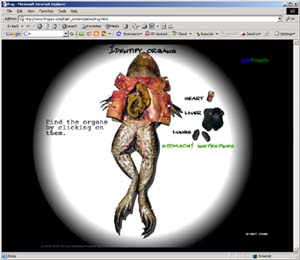
Dissecting the Body* and Soul
Dear God,
If only dissecting the soul were as straightforward as dissecting the body, perhaps we would not have to take so many anti-depressants.

Click Here to Dissect
Betsy
*I love this Website
If only dissecting the soul were as straightforward as dissecting the body, perhaps we would not have to take so many anti-depressants.
Betsy
*I love this Website
Wednesday, October 11, 2006
The Mystery of the Soul: Symbol and Salvation
Dear Psyche,
I’m having trouble moving my thought processes along in a clearly discernable way. Last night I realized that the best thing to do would be to try to say it and have you and anyone else who wants to try, rip it apart and then I’ll put it back together again.
Let me draw a picture.
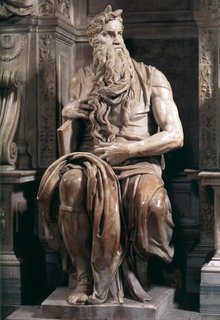 God waited around for Moses to die. He didn’t rush the process and I think it is because God likes poetry (hence God would no doubt be entertained by the Paterson Project) and waited around for Moses to speak to the end of his last “Ha’azinu,” his last proclamation of a “Shema Israel.” In a way, it reminds me of John the Baptist’s death question to Jesus. “Are you really the Christ?” But Moses rolls it out more, beginning in his own voice with a proclamation of God’s name, “Oh, praise the greatness of our God! He is the Rock, his works are perfect, and all his ways are just.” But he turns the voice of the poem over to the Rock, seeking confirmation to the earlier “Shema Israel, the Lord our God, the Lord is one.” And the Rock doesn’t say, “hear”, it says, “See now that I myself am He! There is no God besides me. I put to death and I bring to life, I have wounded and I will heal, and no one can deliver out of my hand.” And then Moses dies.
And then, Joshua begins. And the folks of Israel are ready to enter the land of dreams. And this part of Scripture is where I, too, begin in piecing together my picture of the human soul. The children must cross the River Jordan in order to enter the Promised Land. Of course, I don’t have to talk about the salvation symbolism that has splashed out of that river. The whole party of Israelites went through the dry baptism of the River Jordan led by the covenant of God. And when they had reached the other side, Joshua chose 12 disciples and sent them back out into the riverbed to gather memorial stones. Those they brought to where they lived in the camp. And Joshua made a pile to serve as an eternal reminder.
That pile of rocks, for me, describes the human soul. Our souls are monuments to the salvation of the Lord, the Rock of our salvation. The salvific act of crossing the Jordan is one thing and it is a miracle of God and has to do with the essence of our beings. But the composition of our eternal souls is a rock collection that memorializes for time and eternity the existential affirmations, happening moment by moment, to the salvation that enlivens us.
The other symbols of Scripture that speak of soul are similar in their multiplicity of form. The children of Israel themselves are a picture of the soul. The grapes of the vineyard. The molecules that make up the baby being born. All have unity and diversity, singularity and multiplicity intrinsic to them. The soul is not a singularity.
Believe it or not, this is where I begin my thinking about exclusivism. And I'll continue this line of thinking another day.
B
I’m having trouble moving my thought processes along in a clearly discernable way. Last night I realized that the best thing to do would be to try to say it and have you and anyone else who wants to try, rip it apart and then I’ll put it back together again.
Let me draw a picture.
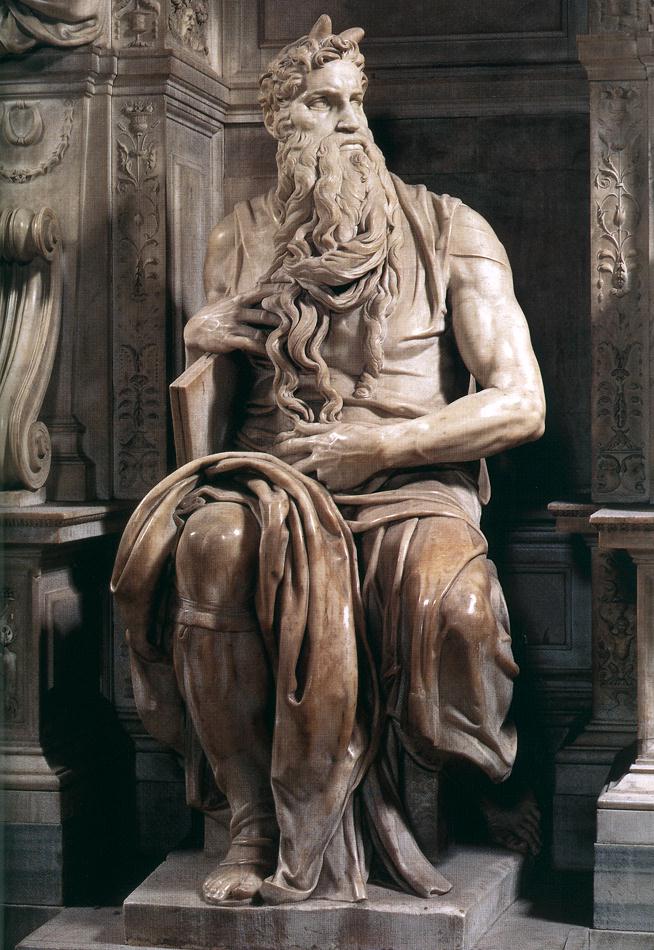 God waited around for Moses to die. He didn’t rush the process and I think it is because God likes poetry (hence God would no doubt be entertained by the Paterson Project) and waited around for Moses to speak to the end of his last “Ha’azinu,” his last proclamation of a “Shema Israel.” In a way, it reminds me of John the Baptist’s death question to Jesus. “Are you really the Christ?” But Moses rolls it out more, beginning in his own voice with a proclamation of God’s name, “Oh, praise the greatness of our God! He is the Rock, his works are perfect, and all his ways are just.” But he turns the voice of the poem over to the Rock, seeking confirmation to the earlier “Shema Israel, the Lord our God, the Lord is one.” And the Rock doesn’t say, “hear”, it says, “See now that I myself am He! There is no God besides me. I put to death and I bring to life, I have wounded and I will heal, and no one can deliver out of my hand.” And then Moses dies.
And then, Joshua begins. And the folks of Israel are ready to enter the land of dreams.
 And this part of Scripture is where I, too, begin in piecing together my picture of the human soul. The children must cross the River Jordan in order to enter the Promised Land. Of course, I don’t have to talk about the salvation symbolism that has splashed out of that river. The whole party of Israelites went through the dry baptism of the River Jordan led by the covenant of God. And when they had reached the other side, Joshua chose 12 disciples and sent them back out into the riverbed to gather memorial stones. Those they brought to where they lived in the camp. And Joshua made a pile to serve as an eternal reminder.
That pile of rocks, for me, describes the human soul. Our souls are monuments to the salvation of the Lord, the Rock of our salvation. The salvific act of crossing the Jordan is one thing and it is a miracle of God and has to do with the essence of our beings. But the composition of our eternal souls is a rock collection that memorializes for time and eternity the existential affirmations, happening moment by moment, to the salvation that enlivens us.
The other symbols of Scripture that speak of soul are similar in their multiplicity of form. The children of Israel themselves are a picture of the soul. The grapes of the vineyard. The molecules that make up the baby being born. All have unity and diversity, singularity and multiplicity intrinsic to them. The soul is not a singularity.
Believe it or not, this is where I begin my thinking about exclusivism. And I'll continue this line of thinking another day.
B
Tuesday, October 03, 2006
Exclusivism and the Holy Catholic* Christian Church
*Another word that needs to be excised and replaced in the creeds. The baggage that term carries is totally unacceptable. Yet we continue to drag it along without a thought.
Dear Theologians, especially Anne GG and Cate, who asked,
This is going to be long. I will have to break it into at least two parts. I want to try and work this through (for myself) carefully. I'm hoping you will help me with this and not rigidly quote me on any of this. I don't want to be heretical for heretical sake.
Eric Hoffer says, "To know a person's religion we need not listen to his profession of faith but just find his brand of intolerance." (I unfurled this quote yesterday from the code of the local paper's Celebrity Cipher, but it does speak to the subject.) Exclusivism of faith is the up side of intolerance. It comes from, I believe, the depths of our desire to get it right. We, humans (some of us anyway), spend our lives trying to nail down what we believe. We check our beliefs for errors, systematize, categorize, make application, and then stand guard. We, from whatever denominational or religious perch we sit, hawk-eye everyone else, either kindly or viciously, but knowingly.
It's not just Christians who do this, though this is certainly where I come from. I loved the quote I read on msnbc.msn.com the other day when the folks of Turkey were up in arms about the comments of the Pope. "Anyone who describes Islam as a religion as intolerant encourages violence," Foreign Ministry spokeswoman Tasnim Aslam said. One would have to smile, if the implications weren't so virulent.
But I'm not worried about others. I'm worried about me and whether my own tendencies to exclusivism actually would brand a true Christ follower or not. I think there are a variety of concerns that we need to think about.
1) Has God assigned us the task of making sure everyone is "thinking straight and the same?"
2) Is faith primarily content based?
3) Is faith a goal or an end in and of itself or is it a means to achieving something, i.e. "Salvation, eternal life, heaven, etc."
Possibly if we answer the third question, the first two will fall away. However, I think this is how we wind our way to the issue of exclusivism, at least I do. I look at life and other people and discern reason in terms of relationship. A really good thinker would be much more sterile in their approach. But for me, I'm brought to thought via example. So here are examples that have brought me to crisis of thought. I have a non-Christian friend, (spell that Muslim). She lives like me. Her moral and spiritual concerns are very close to mine, closer than many of my Christian friends. She even uses a wonderful term to draw us together. She says that we are "people of the book." I love that. On top of that, as stated above, I have Christian friends who are very dissimilar to me. Their moral reflections are quite different from mine, some stretching in one direction, some the polar opposite. Both types of people are equally sincere in their basic spiritual concerns.
(Margaret GG would approach this more simply. She thinks the answer is more obvious, and, perhaps, that one need not intellectualize so. But I do that, so let's continue.)
What does this mean, I say in my shriveled little heart? I feel like I am an employee of the mail office who was given two stamps, years ago, to mark packages. One says, "Forward to St. Peter, signature required," the other says, "Go to Hell." But I've gone postal. The packages in front of me are piling up and all I can do is take turns hitting myself on the forehead, first with one stamp and then the other.
Well, I haven't done anything but present an introduction to this subject. So what! This is my blog. Anyone who criticizes me for going on too long encourages violence! But you, too, can say whatever you want and I will probably not delete, excepting spam.
Betsy
Dear Theologians, especially Anne GG and Cate, who asked,
This is going to be long. I will have to break it into at least two parts. I want to try and work this through (for myself) carefully. I'm hoping you will help me with this and not rigidly quote me on any of this. I don't want to be heretical for heretical sake.
Eric Hoffer says, "To know a person's religion we need not listen to his profession of faith but just find his brand of intolerance." (I unfurled this quote yesterday from the code of the local paper's Celebrity Cipher, but it does speak to the subject.) Exclusivism of faith is the up side of intolerance. It comes from, I believe, the depths of our desire to get it right. We, humans (some of us anyway), spend our lives trying to nail down what we believe. We check our beliefs for errors, systematize, categorize, make application, and then stand guard. We, from whatever denominational or religious perch we sit, hawk-eye everyone else, either kindly or viciously, but knowingly.
It's not just Christians who do this, though this is certainly where I come from. I loved the quote I read on msnbc.msn.com the other day when the folks of Turkey were up in arms about the comments of the Pope. "Anyone who describes Islam as a religion as intolerant encourages violence," Foreign Ministry spokeswoman Tasnim Aslam said. One would have to smile, if the implications weren't so virulent.
But I'm not worried about others. I'm worried about me and whether my own tendencies to exclusivism actually would brand a true Christ follower or not. I think there are a variety of concerns that we need to think about.
1) Has God assigned us the task of making sure everyone is "thinking straight and the same?"
2) Is faith primarily content based?
3) Is faith a goal or an end in and of itself or is it a means to achieving something, i.e. "Salvation, eternal life, heaven, etc."
Possibly if we answer the third question, the first two will fall away. However, I think this is how we wind our way to the issue of exclusivism, at least I do. I look at life and other people and discern reason in terms of relationship. A really good thinker would be much more sterile in their approach. But for me, I'm brought to thought via example. So here are examples that have brought me to crisis of thought. I have a non-Christian friend, (spell that Muslim). She lives like me. Her moral and spiritual concerns are very close to mine, closer than many of my Christian friends. She even uses a wonderful term to draw us together. She says that we are "people of the book." I love that. On top of that, as stated above, I have Christian friends who are very dissimilar to me. Their moral reflections are quite different from mine, some stretching in one direction, some the polar opposite. Both types of people are equally sincere in their basic spiritual concerns.
(Margaret GG would approach this more simply. She thinks the answer is more obvious, and, perhaps, that one need not intellectualize so. But I do that, so let's continue.)
What does this mean, I say in my shriveled little heart? I feel like I am an employee of the mail office who was given two stamps, years ago, to mark packages. One says, "Forward to St. Peter, signature required," the other says, "Go to Hell." But I've gone postal. The packages in front of me are piling up and all I can do is take turns hitting myself on the forehead, first with one stamp and then the other.
Well, I haven't done anything but present an introduction to this subject. So what! This is my blog. Anyone who criticizes me for going on too long encourages violence! But you, too, can say whatever you want and I will probably not delete, excepting spam.
Betsy
Friday, September 29, 2006
Home for a Mudsill
Dear Walker Percy,
It was like awaking from a "deja vu." The sonorous rattle of the cicada clacking across the patched cement of our back deck. The disconcerting thing is that the sound of a single cicada, 2 1/2 inches long on the outside, is a racket. And that is when I realized that I am homeless.
Strange for someone who nests, who gathers around herself impatiens and begonias, who puts family snap-photos in groupings under the plexiglass of poster frames, who keeps second grade successes marked with stars, and trophies from mini-marathons for the benefit of a children's hospital, but there it is.
My husband speaks it out loud, but he is wont to do that, ready to up and out of there at the notice of a moment. He isn't homebound. "I've had it," he'll say. But I'm trapped by a few pieces of homeliness. Something in the turf or in the walls can cling to me, but mostly it's the cleavings of relationships. Up and out of there isn't comfortably part of my framework. However, in spite of my longings, my propensity to be a local, I haven't found a nail for my Welcome Home sign.
Walker, you say, "New York is New York", but localities in Alabama, Mississippi, and Louisiana (and perhaps Tennessee too) share traits which set the region apart from much of the United States. Perhaps that is true. Perhaps there is a southern traitedness that shuts its door on outsiders who would seek a home place, laughing with that Southern irony you talk about so much, at visitors who knock and seek to gain some entrance. I'm not sure if it is refusal based on irony or refusal based upon refusal, that otherly refusal of the traitedness. "Y'all come back, now," is after all predicated on the delicious assumption that we'all are leaving.
Janine just arrived from up north. Well, West Virginia. Her family moved her in with a rush, what you might term "Northern edgyness". The apartment was set up and operating before I arrived with my dolly. Welcome, welcome, good luck. We stood outside in the warm evening with glasses of unsweetened tea and she asked me a very unsettling question. "What is that sound? It's driving me crazy." What sound? What was she talking about? And that was the moment that started the deja vu. It set me up for an awakening of sorts. I had stopped hearing the cacophony of the cicadas.
Your frontispiece to The Last Gentleman quotes Father Romano Guardini from The End of the Modern World. "Loneliness in faith will be terrible. Love will disappear from the face of the public world, but the more precious will that love be which flows from one lonely person to another."
And so it has, love is gone, North, South, East, West, publicly gone. We're a lonely bunch and in the midst of the static of life it is hard enough to identify other lonely faithful even when you can speak the same cultural language and there nothing to distract you from hearing. So shall I go home to the North or stay here and continue in failing attempts to find the flow of love as it exists here?
Perhaps I should be encouraged that the cicadas have faded from my attention. It could be a sign that I may find a home here after all. And, as the good Guardini went on to say, "Perhaps [wo]man will come to experience this love anew, to taste the sovereignty of its origin, to know its independence of the world, to sense the mystery of its final why? Perhaps love will achieve an intimacy and harmony never known to this day. Perhaps it will gain what lies hidden in the key words of the providential message of Jesus: that things are transformed for the [wo]man who makes God's will for His Kingdom his [her] first concern (Matt 6:33)."
May it be so.
Betsy DeGeorge
It was like awaking from a "deja vu." The sonorous rattle of the cicada clacking across the patched cement of our back deck. The disconcerting thing is that the sound of a single cicada, 2 1/2 inches long on the outside, is a racket. And that is when I realized that I am homeless.
Strange for someone who nests, who gathers around herself impatiens and begonias, who puts family snap-photos in groupings under the plexiglass of poster frames, who keeps second grade successes marked with stars, and trophies from mini-marathons for the benefit of a children's hospital, but there it is.
My husband speaks it out loud, but he is wont to do that, ready to up and out of there at the notice of a moment. He isn't homebound. "I've had it," he'll say. But I'm trapped by a few pieces of homeliness. Something in the turf or in the walls can cling to me, but mostly it's the cleavings of relationships. Up and out of there isn't comfortably part of my framework. However, in spite of my longings, my propensity to be a local, I haven't found a nail for my Welcome Home sign.
Walker, you say, "New York is New York", but localities in Alabama, Mississippi, and Louisiana (and perhaps Tennessee too) share traits which set the region apart from much of the United States. Perhaps that is true. Perhaps there is a southern traitedness that shuts its door on outsiders who would seek a home place, laughing with that Southern irony you talk about so much, at visitors who knock and seek to gain some entrance. I'm not sure if it is refusal based on irony or refusal based upon refusal, that otherly refusal of the traitedness. "Y'all come back, now," is after all predicated on the delicious assumption that we'all are leaving.
Janine just arrived from up north. Well, West Virginia. Her family moved her in with a rush, what you might term "Northern edgyness". The apartment was set up and operating before I arrived with my dolly. Welcome, welcome, good luck. We stood outside in the warm evening with glasses of unsweetened tea and she asked me a very unsettling question. "What is that sound? It's driving me crazy." What sound? What was she talking about? And that was the moment that started the deja vu. It set me up for an awakening of sorts. I had stopped hearing the cacophony of the cicadas.
Your frontispiece to The Last Gentleman quotes Father Romano Guardini from The End of the Modern World. "Loneliness in faith will be terrible. Love will disappear from the face of the public world, but the more precious will that love be which flows from one lonely person to another."
And so it has, love is gone, North, South, East, West, publicly gone. We're a lonely bunch and in the midst of the static of life it is hard enough to identify other lonely faithful even when you can speak the same cultural language and there nothing to distract you from hearing. So shall I go home to the North or stay here and continue in failing attempts to find the flow of love as it exists here?
Perhaps I should be encouraged that the cicadas have faded from my attention. It could be a sign that I may find a home here after all. And, as the good Guardini went on to say, "Perhaps [wo]man will come to experience this love anew, to taste the sovereignty of its origin, to know its independence of the world, to sense the mystery of its final why? Perhaps love will achieve an intimacy and harmony never known to this day. Perhaps it will gain what lies hidden in the key words of the providential message of Jesus: that things are transformed for the [wo]man who makes God's will for His Kingdom his [her] first concern (Matt 6:33)."
May it be so.
Betsy DeGeorge
Sunday, September 24, 2006
Memoriam for AJ
Dear Bloggers,
I began blogging because I am interested in technology and publication. I am a manager of a publications department and was scheduled to do a workshop on using the tools of the 21st century for communication in the classroom. So I began my blog. And I began reading blogs. Meanwhile, I heard about AJ. He is the son of a friend of a friend. He had cancer and the prognosis was not good. And he was posting to a blog called Care Pages.
 So I began to read this blog, a phenomenal account of strength and love, the fortitude of a family in faith dealing with the worst fortune. The whole family got involved with the posting especially as AJ got weaker and could not always record the account of the day or event himself.
AJ continued living fully every day and continued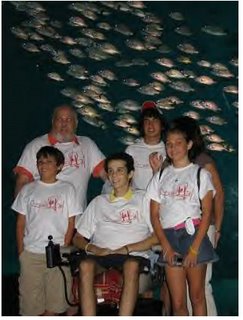
his faith journey with authenticity and with energy for doing good. And he continued his adventures, visiting an aquarium when he was no longer able to pursue more exotic interests like parasailing. Even in his last days, he initiated a partially blog-driven campaign to raise money for the hospital that served his needs during his treatment. The last day of his life it was announced that the fund had reached a milestone of $50,000.

We blogreaders knew that today's post was inevitable and that it would not be written by AJ, this strong friend who had come alive to us on the pages of a blog, and who had, through it, encouraged us to a fuller kind of living. AJ's Dad said,
"We felt sorrow, pain, relief, joy, doubt, amazement, comfort, calm, anxiety, anguish, mercy, and other emotions that words can't describe just yet. So, I come to my familar place and time to share with all of you. I am not sure how long I will need to do this."
Publication is a communication, a public form of communication. Blogging allows us to publish. AJ's life deserved to be published, for he was a fine young man and gave beautifully to his family, friends, and those around him. I'm glad he published that spirit to those of us in the etherworld also. We, too, have benefited from knowing him.
Blogging, I'm sure, met a particular need for AJ and family. It meets needs for all of us blogging souls. We ship our thoughts out bottled up in electrons and corked with a .com, and we have said something, whether useful or not. Certainly, AJ didn't waste a word.
Domine, Jesu Christe, Rex gloriae
libera animas omniurn fidelium. . .
repraesentet eas in lucem sanctam quam olim
Abrahae promisisti et semini ejus.
Betsy
I began blogging because I am interested in technology and publication. I am a manager of a publications department and was scheduled to do a workshop on using the tools of the 21st century for communication in the classroom. So I began my blog. And I began reading blogs. Meanwhile, I heard about AJ. He is the son of a friend of a friend. He had cancer and the prognosis was not good. And he was posting to a blog called Care Pages.
 So I began to read this blog, a phenomenal account of strength and love, the fortitude of a family in faith dealing with the worst fortune. The whole family got involved with the posting especially as AJ got weaker and could not always record the account of the day or event himself.
AJ continued living fully every day and continued

his faith journey with authenticity and with energy for doing good. And he continued his adventures, visiting an aquarium when he was no longer able to pursue more exotic interests like parasailing. Even in his last days, he initiated a partially blog-driven campaign to raise money for the hospital that served his needs during his treatment. The last day of his life it was announced that the fund had reached a milestone of $50,000.

We blogreaders knew that today's post was inevitable and that it would not be written by AJ, this strong friend who had come alive to us on the pages of a blog, and who had, through it, encouraged us to a fuller kind of living. AJ's Dad said,
"We felt sorrow, pain, relief, joy, doubt, amazement, comfort, calm, anxiety, anguish, mercy, and other emotions that words can't describe just yet. So, I come to my familar place and time to share with all of you. I am not sure how long I will need to do this."
Publication is a communication, a public form of communication. Blogging allows us to publish. AJ's life deserved to be published, for he was a fine young man and gave beautifully to his family, friends, and those around him. I'm glad he published that spirit to those of us in the etherworld also. We, too, have benefited from knowing him.
Blogging, I'm sure, met a particular need for AJ and family. It meets needs for all of us blogging souls. We ship our thoughts out bottled up in electrons and corked with a .com, and we have said something, whether useful or not. Certainly, AJ didn't waste a word.
Domine, Jesu Christe, Rex gloriae
libera animas omniurn fidelium. . .
repraesentet eas in lucem sanctam quam olim
Abrahae promisisti et semini ejus.
Betsy
Wednesday, September 20, 2006
Preface for a New Creed--A Survey
Dear Theologians,
I am getting ready to write a new creed. I promised my daughter that I would. Perhaps you could give me a jump start. This Scripture is one that is a bit of a driver for my thinking. How about you?
"We know that we have passed from death to life because we love one another. Whoever does not love abides in death. All who hate a brother or sister are murderers, and you know that murderers do not have eternal life abiding in them. We know love by this, that [Jesus] laid down his life for us - and we ought to lay down our lives for one another. How does God's love abide in anyone who has the world's goods and sees a brother or sister in need and yet refuses help? Little children, let us love, not in word or speech, but in truth and action."
- 1 John 3:14-18
OK. Here is the survey question.
What do you consider to be an important, primary faith statement, not present in current credal statements that should be included in those statements?
Reminder:
Apostle's Creed
Nicene Creed
Athanasian Creed
Steve Martin Creed
Thanks for any ideas you can contribute.
Betsy
I am getting ready to write a new creed. I promised my daughter that I would. Perhaps you could give me a jump start. This Scripture is one that is a bit of a driver for my thinking. How about you?
"We know that we have passed from death to life because we love one another. Whoever does not love abides in death. All who hate a brother or sister are murderers, and you know that murderers do not have eternal life abiding in them. We know love by this, that [Jesus] laid down his life for us - and we ought to lay down our lives for one another. How does God's love abide in anyone who has the world's goods and sees a brother or sister in need and yet refuses help? Little children, let us love, not in word or speech, but in truth and action."
- 1 John 3:14-18
OK. Here is the survey question.
What do you consider to be an important, primary faith statement, not present in current credal statements that should be included in those statements?
Reminder:
Apostle's Creed
Nicene Creed
Athanasian Creed
Steve Martin Creed
Thanks for any ideas you can contribute.
Betsy
Tuesday, September 12, 2006
Words, Words, Words
Dear Anne G G,
Take up as much of my cyberspace as possible! I will answer in this new post because the other post that I'm currently working on is taking too long to develop. It's kind of about being a Northerner living in the South. (Touchy stuff.) Here is my response to your response.
1) Your father quotes Meatloaf saying, "We can talk all night but it ain't gettin' us nowhere." I say that a diminished 5th chord may, in fact, communicate a precise "something" more universally than a word. But for ideas of a certain sort, we are left with only words to build concepts and, no matter how flawed, they are the tools of humanity. But, does that mean, that God can foist something upon these puny tools that we cannot? If He/She can, then I would say with Max of the Princess Bride, "It would take a miracle," at every single reading, which is possible given that we are talking about God. But, if that is so, why don't we all receive these words in identical ways. We surely do not.
The miracle may be that we seem to be able to sustain some remnant of the original concept, a common range of meaning. I refer to my survey on goodness. I find it revealing that people find common themes of understanding and that those understandings are persistent. Nonetheless, I would maintain that slippage occurs.
Oh dear, I'm out of writing time and I only covered one of your three questions. Well, to misquote the original ground round musical composition, "One out of three ain't bad."
I will return to the question of Christian Exclusivism in my next post, because it is indeed, and should be I think, a hot button or at least hot fodder for thinking.
I love talking and thinking with you, in spite of the inadequacy of language.
XOX
MOM
Take up as much of my cyberspace as possible! I will answer in this new post because the other post that I'm currently working on is taking too long to develop. It's kind of about being a Northerner living in the South. (Touchy stuff.) Here is my response to your response.
1) Your father quotes Meatloaf saying, "We can talk all night but it ain't gettin' us nowhere." I say that a diminished 5th chord may, in fact, communicate a precise "something" more universally than a word. But for ideas of a certain sort, we are left with only words to build concepts and, no matter how flawed, they are the tools of humanity. But, does that mean, that God can foist something upon these puny tools that we cannot? If He/She can, then I would say with Max of the Princess Bride, "It would take a miracle," at every single reading, which is possible given that we are talking about God. But, if that is so, why don't we all receive these words in identical ways. We surely do not.
The miracle may be that we seem to be able to sustain some remnant of the original concept, a common range of meaning. I refer to my survey on goodness. I find it revealing that people find common themes of understanding and that those understandings are persistent. Nonetheless, I would maintain that slippage occurs.
Oh dear, I'm out of writing time and I only covered one of your three questions. Well, to misquote the original ground round musical composition, "One out of three ain't bad."
I will return to the question of Christian Exclusivism in my next post, because it is indeed, and should be I think, a hot button or at least hot fodder for thinking.
I love talking and thinking with you, in spite of the inadequacy of language.
XOX
MOM
Saturday, September 09, 2006
The Heart of Christianity (Marcus Borg)--Chapter 2--A Study
Dear Stevie et al,
I'm dragging through this book very slowly. Perhaps I'll ending up posting per chapter and long after your group has moved through the material. Oh well. I'll try not to be long winded this time.
As I read through this I am immediately reactionary. It comes from a life of reaction I suppose. Borg too is reactionary, but he is fighting it and so I will too. His Returning to Faith as Believing at the end of Chapter 2, shows that he is, indeed, fighting his own reactions.
I appreciate the four words that he presents as faith definitions: Assensus-Belief, Fiducia-Trust, Fidelitas-Fidelity or -Allegiance, and Visio-Vision. I think these are good, though I thought that the vision concept actually goes outside the bounds of the freight that faith is typically asked to carry.
Here is what I liked about what is said. Faith is not just a list of beliefs for us to tuck away in our heads and pull out whenever we are asked for our statement of faith. First of all, we are asked to do that very infrequently. Second, this list rarely helps us live, really live our lives.
Borg at first seems to say that our Biblical Credo is not much more important than a Steve Martin schtick, but he redeems his thinking later in the chapter. First he says, "Does God really care what is in our heads?" He answers that question with a "No." That was uncomfortable for me. Later though, he fesses up and says, "We cannot give our heart to something that our mind rejects." And lets face it, he is writing a book to convince people via their heads to think/believe a certain way about Christianity, ergo he must care about belief as "assensus," belief as rational content.
I have long accepted an image of my faith that fits his description under Faith as Fiducia (Trust). It is linked to Soren Kierkegaard and the expression he introduced in the book The Concept of Anxiety. Borg talks about Soren's floating metaphor. The metaphor I relate to is the Leap of Faith. This is the point of existential engagement when, not knowing for sure in the typical rational, empirical sense of knowing for sure, not knowing comprehensively because our minds fall short, we study and forget, we have only about 80 years to work through the material, we don't get it, when that. . . we take a leap into the not sure, ready to free fall in our belief, our trust.
Part of that Leap is not knowing, but knowing that we will choose this, nonetheless. That is how I feel about the teachings of Christ. I choose this. I affirm this. I say "Yes" to this kind of loving, this kind of good, this kind of justice, this kind of living. As far as my head can go with this, I say "Yes" and then my heart takes over and leaps to the arms of Jesus.
One last thing, Borg's description of modern use of creed reminds me in an eerie way of the last scene of the initial Battlestar Galactica movie, when the commander describes Earth, which he does not believe exists, and convinces everyone that it does, ending with a raucous, "So say we all, so say we all, so say we all."
I have been for some time been working on a new credal statement, one that revamps the worn and inadequate one we currently use, replacing the term "Father Almightly" with "Creator All Loving", etc. The creeds need work not vacuous recitation.
I love you,
Mom
XOX
I'm dragging through this book very slowly. Perhaps I'll ending up posting per chapter and long after your group has moved through the material. Oh well. I'll try not to be long winded this time.
As I read through this I am immediately reactionary. It comes from a life of reaction I suppose. Borg too is reactionary, but he is fighting it and so I will too. His Returning to Faith as Believing at the end of Chapter 2, shows that he is, indeed, fighting his own reactions.
I appreciate the four words that he presents as faith definitions: Assensus-Belief, Fiducia-Trust, Fidelitas-Fidelity or -Allegiance, and Visio-Vision. I think these are good, though I thought that the vision concept actually goes outside the bounds of the freight that faith is typically asked to carry.
Here is what I liked about what is said. Faith is not just a list of beliefs for us to tuck away in our heads and pull out whenever we are asked for our statement of faith. First of all, we are asked to do that very infrequently. Second, this list rarely helps us live, really live our lives.
Borg at first seems to say that our Biblical Credo is not much more important than a Steve Martin schtick, but he redeems his thinking later in the chapter. First he says, "Does God really care what is in our heads?" He answers that question with a "No." That was uncomfortable for me. Later though, he fesses up and says, "We cannot give our heart to something that our mind rejects." And lets face it, he is writing a book to convince people via their heads to think/believe a certain way about Christianity, ergo he must care about belief as "assensus," belief as rational content.
I have long accepted an image of my faith that fits his description under Faith as Fiducia (Trust). It is linked to Soren Kierkegaard and the expression he introduced in the book The Concept of Anxiety. Borg talks about Soren's floating metaphor. The metaphor I relate to is the Leap of Faith. This is the point of existential engagement when, not knowing for sure in the typical rational, empirical sense of knowing for sure, not knowing comprehensively because our minds fall short, we study and forget, we have only about 80 years to work through the material, we don't get it, when that. . . we take a leap into the not sure, ready to free fall in our belief, our trust.
Part of that Leap is not knowing, but knowing that we will choose this, nonetheless. That is how I feel about the teachings of Christ. I choose this. I affirm this. I say "Yes" to this kind of loving, this kind of good, this kind of justice, this kind of living. As far as my head can go with this, I say "Yes" and then my heart takes over and leaps to the arms of Jesus.
One last thing, Borg's description of modern use of creed reminds me in an eerie way of the last scene of the initial Battlestar Galactica movie, when the commander describes Earth, which he does not believe exists, and convinces everyone that it does, ending with a raucous, "So say we all, so say we all, so say we all."
I have been for some time been working on a new credal statement, one that revamps the worn and inadequate one we currently use, replacing the term "Father Almightly" with "Creator All Loving", etc. The creeds need work not vacuous recitation.
I love you,
Mom
XOX
Friday, September 08, 2006
Tuesday, September 05, 2006
Out of the Debris
Dear Rukshani Weerasooriya,
I have enjoyed (is that the right word? I don't think so.) reading your poetry. My sister Debby gave your book, Salt to me for a few days. It is very good. Out of the Debris is very touching. On the WriteClique.net site you have titled the work Tsunami. I understand that, but I prefer the title you used in Salt for I pictured so many places, Pakistan, New Orleans, Iraq, and Sri Lanka.
I appreciated the words of Lance Corporal also:
"I'm tired
It's midnight.
I'm propped up
Against the mud
Like a cannon gun,
To fight
The battles you
Criticize
From behind
Your trenches
Of ink.
My blood.
Your right.
That's not so hard
To rationalise,
When I'm out here
And you're safe in there.
Your sovereignty
Well intact.
Our skies are not the same.
Mine and yours.
Mine is black.
You've taken my stars
Away.
Away.
To stud
Your darkness
With my light.
I was like you
When I signed my name.
Just a father,
A son,
A lover. A friend.
But today
I am a coin in your
Treasury of blood.
Cold, worthless blood
You so casually
Spend."
More people need to be able to read your thoughts. But I couldn't even buy this on Amazon.
Email: pp144@isb.paknet.com isn't enough of a marketing plan for you. Are you working on it?
Betsy
I have enjoyed (is that the right word? I don't think so.) reading your poetry. My sister Debby gave your book, Salt to me for a few days. It is very good. Out of the Debris is very touching. On the WriteClique.net site you have titled the work Tsunami. I understand that, but I prefer the title you used in Salt for I pictured so many places, Pakistan, New Orleans, Iraq, and Sri Lanka.
I appreciated the words of Lance Corporal also:
"I'm tired
It's midnight.
I'm propped up
Against the mud
Like a cannon gun,
To fight
The battles you
Criticize
From behind
Your trenches
Of ink.
My blood.
Your right.
That's not so hard
To rationalise,
When I'm out here
And you're safe in there.
Your sovereignty
Well intact.
Our skies are not the same.
Mine and yours.
Mine is black.
You've taken my stars
Away.
Away.
To stud
Your darkness
With my light.
I was like you
When I signed my name.
Just a father,
A son,
A lover. A friend.
But today
I am a coin in your
Treasury of blood.
Cold, worthless blood
You so casually
Spend."
More people need to be able to read your thoughts. But I couldn't even buy this on Amazon.
Email: pp144@isb.paknet.com isn't enough of a marketing plan for you. Are you working on it?
Betsy
Saturday, September 02, 2006
The Heart of Christianity (Marcus Borg)--Part I--A Study
Dear Stevie (and Your Study Group),
I have started the book. I thought I might throw a little information at you that would be like background. Let's start with the terms Borg gives for two kinds of Christianity, "Earlier" and "Emerging." I think he is trying to get at something here, but those choices, though they do accomplish one thing that he is aiming at, fail at another.
1. I think he is trying to do plain talk. He doesn't use the technical terminology. He is moving away from terms that carry unnecessary baggage with them, i.e. fundamentalism, evangelicalism, liberalism, etc. He succeeds here.
2. However, he chooses terms with their own built-in baggage system and does so inaccurately. For instance, liberalism in it's most prominent current form does predate fundamentalism in its current form and predates evangelicalism by a long shot. Therefore to identify what he defines as earlier with the term earlier, is not intrinsically accurate. Old line liberalism is hardly an "emerging" theology. It has been around since the days of Darwin. (Darwin was not operating in a theological vacuum. I'm not saying that Darwin was primarily speaking of theological things, just that he was not alone in his willingness to question theological suppositions.)
So, I don't like his terms because they mislead us.
Next, let's talk about verbal plenary inspiration. Again, Borg avoids the tech terms. He calls this literal-factual.
"Verbal plenary inerrancy means that one believes all of the Bible is inspired down to the very words of Scripture. The belief in non-verbal plenary inerrancy would mean that one believes all the Bible is inspired, but only as to its concepts—not all the words—meaning that it might contain historical errors."
Conservative Bible scholars would immediately defend "verbal" inspiration, claiming that concepts are built upon words, so you can't give up the God-source for the very words of Scripture. Less conservative folks, me included, would say, yes, but words are, after all, only words. They do not remain stable, meaning slips out from under them.
(Eg What did William Butler Yeats mean when he wrote:
“I have heard that hysterical women say
They are sick of the palette and fiddle-bow.
Of poets that are always gay,”
Not a comment on sexual identity, but. . . )
Words do not have the power to remain verbally inspired even if they want to, even if God wants them to. Not in the world we live in.
At any rate, the whole inspiration discussion is an important one, but not one that you can engage in properly without the whole history. I’m not saying he is doing an unfair thing. Just that you, as a “hunter” need to acknowledge that there is more, much more, to be said on this subject.
It wasn’t until the second century that people started talking about such a thing as verbal, plenary inspiration. Augustine in the fourth century probably tackled the subject more completely, but that was at a time when the content of the Canon of Scripture was still under debate. Augustine included in his Canon a book or two that we don’t include. Groups of church leaders got together to argue vehemently about this stuff, back then. The fact that we are discussing it now should not be hard to believe. However, we should not draw too many conclusions without doing all of our homework.
Borg has done some homework, but his opinions come from a particular perspective. It is a different one from mine. I have done some homework too. You have a perspective. You have done some homework. That doesn’t mean we can’t learn from each other. And it doesn’t mean we don’t have more homework to do.
This is getting long. But, I want to include comments on what we discussed on the phone.
Borg lists 3 things as specific issues that divide the contemporary church.
1. Ordination of women
2. Gays and lesbians
3. Christian exclusivism
The first two are cultural hot buttons. They are important. You know your feminist mother is very active in the cause of the first issue. I am doing my homework in the area of the second. But the third is in a totally different category. Putting the third in the list with the first two and only those two minimizes the qualitative difference of that issue.
I’m not saying that it is out of line to discuss the third.
A realtor friend once said to me, “everything I own is for sale, if the price is right.” For me, everything I believe is up for discussion, if the thinking is clear enough.
However, this list is not clear thinking. It is using hot buttons to introduce a categorically different line of discussion. That is intellectual manipulation. Don’t be fooled by it. Borg should know better. Again, I’m not saying he doesn’t have important things to say.
More later,
I love you.
MOM
XOX
PS. I meant to give you some background on Borg and Spong, who he refers to. I’ll do that later. But the connection between Borg and the Jesus Seminar is key to understanding him. This is part of the “Quest for the historical Jesus” movement, driven by the idea that you can take the Gospels and figure out which statement Jesus actually made and which he did not make. Of course there is very little historical information about Jesus outside of the scriptural texts. Just a quick reference to him in the works of Josephus. That’s about it. Obviously, the work of the Jesus Seminar is pretty speculative. I think they would like it to be authoritative and Borg’s more popularized books (with their non-technical prose) are an attempt to present the work of the Seminar to the “common folk.”
I have started the book. I thought I might throw a little information at you that would be like background. Let's start with the terms Borg gives for two kinds of Christianity, "Earlier" and "Emerging." I think he is trying to get at something here, but those choices, though they do accomplish one thing that he is aiming at, fail at another.
1. I think he is trying to do plain talk. He doesn't use the technical terminology. He is moving away from terms that carry unnecessary baggage with them, i.e. fundamentalism, evangelicalism, liberalism, etc. He succeeds here.
2. However, he chooses terms with their own built-in baggage system and does so inaccurately. For instance, liberalism in it's most prominent current form does predate fundamentalism in its current form and predates evangelicalism by a long shot. Therefore to identify what he defines as earlier with the term earlier, is not intrinsically accurate. Old line liberalism is hardly an "emerging" theology. It has been around since the days of Darwin. (Darwin was not operating in a theological vacuum. I'm not saying that Darwin was primarily speaking of theological things, just that he was not alone in his willingness to question theological suppositions.)
So, I don't like his terms because they mislead us.
Next, let's talk about verbal plenary inspiration. Again, Borg avoids the tech terms. He calls this literal-factual.
"Verbal plenary inerrancy means that one believes all of the Bible is inspired down to the very words of Scripture. The belief in non-verbal plenary inerrancy would mean that one believes all the Bible is inspired, but only as to its concepts—not all the words—meaning that it might contain historical errors."
Conservative Bible scholars would immediately defend "verbal" inspiration, claiming that concepts are built upon words, so you can't give up the God-source for the very words of Scripture. Less conservative folks, me included, would say, yes, but words are, after all, only words. They do not remain stable, meaning slips out from under them.
(Eg What did William Butler Yeats mean when he wrote:
“I have heard that hysterical women say
They are sick of the palette and fiddle-bow.
Of poets that are always gay,”
Not a comment on sexual identity, but. . . )
Words do not have the power to remain verbally inspired even if they want to, even if God wants them to. Not in the world we live in.
At any rate, the whole inspiration discussion is an important one, but not one that you can engage in properly without the whole history. I’m not saying he is doing an unfair thing. Just that you, as a “hunter” need to acknowledge that there is more, much more, to be said on this subject.
It wasn’t until the second century that people started talking about such a thing as verbal, plenary inspiration. Augustine in the fourth century probably tackled the subject more completely, but that was at a time when the content of the Canon of Scripture was still under debate. Augustine included in his Canon a book or two that we don’t include. Groups of church leaders got together to argue vehemently about this stuff, back then. The fact that we are discussing it now should not be hard to believe. However, we should not draw too many conclusions without doing all of our homework.
Borg has done some homework, but his opinions come from a particular perspective. It is a different one from mine. I have done some homework too. You have a perspective. You have done some homework. That doesn’t mean we can’t learn from each other. And it doesn’t mean we don’t have more homework to do.
This is getting long. But, I want to include comments on what we discussed on the phone.
Borg lists 3 things as specific issues that divide the contemporary church.
1. Ordination of women
2. Gays and lesbians
3. Christian exclusivism
The first two are cultural hot buttons. They are important. You know your feminist mother is very active in the cause of the first issue. I am doing my homework in the area of the second. But the third is in a totally different category. Putting the third in the list with the first two and only those two minimizes the qualitative difference of that issue.
I’m not saying that it is out of line to discuss the third.
A realtor friend once said to me, “everything I own is for sale, if the price is right.” For me, everything I believe is up for discussion, if the thinking is clear enough.
However, this list is not clear thinking. It is using hot buttons to introduce a categorically different line of discussion. That is intellectual manipulation. Don’t be fooled by it. Borg should know better. Again, I’m not saying he doesn’t have important things to say.
More later,
I love you.
MOM
XOX
PS. I meant to give you some background on Borg and Spong, who he refers to. I’ll do that later. But the connection between Borg and the Jesus Seminar is key to understanding him. This is part of the “Quest for the historical Jesus” movement, driven by the idea that you can take the Gospels and figure out which statement Jesus actually made and which he did not make. Of course there is very little historical information about Jesus outside of the scriptural texts. Just a quick reference to him in the works of Josephus. That’s about it. Obviously, the work of the Jesus Seminar is pretty speculative. I think they would like it to be authoritative and Borg’s more popularized books (with their non-technical prose) are an attempt to present the work of the Seminar to the “common folk.”
Saturday, August 26, 2006
Doubting I'll Win, Place, or Even Show
Dear Horses of the Rickety Fence,
I'm a little frustrated. The bruise has gone, but the situation remains the same. The field is large and you are hard to work with. All I have is a cinderella license in horsing around and perhaps I'm not up to this challenge.
Three horses, a five acre field, no halters, and just me with a pocket of treats and a switch. Really, what do I think I can accomplish?
Cleopatra, as lovely as your name. Why are you so afraid and reclusive. I kneel before you, keeping low and averting my eyes. You occasionally circle, examining, determining whether, not I, but my apple, or carrot, or crunchy nugget is worth you apprehension. Sometimes it is. And I am swept by a wave of achievement--"I touched your muzzle this time!" Or not, I moved too quickly, and you are gone. Lovely Cleopatra, why should you come to me?
Chase, you old fellow. Perhaps too old to fool with. You are just in the way. You are not even endearing with your constant but irritating presence. Yet, maybe you have something left in you to find. Meanwhile my purpose is to set you aside in hopes of reaching the others.
Cyrus, my dear violent one. Someday you may actually hurt me with not just a nip but a real bite, or not just a rush but a strike. Then I shall regret that I ever met you. Meanwhile, you challenge me and I challenge you back. We are in a dance and if I never return to you in your field, it will be because I have fallen into my fear, or you have pushed me there.
Betsy
Trainer, Novice 2nd Class
I'm a little frustrated. The bruise has gone, but the situation remains the same. The field is large and you are hard to work with. All I have is a cinderella license in horsing around and perhaps I'm not up to this challenge.
Three horses, a five acre field, no halters, and just me with a pocket of treats and a switch. Really, what do I think I can accomplish?
Cleopatra, as lovely as your name. Why are you so afraid and reclusive. I kneel before you, keeping low and averting my eyes. You occasionally circle, examining, determining whether, not I, but my apple, or carrot, or crunchy nugget is worth you apprehension. Sometimes it is. And I am swept by a wave of achievement--"I touched your muzzle this time!" Or not, I moved too quickly, and you are gone. Lovely Cleopatra, why should you come to me?
Chase, you old fellow. Perhaps too old to fool with. You are just in the way. You are not even endearing with your constant but irritating presence. Yet, maybe you have something left in you to find. Meanwhile my purpose is to set you aside in hopes of reaching the others.
Cyrus, my dear violent one. Someday you may actually hurt me with not just a nip but a real bite, or not just a rush but a strike. Then I shall regret that I ever met you. Meanwhile, you challenge me and I challenge you back. We are in a dance and if I never return to you in your field, it will be because I have fallen into my fear, or you have pushed me there.
Betsy
Trainer, Novice 2nd Class
Thursday, August 24, 2006
Not a Hail, Heil, or Hello
Dear Blogger,
“Hail Satan”, you said. And lightly. And I do understand now that you were quoting a song that offers no such welcome. But how can a page bear those words? How can your voice sustain them? My ears just can’t stand it. The words tear through already stretched drums and break them in one blast.
Of course, it’s not the fault of the last straw when the back of the camel pops. Not the fault of the last brick when the pile topples. But my ears have heard too much. They’ve heard the roar of televised tumbling skyscrapers, the explosion of missiles (my missiles, my own American made, not imported from Taiwan, missiles) exploding in ancient cities, the crunch of bulldozers, Caterpillars, over homes and single bodies standing, the wail of mothers and fathers, not just one, not just one nation’s, seeking their lost daughters and sons, hoarsely crying, lifting rubble, not in hope but desperation.
My ears hear mad shouts of fault, fault, fault, like the echo of some ghostly court, but it is no game, just one terrorist liability after another, shaking the world at some level not measurable on the moral Richter scale.
And if words mean anything, which I will grant that they may not, but if they do, then this is what the word Satan means, this holocaust of craziness, this pogrom of power wielding it’s weight for ill. Enough. Too much. Even this slight welcome is more than my world can stand.
But of course you did not mean this. It is not what you said, it’s just what I heard.
Betsy
“Hail Satan”, you said. And lightly. And I do understand now that you were quoting a song that offers no such welcome. But how can a page bear those words? How can your voice sustain them? My ears just can’t stand it. The words tear through already stretched drums and break them in one blast.
Of course, it’s not the fault of the last straw when the back of the camel pops. Not the fault of the last brick when the pile topples. But my ears have heard too much. They’ve heard the roar of televised tumbling skyscrapers, the explosion of missiles (my missiles, my own American made, not imported from Taiwan, missiles) exploding in ancient cities, the crunch of bulldozers, Caterpillars, over homes and single bodies standing, the wail of mothers and fathers, not just one, not just one nation’s, seeking their lost daughters and sons, hoarsely crying, lifting rubble, not in hope but desperation.
My ears hear mad shouts of fault, fault, fault, like the echo of some ghostly court, but it is no game, just one terrorist liability after another, shaking the world at some level not measurable on the moral Richter scale.
And if words mean anything, which I will grant that they may not, but if they do, then this is what the word Satan means, this holocaust of craziness, this pogrom of power wielding it’s weight for ill. Enough. Too much. Even this slight welcome is more than my world can stand.
But of course you did not mean this. It is not what you said, it’s just what I heard.
Betsy
Monday, August 21, 2006
Requiem
Dear Angie and Tommy,
The saliva is slowly accumulating in my mouth but I can’t swallow. When I notice my cheeks, they are wet and my headache is not gone, in spite of double doses of Ibuprophen. If I were to go to the Hallmark store and would search for a card, it would not be for the most perfect one, but for the most imperfect, the black and gray and stained and torn one, with no words at all, for there are no words for this. No sympathy can move into this great pit of despairing ache. If there is something that may enter into this grief, it certainly is not words.
Yet, words are our first tools, the ones we so rely upon for almost everything. Words, the definers of humanity, right up there with opposable thumbs in lifting us above the animals, are simply inadequate for this task, which could, I believe, be achieved better by a six week old puppy that could at least crawl warmly into your laps to offer fur for stroking and eyes to look into without having to glance away under the weight of meaning.
So I offer nothing really. What would the right card say? "In this darkest night, there is the light of hope." Or, "May there be comfort in knowing that the memories will live in our hearts forever." Yes, but this is more than can be borne now. Now, the cards should only say, "Would you like a glass of water", or "I fed the dog last night and I’m taking the parakeet to my house for a few days."
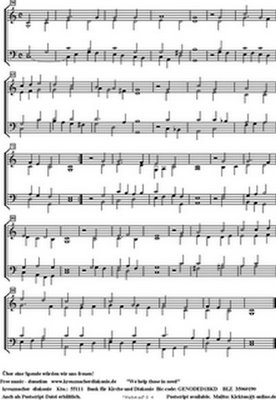
This morning I listened to the chorale that sits behind Cantata 140 by Bach. This spoke a little of what my heart is feeling. It said in the notation of melody and harmony, just a little that seemed right. The words are in German so they do not interfere, though I do know that the scriptural text is Matthew 25; not inappropos. Around about the fourth line of this, the harmonies say for just a few bars, what I would like to say.
And maybe tomorrow there will be words. And after that some hope and memories.
With my love and many tears,
Betsy
The saliva is slowly accumulating in my mouth but I can’t swallow. When I notice my cheeks, they are wet and my headache is not gone, in spite of double doses of Ibuprophen. If I were to go to the Hallmark store and would search for a card, it would not be for the most perfect one, but for the most imperfect, the black and gray and stained and torn one, with no words at all, for there are no words for this. No sympathy can move into this great pit of despairing ache. If there is something that may enter into this grief, it certainly is not words.
Yet, words are our first tools, the ones we so rely upon for almost everything. Words, the definers of humanity, right up there with opposable thumbs in lifting us above the animals, are simply inadequate for this task, which could, I believe, be achieved better by a six week old puppy that could at least crawl warmly into your laps to offer fur for stroking and eyes to look into without having to glance away under the weight of meaning.
So I offer nothing really. What would the right card say? "In this darkest night, there is the light of hope." Or, "May there be comfort in knowing that the memories will live in our hearts forever." Yes, but this is more than can be borne now. Now, the cards should only say, "Would you like a glass of water", or "I fed the dog last night and I’m taking the parakeet to my house for a few days."
This morning I listened to the chorale that sits behind Cantata 140 by Bach. This spoke a little of what my heart is feeling. It said in the notation of melody and harmony, just a little that seemed right. The words are in German so they do not interfere, though I do know that the scriptural text is Matthew 25; not inappropos. Around about the fourth line of this, the harmonies say for just a few bars, what I would like to say.
And maybe tomorrow there will be words. And after that some hope and memories.
With my love and many tears,
Betsy

Friday, August 18, 2006
Techno-Socialist Manifesto
Dear W.
Good news! He is available, and just in time for you to set up the most powerful and important position in the federal government. The Secretary of Technology, Bill Gates, will define the parameters himself. You will not find it needful to explain the position to Bill. He will be able to do that himself. You will not have to apologize for his actions, for we Americans, long ago, learned not to mess with this master of our world.
Besides, Bill has been Secretary of Technology for a long time now, he might as well have the title. Now, I’m not saying that there won’t have to be changes, and Bill will have to get on board, but I think he can be convinced. I believe he has already moved into that stage of life called “generativity.” You will only be feeding the monster for him.
Here is the plan. All hardware and operating system software becomes nationalized. In addition, certain use-critical software should be nationalized too, word processing, image manipulation, email, might as well include blogging. Then Bill oversees this.
We need to get MIT onboard and have them get those $100.00 laptops finished. Here’s the plan. Every boy and girl in the country gets one of these every couple of years. No questions asked. Laptops have to be a given. They are the new #2 pencil.
When I first learned to use a computer, this 20-something girl, Karyn, explained the internet to me as a superhighway for information. That is when I got this idea. Transportation systems are not private. Highways can’t be built hodge-podge by local companies and neighborhood volunteers. They are critical to national life. The feds and states take over. Well, what is more important to our national life today than the information superhighway. Nothing, my friend.
It is time for you to pay attention to an issue that will draw more flak than the war in Iraq. This is it. It is also something that could raise your status in the pantheon of presidents. You want to be remembered for something. You don’t want to be thrown in the waste can of presidents with Calvin Coolidge and (who was that guy?) Benjamin Harrison. This could put you on the presidential map. They might even bring in more granite for a new face in South Dakota. You would join the ranks of the lofty--George Washington, Abraham Lincoln, and George W. There could be a new holiday, The Bush/Gates Technology day.
Think about it. You don’t have much more time to pull this off!
Sincerely,
Betsy
P.S. Yes, I am available to act as Undersecretary for Download Management
Good news! He is available, and just in time for you to set up the most powerful and important position in the federal government. The Secretary of Technology, Bill Gates, will define the parameters himself. You will not find it needful to explain the position to Bill. He will be able to do that himself. You will not have to apologize for his actions, for we Americans, long ago, learned not to mess with this master of our world.
Besides, Bill has been Secretary of Technology for a long time now, he might as well have the title. Now, I’m not saying that there won’t have to be changes, and Bill will have to get on board, but I think he can be convinced. I believe he has already moved into that stage of life called “generativity.” You will only be feeding the monster for him.
Here is the plan. All hardware and operating system software becomes nationalized. In addition, certain use-critical software should be nationalized too, word processing, image manipulation, email, might as well include blogging. Then Bill oversees this.
We need to get MIT onboard and have them get those $100.00 laptops finished. Here’s the plan. Every boy and girl in the country gets one of these every couple of years. No questions asked. Laptops have to be a given. They are the new #2 pencil.
When I first learned to use a computer, this 20-something girl, Karyn, explained the internet to me as a superhighway for information. That is when I got this idea. Transportation systems are not private. Highways can’t be built hodge-podge by local companies and neighborhood volunteers. They are critical to national life. The feds and states take over. Well, what is more important to our national life today than the information superhighway. Nothing, my friend.
It is time for you to pay attention to an issue that will draw more flak than the war in Iraq. This is it. It is also something that could raise your status in the pantheon of presidents. You want to be remembered for something. You don’t want to be thrown in the waste can of presidents with Calvin Coolidge and (who was that guy?) Benjamin Harrison. This could put you on the presidential map. They might even bring in more granite for a new face in South Dakota. You would join the ranks of the lofty--George Washington, Abraham Lincoln, and George W. There could be a new holiday, The Bush/Gates Technology day.
Think about it. You don’t have much more time to pull this off!
Sincerely,
Betsy
P.S. Yes, I am available to act as Undersecretary for Download Management
Tuesday, August 15, 2006
Friday, August 11, 2006
Online Petition Requesting UN to Work for Ceasefire
Dear Ricken Patel of the Ceasefire Campaign,
In accordance with your request, I am posting this link to my blog.
"As the awful civilian death toll rises above 1000 in Lebanon and Israel, people around the world are seeking a place to voice their frustration and concern. Over the last 4 days, 200,000 people from 148 countries have signed the ceasefire petition. At this rate, we could soon be the largest global online petition in history."
Online Ceasefire Petition
With hope (almost),
Betsy
In accordance with your request, I am posting this link to my blog.
"As the awful civilian death toll rises above 1000 in Lebanon and Israel, people around the world are seeking a place to voice their frustration and concern. Over the last 4 days, 200,000 people from 148 countries have signed the ceasefire petition. At this rate, we could soon be the largest global online petition in history."
Online Ceasefire Petition
With hope (almost),
Betsy
Scent of a Truth
Dearest Son,
I have been thinking about our last conversation. We, I think, did achieve a level of interaction that is not always attained. I wish we had more time together for such talks without interruption. But even our phones provided interruption for us, now that I think about it. We would say something wholly profound, there would be a pregnant pause, then a tin-man’s voice with news of the disconnection, or worse than that, a period of being unsure and the hopeful but prescient “can you hear me now?”
What is truth and how can we know it? You could study for a degree in philosophy, but I fear that is not how you will find an answer to this question. You will find more good questions and perspectives if you want to do that, but not an answer. For this answer, you do not study; you stalk.
When your grandparents were much younger (I was in third grade), they decided to leave the Lutheran church that they attended. In those days, or should I say, in their lives, leaving this church was like leaving home. They had attended that church since their infancy. Their parents, both sets, were part of that church, brother, friends, aunts, friends of parents. They had sung in the choir, participated in the services, taught Sunday school, led in vacation Bible school. They were respected there, for Pete’s sake. But now, in their soulish stalking, they felt they should leave that church and find a different one.
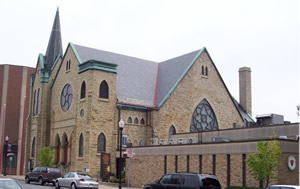
I don’t remember all the machinations. I do remember the day the trigger was pulled, though even that is vague. A visiting minister came to the pulpit of the church in this conservative old town. He, probably a recent graduate of some forward-looking seminary, was armed with a sermon whose punch line was, “God is a grunt.” I do remember that, not from hearing him say it, but from my parents’ reactions and discussions afterward, for hours, in the foyer of the fellowship hall, not with this visiting wraith, who, I am sure was whisked away for dinner at Taylor’s Restaurant, but with one friend and then another who could not, or could, understand my parents’ sense of the “last straw” in regard to this sermon, and a church that seemed to be slipping away from “sound moorings.”
Little did my parents know, that the young minister was probably not being heretical. I doubt that he was trying to communicate any Nietzchesque thoughts about the non-existence or deadness of God, but was more likely trying to suggest the fallibility of human understanding and our inability to see spiritual truths in any way but obliquely. He may have been trying to point out that language, our greatest human invention, is flawed, and little more than a series of grunts and clicks designed to put outward form, however, inadequate, to our inner lives.
Nonetheless, my parents did leave that church in the heat and ardor of their spiritual pursuit.
When I was in college, studying social work, I had my first experience with a teacher who designed his courses in such a way that everything related to process rather than conclusion. I was adrift. I could not figure this out, quick as I was to excel at learning in a rote and prescribed manner. This was a new thing and I was not ready. “What is the answer?” I wanted to know.
I’m still like that I suppose, and I’m like my mother enough to get angry in the face of those issues that, to me, are the lines in the sand that I will not step over.
But let’s get back to your hunt, for you too, want to know, want to find. I cannot tell you where to find your prey, or how exactly to do it. I will tell you how I began and that you must be ready for this search to be a process, not one with the answers laid out before you. Truth is elusive, not because of the inadequacy of truth, I think, but because of the limitation of the human being and mind. Of course there are truths that are less elusive. 2+2=4 appears to be fairly solid. Falling bodies accelerate at 32 ft per sec/per sec until they reach maximum velocity of about 135 miles per hour for a human body (hopefully equipped with parachute and rip cord to bring that speed down to 12 miles per hour prior to impact.)
But the truths we are talking about. Those that intersect with the spiritual realm are quite vaporous at times. I say vaporous, not non-existent. So you start, where you can start. You go into the woods. And here is how you do that. You set up the presuppositions. You say, “if God exists, then. . .” Later, you say, “if God does not exist, then. . .” As you study the conclusions you match them with your actual observations of the world. Is the world, as you know it more like the world you would expect if there were a God, than if there were not a God?
You know already what I have concluded, generally, as a result of this exercise in my life. But you must pursue these thoughts for yourself, not in a vacuum but as honestly as possible. Not in a vacuum, because you do have many good resources at your disposal. I recommend seeking out the advice of good people. What kind of people are good people? Well, I happen to have a survey available for you to consider if you need to identify their characteristics.
I was listening to an interview with Toni Morrison the other day. On the subject of good and evil she said, “Being good is more complicated an idea than being or doing evil. Evil gets more play, but evil is a sham, screaming like a petulant child.” That is one of the kinds of clues you look for in the course of your search. Look for patterns related to good and truth. Don’t just look to smart people. Smart is a grunt. Look for people who say stupid things but who know how to do good. That is a track. Look for love and lovers and people who can love without reward. That is a fingerprint. Look for that which is not power driven or materialist driven, that is scat, and you just might be onto something; you’re on the trail.
I love you son. Do not tire of this even when it is deeper than you can go and further than you can see.
XOX
MOM
I have been thinking about our last conversation. We, I think, did achieve a level of interaction that is not always attained. I wish we had more time together for such talks without interruption. But even our phones provided interruption for us, now that I think about it. We would say something wholly profound, there would be a pregnant pause, then a tin-man’s voice with news of the disconnection, or worse than that, a period of being unsure and the hopeful but prescient “can you hear me now?”
What is truth and how can we know it? You could study for a degree in philosophy, but I fear that is not how you will find an answer to this question. You will find more good questions and perspectives if you want to do that, but not an answer. For this answer, you do not study; you stalk.
When your grandparents were much younger (I was in third grade), they decided to leave the Lutheran church that they attended. In those days, or should I say, in their lives, leaving this church was like leaving home. They had attended that church since their infancy. Their parents, both sets, were part of that church, brother, friends, aunts, friends of parents. They had sung in the choir, participated in the services, taught Sunday school, led in vacation Bible school. They were respected there, for Pete’s sake. But now, in their soulish stalking, they felt they should leave that church and find a different one.

I don’t remember all the machinations. I do remember the day the trigger was pulled, though even that is vague. A visiting minister came to the pulpit of the church in this conservative old town. He, probably a recent graduate of some forward-looking seminary, was armed with a sermon whose punch line was, “God is a grunt.” I do remember that, not from hearing him say it, but from my parents’ reactions and discussions afterward, for hours, in the foyer of the fellowship hall, not with this visiting wraith, who, I am sure was whisked away for dinner at Taylor’s Restaurant, but with one friend and then another who could not, or could, understand my parents’ sense of the “last straw” in regard to this sermon, and a church that seemed to be slipping away from “sound moorings.”
Little did my parents know, that the young minister was probably not being heretical. I doubt that he was trying to communicate any Nietzchesque thoughts about the non-existence or deadness of God, but was more likely trying to suggest the fallibility of human understanding and our inability to see spiritual truths in any way but obliquely. He may have been trying to point out that language, our greatest human invention, is flawed, and little more than a series of grunts and clicks designed to put outward form, however, inadequate, to our inner lives.
Nonetheless, my parents did leave that church in the heat and ardor of their spiritual pursuit.
When I was in college, studying social work, I had my first experience with a teacher who designed his courses in such a way that everything related to process rather than conclusion. I was adrift. I could not figure this out, quick as I was to excel at learning in a rote and prescribed manner. This was a new thing and I was not ready. “What is the answer?” I wanted to know.
I’m still like that I suppose, and I’m like my mother enough to get angry in the face of those issues that, to me, are the lines in the sand that I will not step over.
But let’s get back to your hunt, for you too, want to know, want to find. I cannot tell you where to find your prey, or how exactly to do it. I will tell you how I began and that you must be ready for this search to be a process, not one with the answers laid out before you. Truth is elusive, not because of the inadequacy of truth, I think, but because of the limitation of the human being and mind. Of course there are truths that are less elusive. 2+2=4 appears to be fairly solid. Falling bodies accelerate at 32 ft per sec/per sec until they reach maximum velocity of about 135 miles per hour for a human body (hopefully equipped with parachute and rip cord to bring that speed down to 12 miles per hour prior to impact.)
But the truths we are talking about. Those that intersect with the spiritual realm are quite vaporous at times. I say vaporous, not non-existent. So you start, where you can start. You go into the woods. And here is how you do that. You set up the presuppositions. You say, “if God exists, then. . .” Later, you say, “if God does not exist, then. . .” As you study the conclusions you match them with your actual observations of the world. Is the world, as you know it more like the world you would expect if there were a God, than if there were not a God?
You know already what I have concluded, generally, as a result of this exercise in my life. But you must pursue these thoughts for yourself, not in a vacuum but as honestly as possible. Not in a vacuum, because you do have many good resources at your disposal. I recommend seeking out the advice of good people. What kind of people are good people? Well, I happen to have a survey available for you to consider if you need to identify their characteristics.
I was listening to an interview with Toni Morrison the other day. On the subject of good and evil she said, “Being good is more complicated an idea than being or doing evil. Evil gets more play, but evil is a sham, screaming like a petulant child.” That is one of the kinds of clues you look for in the course of your search. Look for patterns related to good and truth. Don’t just look to smart people. Smart is a grunt. Look for people who say stupid things but who know how to do good. That is a track. Look for love and lovers and people who can love without reward. That is a fingerprint. Look for that which is not power driven or materialist driven, that is scat, and you just might be onto something; you’re on the trail.
I love you son. Do not tire of this even when it is deeper than you can go and further than you can see.
XOX
MOM
Sunday, August 06, 2006
Lightening Bugs from the Porch
Dear Eudora Welty,
I told my children about sex in front of the rabbit pen. The bunnies were doing what bunnies do. The older children sensed the import of it all, but the youngest claims to this day I didn't tell her at all. Telling these top secrets at too young an age can, at times, result only in satisfaction to the heart of parents that the deed is done.
When my daughter told me in her late teens that I had failed as a mother, I immediately launched into an explication of the subject right there at the dinner table. The reaction: "Stop, stop. You are too late now." I received a similar reaction from my married children when I flew a trial balloon with them to test the wording for my next survey question. "What, do you think, is the most important element of sexual practice in the lives of committed partners?" This time the reaction was just, "STOP. STOP." (Oh, the life of the pure researcher is certainly a daunting one.)
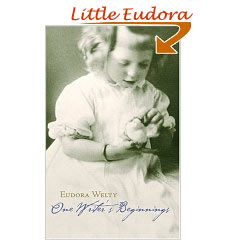
I'm bringing this up with you because I'm reading your musings in a book titled, One Writer's Beginnings. I'm reading what, apparently, was originally a lecture entitled, Listening. You say,
"Ever since I was first read to, then started reading to myself, there has never been a line read that I didn't hear. As my eyes followed the sentence, a voice was saying it silently to me. It isn't my mother's voice, or the voice of any person I can identify, certainly not my own. It is human, but inward, and it is inwardly that I listen to it. It is to me the voice of the story or the poem itself. The cadence, whatever it is that asks you to believe, the feeling that resides in the printed work, reaches me through the reader-voice."
You ask whether others hear that voice too. Yes, I do. And sometimes I must read aloud to hear the intonations in unison and test the sound to make sure that I am hearing it right. I hear it even more when I am writing. I think that is why I've started to blog, to get the sound out of my head and onto the screen. I write it down so I'll have it for later, so I can check it and make sure it is true. If it stays inside my head, I can't, as you say, "begin the process of testing it for truth."
When you interrupted your mother as she broached the subject of sex, and instead chose to talk of lightening bugs, do you think you weren't ready to test those words for truth? Perhaps, she would have done better to read the words from a book so the voice telling you those truths would have been one other than your mother's. There are words that mothers just aren't allowed to say because testing a mother's words for truth is almost a sacrilege. It is better to say, "Stop, stop. Look at the lightening bugs."
Best,
Betsy DeGeorge
P.S. I certainly hope your read my last letter to Toni Morrison. I haven't finished with you on that subject yet!
I told my children about sex in front of the rabbit pen. The bunnies were doing what bunnies do. The older children sensed the import of it all, but the youngest claims to this day I didn't tell her at all. Telling these top secrets at too young an age can, at times, result only in satisfaction to the heart of parents that the deed is done.
When my daughter told me in her late teens that I had failed as a mother, I immediately launched into an explication of the subject right there at the dinner table. The reaction: "Stop, stop. You are too late now." I received a similar reaction from my married children when I flew a trial balloon with them to test the wording for my next survey question. "What, do you think, is the most important element of sexual practice in the lives of committed partners?" This time the reaction was just, "STOP. STOP." (Oh, the life of the pure researcher is certainly a daunting one.)

I'm bringing this up with you because I'm reading your musings in a book titled, One Writer's Beginnings. I'm reading what, apparently, was originally a lecture entitled, Listening. You say,
"Ever since I was first read to, then started reading to myself, there has never been a line read that I didn't hear. As my eyes followed the sentence, a voice was saying it silently to me. It isn't my mother's voice, or the voice of any person I can identify, certainly not my own. It is human, but inward, and it is inwardly that I listen to it. It is to me the voice of the story or the poem itself. The cadence, whatever it is that asks you to believe, the feeling that resides in the printed work, reaches me through the reader-voice."
You ask whether others hear that voice too. Yes, I do. And sometimes I must read aloud to hear the intonations in unison and test the sound to make sure that I am hearing it right. I hear it even more when I am writing. I think that is why I've started to blog, to get the sound out of my head and onto the screen. I write it down so I'll have it for later, so I can check it and make sure it is true. If it stays inside my head, I can't, as you say, "begin the process of testing it for truth."
When you interrupted your mother as she broached the subject of sex, and instead chose to talk of lightening bugs, do you think you weren't ready to test those words for truth? Perhaps, she would have done better to read the words from a book so the voice telling you those truths would have been one other than your mother's. There are words that mothers just aren't allowed to say because testing a mother's words for truth is almost a sacrilege. It is better to say, "Stop, stop. Look at the lightening bugs."
Best,
Betsy DeGeorge
P.S. I certainly hope your read my last letter to Toni Morrison. I haven't finished with you on that subject yet!
Saturday, July 29, 2006
Must Toni Morrison Crusade
Dear Toni Morrison,
Somewhere near the end of three hours of interview with Toni Morrison on C-Span's In Depth, I identified your answer to the question I have been asking authors. Must the author crusade?
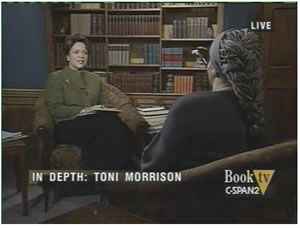
Ok. That is not exactly how Sam Saleem asked his question, but it was close and followed some other interesting discussion on morality and the necessity of negotiating rather than dictating a moral position.
Sam asked, "How have you been able to balance the role of spokesperson on racial issues on the one hand and an artist on the other."
You said, "Those two go together for me. I don't find them different at all. I think that art should be political, representative, and absolutely and irrevocably beautiful at the same time."
There it is, I said in my mind. Meanwhile, I tucked away my own personal 15 minutes of fame in my file box. My 15 took place today as I basked in the limelight of being on the cover of the Knoxville Voice, along with my Women in Black cohorts under a headline that, well, didn't make any sense at all. This time, though, I wasn't the editor so it wasn't my fault, I was, instead, one of the cover girls (and guys).

We may not be absolutely and irrevocably beautiful, but we are political, representative and speaking for a just peace.
Thanks for your thoughts. I will write to you later about your comments on morality. The discussion was fascinating.
Betsy
Somewhere near the end of three hours of interview with Toni Morrison on C-Span's In Depth, I identified your answer to the question I have been asking authors. Must the author crusade?
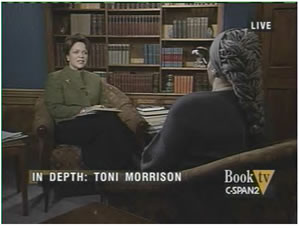
Ok. That is not exactly how Sam Saleem asked his question, but it was close and followed some other interesting discussion on morality and the necessity of negotiating rather than dictating a moral position.
Sam asked, "How have you been able to balance the role of spokesperson on racial issues on the one hand and an artist on the other."
You said, "Those two go together for me. I don't find them different at all. I think that art should be political, representative, and absolutely and irrevocably beautiful at the same time."
There it is, I said in my mind. Meanwhile, I tucked away my own personal 15 minutes of fame in my file box. My 15 took place today as I basked in the limelight of being on the cover of the Knoxville Voice, along with my Women in Black cohorts under a headline that, well, didn't make any sense at all. This time, though, I wasn't the editor so it wasn't my fault, I was, instead, one of the cover girls (and guys).

We may not be absolutely and irrevocably beautiful, but we are political, representative and speaking for a just peace.
Thanks for your thoughts. I will write to you later about your comments on morality. The discussion was fascinating.
Betsy
Tuesday, July 25, 2006
While Shepherds Watched Their Flocks By Night
Dear Shepherd types,
It was when my friend began to describe to me how she expressed the bladder of her paraplegic dog when I actually realized that I do not love my animals. And, on top of that, I am glad.
Perhaps you jump to the conclusion that I am squemish, but I'm not, (well, maybe a little.) Or perhaps you think I draw the line at expressing bladders, but I don't. Baa-aa-aab, our pet lamb needed some "expression" once when he got a ureter infection. We did that, or I should say my husband did, under cover of evening lest the neighbors come to believe that those old tales about sheep herders were being acted out right next door. (By the way, why did they choose sheep herding rather than cattle rounding as the occupation for Enis and Jack?)
But honestly I've gotten hardened to these things since having male horses. The responsibility of grabbing a horse penis and cleaning it's sheath has got to be the farmlife equivalent of taking a good stiff drink, (no pun intended.) And I do know that caring for animals simply demands the gross at times. It comes with the territory.
I've had dogs that I liked lots. Annie was particularly sweet. She was cooperative and gentle. She was dog-loyal, that spirit of the domesticated dog that communicates something akin to love.

I am enjoying my horses enormously. Nebuchadnezzar has a wonderful personality and a great look. When he runs back and forth impatiently in the field he looks like something out of a movie, his head high and curious. And to ride him is an adventure. I say that I ride for the "rush" and he is guaranteed enjoyment. Partly, that is because I can never wholely anticipate his anxieties. The last time he surprised me with his antics was over a butterfly, and a small one at that. There are moments when Neb appears to prefer my company. That is nice. I prefer his often.

Then there is Solomon. Ah, what a nice ride he can give, effortlessly. He isn't pretty. In fact he has lately been accused of being grass fat. But he is a wonderful guy. He has even proven himself to be dependable in a trailer. I can ask for nothing more.

I entitled this picture llama madness. And llamas are indeed a mad bunch. They are not cuddly, unlike some sheep (see references above). My most unusual llama experience took place in the middle of a rain storm. One of the llama's had just given birth and I was worried about the little critter, covered with all the gross stuff that newborns get covered with. Mama was busy delivering the placenta and I decided that I needed to pick baby up and carry her to the relative dryness of the barn. The rest of the female herd was in the vicinity, but as they are not an aggressive lot, I picked up baby and began walking down the hill toward the herd and the barn. Mama followed. As I passed each of the other llamas, one by one, they spit at the baby. It felt like a scene from My Big Fat Greek Wedding and ranks for me as one of the four or five most incredible natural events of my life.

Then the kittens. Oh, my they are cute. The Pink One, The Black One, The Orange One, The Grey One (a.k.a. Graham), and The Black One with the Stubby Tail.
It was when my friend began to describe to me how she expressed the bladder of her paraplegic dog when I actually realized that I do not love my animals. And, on top of that, I am glad.
Perhaps you jump to the conclusion that I am squemish, but I'm not, (well, maybe a little.) Or perhaps you think I draw the line at expressing bladders, but I don't. Baa-aa-aab, our pet lamb needed some "expression" once when he got a ureter infection. We did that, or I should say my husband did, under cover of evening lest the neighbors come to believe that those old tales about sheep herders were being acted out right next door. (By the way, why did they choose sheep herding rather than cattle rounding as the occupation for Enis and Jack?)
But honestly I've gotten hardened to these things since having male horses. The responsibility of grabbing a horse penis and cleaning it's sheath has got to be the farmlife equivalent of taking a good stiff drink, (no pun intended.) And I do know that caring for animals simply demands the gross at times. It comes with the territory.
I've had dogs that I liked lots. Annie was particularly sweet. She was cooperative and gentle. She was dog-loyal, that spirit of the domesticated dog that communicates something akin to love.
I am enjoying my horses enormously. Nebuchadnezzar has a wonderful personality and a great look. When he runs back and forth impatiently in the field he looks like something out of a movie, his head high and curious. And to ride him is an adventure. I say that I ride for the "rush" and he is guaranteed enjoyment. Partly, that is because I can never wholely anticipate his anxieties. The last time he surprised me with his antics was over a butterfly, and a small one at that. There are moments when Neb appears to prefer my company. That is nice. I prefer his often.
Then there is Solomon. Ah, what a nice ride he can give, effortlessly. He isn't pretty. In fact he has lately been accused of being grass fat. But he is a wonderful guy. He has even proven himself to be dependable in a trailer. I can ask for nothing more.
I entitled this picture llama madness. And llamas are indeed a mad bunch. They are not cuddly, unlike some sheep (see references above). My most unusual llama experience took place in the middle of a rain storm. One of the llama's had just given birth and I was worried about the little critter, covered with all the gross stuff that newborns get covered with. Mama was busy delivering the placenta and I decided that I needed to pick baby up and carry her to the relative dryness of the barn. The rest of the female herd was in the vicinity, but as they are not an aggressive lot, I picked up baby and began walking down the hill toward the herd and the barn. Mama followed. As I passed each of the other llamas, one by one, they spit at the baby. It felt like a scene from My Big Fat Greek Wedding and ranks for me as one of the four or five most incredible natural events of my life.
Then the kittens. Oh, my they are cute. The Pink One, The Black One, The Orange One, The Grey One (a.k.a. Graham), and The Black One with the Stubby Tail.

But I do not love them. Thank goodness for that. I love people and my heart dies enough times over them. Suppose I had to include heartbreak for animals. No thank you. I'll stick with people for that.
Betsy
Monday, July 24, 2006
Ode to a Well Tempered Clavier
Dear Myers Briggs,
Oh, Myers, I think it started when I looked at the Keirsey temperament sorter. I didn't mean to take it, but then they said I would be finished in a mere 12 minutes, and. . . that I would have a whole new vision of me, ready to face myself and the world with renewed confidence, knowing that I am I and that, well, I'm perfectly normal, just like 1.8877 percent of the population with a B average.
So, I fell in, and came out an Idealist. Now I'm stuck searching for the ideal way to live. If I could just achieve some baroque kind of order to my life that would balance out the notes I hear in the right side of my brain with the ones I hear in the left. Frankly I think that's what Bach was trying to do when he started messing around with the tunings of his harpsicord. Those old church scales, just weren't ideal, and when he heard that Phrygian mode, he knew it had to go.
With a well-tuned harpsichord, the harmonies began to soar. It was like an invention! And even when the church started shooting their canons at him, he just increased the volume on his basso continuo and turned the other fugue.
I've been working a bit with my clavier, checking the frequencies, doing the math. I think I've just about got it right. I'm preparing for the show, because one of these days my key is going to shift, the tension's going to rise, and bingo, an ideal resolution.
That, my dear Myers, will be the day.
B
Tags: Music
Oh, Myers, I think it started when I looked at the Keirsey temperament sorter. I didn't mean to take it, but then they said I would be finished in a mere 12 minutes, and. . . that I would have a whole new vision of me, ready to face myself and the world with renewed confidence, knowing that I am I and that, well, I'm perfectly normal, just like 1.8877 percent of the population with a B average.
So, I fell in, and came out an Idealist. Now I'm stuck searching for the ideal way to live. If I could just achieve some baroque kind of order to my life that would balance out the notes I hear in the right side of my brain with the ones I hear in the left. Frankly I think that's what Bach was trying to do when he started messing around with the tunings of his harpsicord. Those old church scales, just weren't ideal, and when he heard that Phrygian mode, he knew it had to go.
With a well-tuned harpsichord, the harmonies began to soar. It was like an invention! And even when the church started shooting their canons at him, he just increased the volume on his basso continuo and turned the other fugue.
I've been working a bit with my clavier, checking the frequencies, doing the math. I think I've just about got it right. I'm preparing for the show, because one of these days my key is going to shift, the tension's going to rise, and bingo, an ideal resolution.
That, my dear Myers, will be the day.
B
Tags: Music
Sunday, July 23, 2006
Back to Survey I (subtitled, "Well, at least I tried," with regards to the authors of the original In-laws movie and the Bay of Pigs)
Dear Cate,
"A willingness to be uncertain or to allow for uncertainty. To suspend your own perspective or "bracket". To differentiate between good and evil in what you act on."
A while ago we talked and I imposed my ongoing survey upon you. Your answer (above) was, characteristic of your intellect and consistent depth of thought, one of the most provocative of all the answers I have received to date.
{Note to Readers: Please add your thoughts.}
It seems that you actually packed three or four answers into one. First, a willingness to be uncertain. Well, I'm uncertain, ergo, I'm good?!?! Well, maybe not. My uncertainties, as you well know, don't sustain themselves during the course of my interactions with others. I'm sure my uncertain little heart presents itself as a know-it-all one more often than I would like to believe.
And to allow for uncertainty, ah, how difficult that is. To be patient with that loved one who is simply and perhaps quietly unsure, yes, that does take a good person indeed. I know that it has been beyond my grasp at times when my dear children are seemingly floundering. "I will set you straight. I will point out the right path for you. All will be well if you believe what I say." Dear friend, can you just hear the inflection of my voice. And I am even well intentioned. In one of my favorite movies, (the original In-Laws) Peter Falk explains the presence of a photo of JFK hanging on his office walls inscribed with the words, "Well, at least we tried." "The Bay of Pigs," he says, "That was my idea." Sometimes I feel like my ideas are just about that good.
As you may recall you tried to explain to me the psychological concept of bracketing, which I am not sure I could define here if you gave me a quiz, but that I appreciated and will continue to think about. To suspend my own perspective. I have been working on this one. My perspective has been such a narrow one all of these many years. Barry Goldwater once wrote a book entitled, "The Conscience of a Conservative." The conservative conscience is a narrow one and prescribed. So the outline of the content of my conscience is short. Betsy's shorter catechism. I have tried to trash this in hopes of developing a better catechism of life. I don't mean that I won't rescue the good points from the old cathechism, but it all needs such a review in the light of my survey.
Finally, you are not one to leave out the practical application, are you? "So then, in light of what we have learned here today, go do it." I will try, I will try.
See you soon, my beloved friend. I look forward to it.
Betsy
"A willingness to be uncertain or to allow for uncertainty. To suspend your own perspective or "bracket". To differentiate between good and evil in what you act on."
A while ago we talked and I imposed my ongoing survey upon you. Your answer (above) was, characteristic of your intellect and consistent depth of thought, one of the most provocative of all the answers I have received to date.
{Note to Readers: Please add your thoughts.}
It seems that you actually packed three or four answers into one. First, a willingness to be uncertain. Well, I'm uncertain, ergo, I'm good?!?! Well, maybe not. My uncertainties, as you well know, don't sustain themselves during the course of my interactions with others. I'm sure my uncertain little heart presents itself as a know-it-all one more often than I would like to believe.
And to allow for uncertainty, ah, how difficult that is. To be patient with that loved one who is simply and perhaps quietly unsure, yes, that does take a good person indeed. I know that it has been beyond my grasp at times when my dear children are seemingly floundering. "I will set you straight. I will point out the right path for you. All will be well if you believe what I say." Dear friend, can you just hear the inflection of my voice. And I am even well intentioned. In one of my favorite movies, (the original In-Laws) Peter Falk explains the presence of a photo of JFK hanging on his office walls inscribed with the words, "Well, at least we tried." "The Bay of Pigs," he says, "That was my idea." Sometimes I feel like my ideas are just about that good.
As you may recall you tried to explain to me the psychological concept of bracketing, which I am not sure I could define here if you gave me a quiz, but that I appreciated and will continue to think about. To suspend my own perspective. I have been working on this one. My perspective has been such a narrow one all of these many years. Barry Goldwater once wrote a book entitled, "The Conscience of a Conservative." The conservative conscience is a narrow one and prescribed. So the outline of the content of my conscience is short. Betsy's shorter catechism. I have tried to trash this in hopes of developing a better catechism of life. I don't mean that I won't rescue the good points from the old cathechism, but it all needs such a review in the light of my survey.
Finally, you are not one to leave out the practical application, are you? "So then, in light of what we have learned here today, go do it." I will try, I will try.
See you soon, my beloved friend. I look forward to it.
Betsy
Tuesday, July 18, 2006
Horses in West Virginia
Dear AnneGG,

Remember our first horse, Sugarfoot. He wasn’t truly ours, but we owned him with our hearts and sense of adventure. You and Carrie and Stevie owned him the way three, then four (Diane), small children own anything, carelessly and carefully. You owned him carelessly in the abandon of your pleasure with doses of dirt and energy and daily questing. You owned him carefully with the intensity of the first experience of holding the life and welfare of another being in your own sphere of responsibility.
Remember your great fall. The icy ride and the buck, the toss, and tumble has, I fear, ruined your love of riding forever. I regret that, especially now that I find such moment in my time on horses.
Your father tells the story, proudly, (you have heard this many times) of the dark winter evening when we sat at the dinner table with your grandparents in that ample kitchen of an otherwise very small house on ten acres in the coal hills of West Virginia. We loved that place, with its magical evergreen forest where you played on piles of fallen red needles, it’s giant rock where you occasionally camped out, and it’s grand canyon carved by some miscreant coal company that cut but never reclaimed, leaving for us a wondrous geologic playground, complete with a mine portal and exquisite danger. You were such a little person that night at the dinner table and the night was so dark and the air was so cold, but it was your turn, so when your father said, “Did anyone feed Sugarfoot?” you wordlessly rose and went for your coat. Grandma was horrified. How could we let this tiny child brave the elements to feed and water a horse all by herself?
And that perhaps is still a good question. How could we do that? Why? Did you wonder? Well, here are some reasons. I was very pregnant with your sister Diane. I remember days during that pregnancy when I was forced to stretch the hose to the furthest length and fill 5 gallons buckets, half full each, and carry them the rest of the distance to the horse. I did it slowly, step by step and with some weariness, like a scene out of “Little House on the Prairie.” But your father was injured. His back was “blown,” and that injury had blown some of his other psychological cover, too (another story for another day). So it was up to you children. And you were brave and helpful. Did you know? And a lot of it fell to you and Carrie because you were oldest. You can see from the picture what oldest means!
Thank you my dear AnneGG for the character you displayed then and that you have carried with you far beyond your loss of love for the equine.
Love, always,
MOM
XOX
Tags: Horses Family
Remember our first horse, Sugarfoot. He wasn’t truly ours, but we owned him with our hearts and sense of adventure. You and Carrie and Stevie owned him the way three, then four (Diane), small children own anything, carelessly and carefully. You owned him carelessly in the abandon of your pleasure with doses of dirt and energy and daily questing. You owned him carefully with the intensity of the first experience of holding the life and welfare of another being in your own sphere of responsibility.
Remember your great fall. The icy ride and the buck, the toss, and tumble has, I fear, ruined your love of riding forever. I regret that, especially now that I find such moment in my time on horses.
Your father tells the story, proudly, (you have heard this many times) of the dark winter evening when we sat at the dinner table with your grandparents in that ample kitchen of an otherwise very small house on ten acres in the coal hills of West Virginia. We loved that place, with its magical evergreen forest where you played on piles of fallen red needles, it’s giant rock where you occasionally camped out, and it’s grand canyon carved by some miscreant coal company that cut but never reclaimed, leaving for us a wondrous geologic playground, complete with a mine portal and exquisite danger. You were such a little person that night at the dinner table and the night was so dark and the air was so cold, but it was your turn, so when your father said, “Did anyone feed Sugarfoot?” you wordlessly rose and went for your coat. Grandma was horrified. How could we let this tiny child brave the elements to feed and water a horse all by herself?
And that perhaps is still a good question. How could we do that? Why? Did you wonder? Well, here are some reasons. I was very pregnant with your sister Diane. I remember days during that pregnancy when I was forced to stretch the hose to the furthest length and fill 5 gallons buckets, half full each, and carry them the rest of the distance to the horse. I did it slowly, step by step and with some weariness, like a scene out of “Little House on the Prairie.” But your father was injured. His back was “blown,” and that injury had blown some of his other psychological cover, too (another story for another day). So it was up to you children. And you were brave and helpful. Did you know? And a lot of it fell to you and Carrie because you were oldest. You can see from the picture what oldest means!
Thank you my dear AnneGG for the character you displayed then and that you have carried with you far beyond your loss of love for the equine.
Love, always,
MOM
XOX
Tags: Horses Family
Thursday, July 13, 2006
bell hooks and Foundational Love
Dear bell,
Thanks again for your presentations at the Writing for Reconciliation Conference. We all wish that we had seen more you. I am hoping that you are feeling better and that your year of engaging with difficult things goes well. I certainly understand the challenges, for my mom and dad are 84 and. . .

So, I am reading the article from the Shambala Sun. This after having read enough of your work to feel like I have begun to taste what you are saying. I have focused on two quotes that you have used. They were helpful to me. Almost “aha!” On page 60, you quote Dr. Martin Luther King, Jr., saying “Sooner or later all the people of the world will have to discover a way to live together in peace. . . If this is to be achieved, man must evolve for all human conflict a method which rejects revenge, aggression, and retaliation. The foundation of such a method is love.” Later you quote Thich Nhat Hanh who, “thought it was quite plain that if you have to choose between Buddhism and peace, then you must choose peace.”
These quote crystallize for me the themes you are communicating in your books on love.
Love as foundational to political action. Love as foundational to relationship whether in our households or on our globe. You don’t have to do much convincing with me to get me to embrace the concept superficially. But if I accept it down deep in myself, what changes does it demand, socially, politically, even in my family. And it is hard. Here is why I think it is hard. For me, part of the definition of love includes relationship. You don’t love someone and then walk away and remain distant and inaccessible. So if love becomes foundational, all escape routes are blocked.
Is love the cornerstone on which we could actually build a society capable of existing peacefully and productively in the world? Is this a practical, a doable, an achievable thing? It sounds like a dream. How could you build, for instance, a political party founded on love? How do you deal with an attack similar to that of 9/11/01 based on love? I have thought about these things and the answers I come up with are a little filmy.
But I want it to be true, bell, I really do.
Betsy DeGeorge
Thanks again for your presentations at the Writing for Reconciliation Conference. We all wish that we had seen more you. I am hoping that you are feeling better and that your year of engaging with difficult things goes well. I certainly understand the challenges, for my mom and dad are 84 and. . .

So, I am reading the article from the Shambala Sun. This after having read enough of your work to feel like I have begun to taste what you are saying. I have focused on two quotes that you have used. They were helpful to me. Almost “aha!” On page 60, you quote Dr. Martin Luther King, Jr., saying “Sooner or later all the people of the world will have to discover a way to live together in peace. . . If this is to be achieved, man must evolve for all human conflict a method which rejects revenge, aggression, and retaliation. The foundation of such a method is love.” Later you quote Thich Nhat Hanh who, “thought it was quite plain that if you have to choose between Buddhism and peace, then you must choose peace.”
These quote crystallize for me the themes you are communicating in your books on love.
Love as foundational to political action. Love as foundational to relationship whether in our households or on our globe. You don’t have to do much convincing with me to get me to embrace the concept superficially. But if I accept it down deep in myself, what changes does it demand, socially, politically, even in my family. And it is hard. Here is why I think it is hard. For me, part of the definition of love includes relationship. You don’t love someone and then walk away and remain distant and inaccessible. So if love becomes foundational, all escape routes are blocked.
Is love the cornerstone on which we could actually build a society capable of existing peacefully and productively in the world? Is this a practical, a doable, an achievable thing? It sounds like a dream. How could you build, for instance, a political party founded on love? How do you deal with an attack similar to that of 9/11/01 based on love? I have thought about these things and the answers I come up with are a little filmy.
But I want it to be true, bell, I really do.
Betsy DeGeorge
Monday, July 10, 2006
Must Richard Wright Crusade
Dear Richard Wright,
I have written Eudora Welty about her position expressed in the essay, Must the Novelist Crusade. I contradicted her, for though she doesn’t wear a banner across her gingham, I believe her to be a crusader for truth as she sees it. I guess I see all artists as crusaders for meaning, and though Eudora doesn’t like the word crusade, for it smacks of something blatant and lacking in the artistry of the subtle, I think she crusades too.
On the other hand, you, Richard, talk about the underpinnings of truth in Blueprint for Negro Writing, “Here are those vital beginnings of a recognition of value in life as it is lived, a recognition that marks the emergence of a new culture in the shell of the old. And at the moment this process starts, at the moment when a people begin to realize a meaning in their suffering, the civilization that engenders that suffering is doomed.” The operative word here is “meaning.” Truth, whatever it is actually, is approached through the shadow of meaning. Writing artists live in that shadow whether they admit it or not. They do not own truth any more than painters own beauty, but they live in its shadow.
In the section of your essay called The Problem of Perspective, you say, “they feel with some measure of justification that another commitment means only another disillusionment. But anyone destitute of a theory about the meaning, structure and direction of modern society is a lost victim in a world he cannot understand or control.” In embracing the strength that is found in each of our unique and powerful perspectives, we can engage existentially in the “crusade” for the cultural emergence of something new, something that seeks to achieve a life that is more just, more true, more beautiful.
If Welty doesn’t like the word “crusade,” you don’t like the word “preach.” You don’t want to be a “salesman” or a “prostitute.” These concerns are quite similar. It seems that you don’t deny the danger and the fearful nature of what the writer is doing. You embrace it. “This is the moment,” you say, “. . . When Negro writers think they have arrived at something which smacks of truth. . .”
I have finished reading Native Son. It is one of those books of which I wouldn’t say, “I like that,” but I would say, “I’m glad I read that.” It is a book that reveals a perspective, and one that I need. I am neither black nor poor. I have been poor, but I have never been black. I have been poor, but I have never lived in poverty. There is such a difference. Being poor certainly gives one an appreciation for poverty that is less available to the wealthy, but poverty is so much broader than just being poor, that saying you understand poverty because you’ve been poor would be like saying you understand the problems of Africa because you went on a safari in Kenya.
I feel like I am more ready for your work than I ever have been. I know that if I am to understand the world and culture of the United States, I must try to come to an understanding of the cultures that make it up, especially the black culture. I guess I am ready to some degree because I’ve made an effort to at least desensitize myself to the elements present in your novels that my naïve self, which is still very present in me, revolts against.
Yet, as much as I agree with you and the need for the crusade, I was put off, as I read the last third of Native Son, for it seemed that it became a sermon. The lawyer for the Bigger’s defense, Boris Max, climbed upon the soapbox and preached. He preached about important things, but it was preaching and that, I would think, is a prostitution of the craft. In my reaction to the book, I come to understand Welty’s concern that we not become mere clerics presenting the doctrines of whatever isms we ascribe to.
Perhaps you can tell me where you think the artist must draw his/her lines? Perhaps I draw mine somewhere between yours and Eudora’s.
Hoping to learn more.
Betsy
I have written Eudora Welty about her position expressed in the essay, Must the Novelist Crusade. I contradicted her, for though she doesn’t wear a banner across her gingham, I believe her to be a crusader for truth as she sees it. I guess I see all artists as crusaders for meaning, and though Eudora doesn’t like the word crusade, for it smacks of something blatant and lacking in the artistry of the subtle, I think she crusades too.
On the other hand, you, Richard, talk about the underpinnings of truth in Blueprint for Negro Writing, “Here are those vital beginnings of a recognition of value in life as it is lived, a recognition that marks the emergence of a new culture in the shell of the old. And at the moment this process starts, at the moment when a people begin to realize a meaning in their suffering, the civilization that engenders that suffering is doomed.” The operative word here is “meaning.” Truth, whatever it is actually, is approached through the shadow of meaning. Writing artists live in that shadow whether they admit it or not. They do not own truth any more than painters own beauty, but they live in its shadow.
In the section of your essay called The Problem of Perspective, you say, “they feel with some measure of justification that another commitment means only another disillusionment. But anyone destitute of a theory about the meaning, structure and direction of modern society is a lost victim in a world he cannot understand or control.” In embracing the strength that is found in each of our unique and powerful perspectives, we can engage existentially in the “crusade” for the cultural emergence of something new, something that seeks to achieve a life that is more just, more true, more beautiful.
If Welty doesn’t like the word “crusade,” you don’t like the word “preach.” You don’t want to be a “salesman” or a “prostitute.” These concerns are quite similar. It seems that you don’t deny the danger and the fearful nature of what the writer is doing. You embrace it. “This is the moment,” you say, “. . . When Negro writers think they have arrived at something which smacks of truth. . .”
I have finished reading Native Son. It is one of those books of which I wouldn’t say, “I like that,” but I would say, “I’m glad I read that.” It is a book that reveals a perspective, and one that I need. I am neither black nor poor. I have been poor, but I have never been black. I have been poor, but I have never lived in poverty. There is such a difference. Being poor certainly gives one an appreciation for poverty that is less available to the wealthy, but poverty is so much broader than just being poor, that saying you understand poverty because you’ve been poor would be like saying you understand the problems of Africa because you went on a safari in Kenya.
I feel like I am more ready for your work than I ever have been. I know that if I am to understand the world and culture of the United States, I must try to come to an understanding of the cultures that make it up, especially the black culture. I guess I am ready to some degree because I’ve made an effort to at least desensitize myself to the elements present in your novels that my naïve self, which is still very present in me, revolts against.
Yet, as much as I agree with you and the need for the crusade, I was put off, as I read the last third of Native Son, for it seemed that it became a sermon. The lawyer for the Bigger’s defense, Boris Max, climbed upon the soapbox and preached. He preached about important things, but it was preaching and that, I would think, is a prostitution of the craft. In my reaction to the book, I come to understand Welty’s concern that we not become mere clerics presenting the doctrines of whatever isms we ascribe to.
Perhaps you can tell me where you think the artist must draw his/her lines? Perhaps I draw mine somewhere between yours and Eudora’s.
Hoping to learn more.
Betsy
Sunday, June 25, 2006
Return to the Shack
Dear Zora Neale Hurston,
I have been investigating the term “Shack” and it’s derived forms, “shacking, shack-up, shacked” and so forth. In my search, I have visited your work, Mules and Men, originally published in 1935. It is a fascinating work, revealing your community to me in an intimate way.
As I read the book, I discovered that your hometown, Eatonville, Fla., reminded me, on the surface, of the town in Toni Morrison’s Paradise. However her paradise is very dark while yours is quite light. The warmth and laughter of your town is rather heavenly. Hers just gropes in the twilight hoping for such bliss.
At any rate, in a passage of banter between storytellers Gold and Willie Sewell, you capture some classic repartee like that heard in cultures everywhere since the dawn of gender. After a long tale explaining how man became stronger and woman earned the keys to dealing with that, Willie says, “Y’all lady people ain’t smarter than all men folks. You got plow lines on some of us, but some of us is too smart for you. We go past you jus’ like lightnin’ thru de trees, . . . and what make it so cool, we close enough to you to have a scronchous time, but never no halter on our necks. Ah know they won’t git none on dis last neck of mine.”
“Oh, you kin be had,” Gold retorted. “Ah mean dat abstifically.”
“Yeah? But not wid de trace chains*. Never no shack up. Ah want dis tip-in love and tip yo’ hat and walk out. Ah don’t want nobody to have dis dyin’ love for me.”
Richard Jones (another of the tale tellers) said; “Yeah, man. Love is a funny thing; love is a blossom. If you want yo’ finger bit poke it at a possum.”
Well, Zora, this is interesting talk, and according to information shared provided by comments to my last survey, it is the first literary usage of the term shack up. Here I would interpret that it means marriage or a permanent relationship, not a one-night stand. In fact Willie’s term for that may be tip-in love.
You seem to see love as passing like “Lightnin’ thru de trees,” too.
In Dust Tracks on a Road, you wrote about love: "Under the spell of moonlight, music, flowers, or the cut and smell of good tweeds, I sometimes feel the divine urge for an hour, a day, or maybe a week. Then it is gone and my interest returns to corn pone and mustard greens, or rubbing a paragraph with a soft cloth. Then my ex-sharer of a mood calls up in a fevered voice and reminds me of every silly thing I said, and eggs me on to say them all over again. It is the third presentation of turkey hash after Christmas. It is asking me to be a seven-sided liar. Accuses me of being faithless and inconsistent if I don't. There is no inconsistency there. I was sincere for the moment in which I said the things. It is strictly a matter of time. It was true for the moment, but the next day or the next week, is not that moment. No two moments are any more alike than two snowflakes. Like snowflakes, they get the same look from being so plentiful and falling so close together. But examine them closely and see the multiple differences between them. Each moment has its own task and capacity; doesn't melt down like snow and form again. It keeps in character forever. So the great difficulty lies in trying to transpose last night's moment to a day which has no knowledge of it. That look, that tender touch, was issued by the mint of the richest of all kingdoms. That same expression of today is utter counterfeit; or at best the wildest of inflation. What could be more zestless than passing out canceled checks? It is wrong to be called faithless under circumstances like that. What to do?" (1942). (Quoted in Women's Intellectual Contributions to the Study of Mind and Society.)
My love just doesn’t pass like that. I fall in love for sure, with this one and that one, and it’s electric, but it stays in some form or other, inside me. My heart holds it as in waiting for some paradise when the days are eternal enough to grant those intercourses** I long for here and now.
The meaning of the word “shack up” has deteriorated. You might really appreciate the change. I, for one, would rather have had it remain as a more permanent expression of a love that can last and last even in the most difficult of circumstances.
Betsy
I have been investigating the term “Shack” and it’s derived forms, “shacking, shack-up, shacked” and so forth. In my search, I have visited your work, Mules and Men, originally published in 1935. It is a fascinating work, revealing your community to me in an intimate way.
As I read the book, I discovered that your hometown, Eatonville, Fla., reminded me, on the surface, of the town in Toni Morrison’s Paradise. However her paradise is very dark while yours is quite light. The warmth and laughter of your town is rather heavenly. Hers just gropes in the twilight hoping for such bliss.
At any rate, in a passage of banter between storytellers Gold and Willie Sewell, you capture some classic repartee like that heard in cultures everywhere since the dawn of gender. After a long tale explaining how man became stronger and woman earned the keys to dealing with that, Willie says, “Y’all lady people ain’t smarter than all men folks. You got plow lines on some of us, but some of us is too smart for you. We go past you jus’ like lightnin’ thru de trees, . . . and what make it so cool, we close enough to you to have a scronchous time, but never no halter on our necks. Ah know they won’t git none on dis last neck of mine.”
“Oh, you kin be had,” Gold retorted. “Ah mean dat abstifically.”
“Yeah? But not wid de trace chains*. Never no shack up. Ah want dis tip-in love and tip yo’ hat and walk out. Ah don’t want nobody to have dis dyin’ love for me.”
Richard Jones (another of the tale tellers) said; “Yeah, man. Love is a funny thing; love is a blossom. If you want yo’ finger bit poke it at a possum.”
Well, Zora, this is interesting talk, and according to information shared provided by comments to my last survey, it is the first literary usage of the term shack up. Here I would interpret that it means marriage or a permanent relationship, not a one-night stand. In fact Willie’s term for that may be tip-in love.
You seem to see love as passing like “Lightnin’ thru de trees,” too.
In Dust Tracks on a Road, you wrote about love: "Under the spell of moonlight, music, flowers, or the cut and smell of good tweeds, I sometimes feel the divine urge for an hour, a day, or maybe a week. Then it is gone and my interest returns to corn pone and mustard greens, or rubbing a paragraph with a soft cloth. Then my ex-sharer of a mood calls up in a fevered voice and reminds me of every silly thing I said, and eggs me on to say them all over again. It is the third presentation of turkey hash after Christmas. It is asking me to be a seven-sided liar. Accuses me of being faithless and inconsistent if I don't. There is no inconsistency there. I was sincere for the moment in which I said the things. It is strictly a matter of time. It was true for the moment, but the next day or the next week, is not that moment. No two moments are any more alike than two snowflakes. Like snowflakes, they get the same look from being so plentiful and falling so close together. But examine them closely and see the multiple differences between them. Each moment has its own task and capacity; doesn't melt down like snow and form again. It keeps in character forever. So the great difficulty lies in trying to transpose last night's moment to a day which has no knowledge of it. That look, that tender touch, was issued by the mint of the richest of all kingdoms. That same expression of today is utter counterfeit; or at best the wildest of inflation. What could be more zestless than passing out canceled checks? It is wrong to be called faithless under circumstances like that. What to do?" (1942). (Quoted in Women's Intellectual Contributions to the Study of Mind and Society.)
My love just doesn’t pass like that. I fall in love for sure, with this one and that one, and it’s electric, but it stays in some form or other, inside me. My heart holds it as in waiting for some paradise when the days are eternal enough to grant those intercourses** I long for here and now.
The meaning of the word “shack up” has deteriorated. You might really appreciate the change. I, for one, would rather have had it remain as a more permanent expression of a love that can last and last even in the most difficult of circumstances.
Betsy
Sunday, June 18, 2006
Wagner's Ring and the Final Contract of the Gods
Dear Fafner,
I wanted to get your perspective on contracts. Sure, there are plenty of lawyers around, but your reputation for getting folks to fulfill their part of the bargain is, well, mythic. Your contract, it seems, was the last of Wotan's great contractual arrangements, his first being with his wife. That and yours and the new order are the things I am thinking about.
Supposedly, marriage was the first great contract. And, it seems to me, the conditions and requirements in Wotan and Fricka's deal were not what I would expect or want. I suppose that's because I'm from the new order. Wotan and Fricka were bound to each other just as were Zeus and Hera. Obviously fidelity was not a part of the obligation, so what were they obligated to do? Were they simply promising to create progeny for the Gods? Perhaps they were promising not to kill each other. Was Valhalla part of that deal too? If Wotan was obligated to provide a home, Valhalla, for Fricka, then the whole schema fits together for me. Wotan sells out love and youth (hence immortality) to fulfill the primary contract.

Valhalla Motive
Failing to provide an emotional home for Fricka, he provided a castle in the sky, a materialist's dream of the superlative abode, the golden treasure at the end of the rainbow. Wotan, in utter disregard for real relationship, engages in pretty illicit traffic when he promises to pay for Valhalla with Freia as his currency.
I surely don't want to offend you, but did you know what you were getting? Were you tempted just by Golden Apples or did you really want love with all its demands and tragedy. Poor Fasolt fell in love right away and it was his demise. I don't know if Wotan or Fricka ever really had a clue about the love thing, though Fricka does seem to have at least a sibling style love for Freia. Otherwise, though, she appears to be a true victim/victimizer operating in the patriarchal system, passing on her pain and kicking the dog. But I digress to the issues of feminism here. I really mean to just study the terms of the contracts.
The giants' theme makes me feel that you didn't quite know what was happening. With apologies to the Norns, I hate the word fate because I don't live in the world of the fates. But these notes are so fateful in nature to me.

Giants' Motive
Maybe falling in love is where we touch fingers with the fates. Yes, I recognize that theme from daily life--not every day, thankfully. Oh, but it does take a weighty stack of gold, a penultimate prize, to sell out love. Even Wotan knows he's made a bad deal with the loss of Freia.
I wanted to ask about one more contract, or broken contract. It is Brunnhilde who dared to break contract with her father, and she ends up in flames. Brunnhilde gives up everything, except her beautiful steed Grane (understandable), for love. She is alone, totally devoid of her deity, no longer daughter of Wotan (heaven) or Erda (earth), but daughter of love, true not to contract but true to love and relationship. I'm not sure Wagner had this all together. I think he is confused about the integrity of love apart from passion/sex. But I do think Brunnhilde has gone on beyond passion to a form of loving that is higher. In that she becomes the final mythic hero.

Redemption through Love Motive
What do you think? Could you put on Tarnhelm one more time and become Erda, the wisest person in the world and tell me if love is the final contract?
Thanks for your thoughts.
Betsy
PS: Most interesting informations at the The Wagner Experience.
I wanted to get your perspective on contracts. Sure, there are plenty of lawyers around, but your reputation for getting folks to fulfill their part of the bargain is, well, mythic. Your contract, it seems, was the last of Wotan's great contractual arrangements, his first being with his wife. That and yours and the new order are the things I am thinking about.
Supposedly, marriage was the first great contract. And, it seems to me, the conditions and requirements in Wotan and Fricka's deal were not what I would expect or want. I suppose that's because I'm from the new order. Wotan and Fricka were bound to each other just as were Zeus and Hera. Obviously fidelity was not a part of the obligation, so what were they obligated to do? Were they simply promising to create progeny for the Gods? Perhaps they were promising not to kill each other. Was Valhalla part of that deal too? If Wotan was obligated to provide a home, Valhalla, for Fricka, then the whole schema fits together for me. Wotan sells out love and youth (hence immortality) to fulfill the primary contract.
Failing to provide an emotional home for Fricka, he provided a castle in the sky, a materialist's dream of the superlative abode, the golden treasure at the end of the rainbow. Wotan, in utter disregard for real relationship, engages in pretty illicit traffic when he promises to pay for Valhalla with Freia as his currency.
I surely don't want to offend you, but did you know what you were getting? Were you tempted just by Golden Apples or did you really want love with all its demands and tragedy. Poor Fasolt fell in love right away and it was his demise. I don't know if Wotan or Fricka ever really had a clue about the love thing, though Fricka does seem to have at least a sibling style love for Freia. Otherwise, though, she appears to be a true victim/victimizer operating in the patriarchal system, passing on her pain and kicking the dog. But I digress to the issues of feminism here. I really mean to just study the terms of the contracts.
The giants' theme makes me feel that you didn't quite know what was happening. With apologies to the Norns, I hate the word fate because I don't live in the world of the fates. But these notes are so fateful in nature to me.
Maybe falling in love is where we touch fingers with the fates. Yes, I recognize that theme from daily life--not every day, thankfully. Oh, but it does take a weighty stack of gold, a penultimate prize, to sell out love. Even Wotan knows he's made a bad deal with the loss of Freia.
I wanted to ask about one more contract, or broken contract. It is Brunnhilde who dared to break contract with her father, and she ends up in flames. Brunnhilde gives up everything, except her beautiful steed Grane (understandable), for love. She is alone, totally devoid of her deity, no longer daughter of Wotan (heaven) or Erda (earth), but daughter of love, true not to contract but true to love and relationship. I'm not sure Wagner had this all together. I think he is confused about the integrity of love apart from passion/sex. But I do think Brunnhilde has gone on beyond passion to a form of loving that is higher. In that she becomes the final mythic hero.
What do you think? Could you put on Tarnhelm one more time and become Erda, the wisest person in the world and tell me if love is the final contract?
Thanks for your thoughts.
Betsy
PS: Most interesting informations at the The Wagner Experience.
Thursday, June 15, 2006
Dear Bossy, or How do I fit into my new moo-moo?
The last years have been traumatic ones for many reasons. I suppose it comes back to a simple thing. I decided to start freshening. Now, I'm not sure how the OED defines this, but Moomilk.com, under the topic "Dry Cow Management," offers many practical suggestions.
"Seizing control of dry cow management can pay huge dividends on most dairy farms. Significant amounts of income are lost on many farms because the incidence of periparturient disorders. These disorders can indeed be controlled and their incidence is primarily determined by the feeding and management of pre-fresh cows within the last two weeks prior to freshening.
"The first management decision of the dry period is determining when to dry a cow off. Managers should not have a single policy that applies to all cows; rather, the decision should be made on an individual cow basis.
"Heavy milkers are often allowed to milk longer, and sometimes are given only a 6 week dry period, which adversely affects production in the next lactation. It would appear that drying a cow off abruptly and dry treating all quarters gives the best results. It is important to move her out of the milking barn to a different location to speed up the dry-off procedure. She must be switched to a low-energy ration immediately, and water must occasionally be withheld to dry off high producers."
So, as you can see, if I were to freshen properly, I needed to dry off properly. And that is what I've been doing. Managing this kind of thing really does need to be done on a cow-by-cow basis. My drying off has taken longer than 6 weeks.
Sure, I admit it, I've had to be a heavy milker. I had four children and by necessity have had to milk longer. There were times during the years of getting four "cowlets" ready for school, keeping a "barn" clean, working "odd" jobs (like shoveling manure in churches) to pay bills and have at least $12.00 extra to send with the little cattle on field trips, that I actually felt I'd lost my mind--not crazy--but misplaced. But, it seemed that was the price of being a high producer in the milking barn. It was hard and I needed to dry off.
The pre-freshening procedure hasn't been so easy either. I think I've found my mind, but I'm having to fight through the periparturient diseases. Guillermo Meglia suggests watching two things, nutrition and immune response. That is correct. I have changed my nutritional input entirely. Throughout my life, I consumed regular quantities of Gospels, Pentateuch, and Epistles. Drying off has required that I cut back on that almost entirely. Instead, my intake has included ample quantities of fiction from Bronte (all three of them), to Eliot (both of them), Faulkner, Welty, Hugo (causing a near-foundering situation), Wiesel, Morrison, and Wright among others. I don't know if it's been "low-energy" nutritionally, but it has tasted a bit different.
My former diet was good, don't get me wrong, but it wasn't all. It was out of balance, good and healthy during a certain kind of lactation, but I was long overdue to dry off from it.
Having changed my diet, I had to take advantage of the shift and regulate my immune response system. There were so many old voices in my head saying the same thing over and over again, that I wanted my new diet to create a system that would generate a new voice, a more authentic voice that could say new things that formerly were not allowed or not noticed and that would protect me in a new way, from things that, at one time, I may have mistakenly thought were guarding me.
I could go on and on, but just let me say, this has been and is dangerous business. I've heard that it has a tendency to actually break down the tissue.
I'm thinking, though, hoping, that it will allow room for some authentic regeneration. And that's the point. It's not that I don't want to give milk again. It is that I want to give the stuff that does the body good. The fresh stuff.
After all this is over, I might just go out and buy myself a new moo-moo.
Regards from the barn,
Betsy
"Seizing control of dry cow management can pay huge dividends on most dairy farms. Significant amounts of income are lost on many farms because the incidence of periparturient disorders. These disorders can indeed be controlled and their incidence is primarily determined by the feeding and management of pre-fresh cows within the last two weeks prior to freshening.
"The first management decision of the dry period is determining when to dry a cow off. Managers should not have a single policy that applies to all cows; rather, the decision should be made on an individual cow basis.
"Heavy milkers are often allowed to milk longer, and sometimes are given only a 6 week dry period, which adversely affects production in the next lactation. It would appear that drying a cow off abruptly and dry treating all quarters gives the best results. It is important to move her out of the milking barn to a different location to speed up the dry-off procedure. She must be switched to a low-energy ration immediately, and water must occasionally be withheld to dry off high producers."
So, as you can see, if I were to freshen properly, I needed to dry off properly. And that is what I've been doing. Managing this kind of thing really does need to be done on a cow-by-cow basis. My drying off has taken longer than 6 weeks.
Sure, I admit it, I've had to be a heavy milker. I had four children and by necessity have had to milk longer. There were times during the years of getting four "cowlets" ready for school, keeping a "barn" clean, working "odd" jobs (like shoveling manure in churches) to pay bills and have at least $12.00 extra to send with the little cattle on field trips, that I actually felt I'd lost my mind--not crazy--but misplaced. But, it seemed that was the price of being a high producer in the milking barn. It was hard and I needed to dry off.
The pre-freshening procedure hasn't been so easy either. I think I've found my mind, but I'm having to fight through the periparturient diseases. Guillermo Meglia suggests watching two things, nutrition and immune response. That is correct. I have changed my nutritional input entirely. Throughout my life, I consumed regular quantities of Gospels, Pentateuch, and Epistles. Drying off has required that I cut back on that almost entirely. Instead, my intake has included ample quantities of fiction from Bronte (all three of them), to Eliot (both of them), Faulkner, Welty, Hugo (causing a near-foundering situation), Wiesel, Morrison, and Wright among others. I don't know if it's been "low-energy" nutritionally, but it has tasted a bit different.
My former diet was good, don't get me wrong, but it wasn't all. It was out of balance, good and healthy during a certain kind of lactation, but I was long overdue to dry off from it.
Having changed my diet, I had to take advantage of the shift and regulate my immune response system. There were so many old voices in my head saying the same thing over and over again, that I wanted my new diet to create a system that would generate a new voice, a more authentic voice that could say new things that formerly were not allowed or not noticed and that would protect me in a new way, from things that, at one time, I may have mistakenly thought were guarding me.
I could go on and on, but just let me say, this has been and is dangerous business. I've heard that it has a tendency to actually break down the tissue.
I'm thinking, though, hoping, that it will allow room for some authentic regeneration. And that's the point. It's not that I don't want to give milk again. It is that I want to give the stuff that does the body good. The fresh stuff.
After all this is over, I might just go out and buy myself a new moo-moo.
Regards from the barn,
Betsy
Tuesday, June 13, 2006
Dear Caleb,
Thank you for letting me publish your poem on my blog. I think it is stunning. I meant to comment, but no, I shall let it stand alone. Later, perhaps, I will write.
Copyright 2006--Caleb Brooks
Offering
-For a minister in Loudon, TN
You imagine her looking out
from where you look now,
the chapel dark and soundless
but for the gnarly oak
pawing at the shingles.
You fear the last thought
to sizzle through her head
before that bullet was you.
A step from where she was raised
to new life, she fell last night,
our wounded Healer hanging behind.
The baptistry rippled.
Even the ears of angels rang.
You dip from the tranquil pool,
cradle each drop that is poured
out behind the pulpit,
the two elements mixing
like they might have wept
from the crucifix’s side.
At this altar you have honored
the body and the blood.
Where feet have been washed,
you bow now to scrub like Christ
what you can from this stain.
O my mother, my sister,
the blood is still cleansing,
the water still holy.
-Caleb Brooks
Copyright 2006--Caleb Brooks
Thursday, June 08, 2006
Survey II: Shacking
"Shacking." Today, we say, "Let's shack up," or last night we "shacked up." The connotation that this word carries has a lightness to it and an emphasis on physical sexuality without reference to commitment and marriage. The term does carry with it the concept of being in, for some period of time, the same abode.
But where does this word find it's roots? Here is my guess and the object of a new survey. I guess it comes from the world of 17th and 18th century American slavery.
bell hooks, in the book Salvation: Black People and Love (published in 2001 by William Morrow, an imprint of HarperCollins Publishers), says, "Historically, all unions between black women and men were forged within a culture of white supremacy wherein all bonding which did not serve the interests of white people was deemed suspect and threatening. No group of black people knew better than the slaves that positive union between black women and men threatened white supremacist claims on black bodies. Free and enslaved black folks fought hard to privilege these relationships by rituals and ceremony, both illegal and legal, because they recognized that solidifying these bonds, gaining public recognition of their value, was crucial to the freedom struggle. Reading accounts of heterosexual black relationships during slavery reveals the extent to which the desire to create longstanding domestic partnerships, whether through marriage or shacking (living together without benefit of clergy), often served as the catalyst inspiring individuals to fiercely resist bondage and work for freedom. Importantly, remembering that white supremacist thinking is always challenged by loving unions between black makes and females sheds light on why there have been so many obstacles placed in the path of such unions."
This survey is requesting both comment and a search of literature that may make reference to this term and its origins. The obvious light this survey may shed on the struggle in contemporary heterosexual marriage within all racial communities, and perhaps even the debate on homosexual unions is part of what I'm seeking.
Offer examples from literature. Offer your thoughts on the term.
But where does this word find it's roots? Here is my guess and the object of a new survey. I guess it comes from the world of 17th and 18th century American slavery.
bell hooks, in the book Salvation: Black People and Love (published in 2001 by William Morrow, an imprint of HarperCollins Publishers), says, "Historically, all unions between black women and men were forged within a culture of white supremacy wherein all bonding which did not serve the interests of white people was deemed suspect and threatening. No group of black people knew better than the slaves that positive union between black women and men threatened white supremacist claims on black bodies. Free and enslaved black folks fought hard to privilege these relationships by rituals and ceremony, both illegal and legal, because they recognized that solidifying these bonds, gaining public recognition of their value, was crucial to the freedom struggle. Reading accounts of heterosexual black relationships during slavery reveals the extent to which the desire to create longstanding domestic partnerships, whether through marriage or shacking (living together without benefit of clergy), often served as the catalyst inspiring individuals to fiercely resist bondage and work for freedom. Importantly, remembering that white supremacist thinking is always challenged by loving unions between black makes and females sheds light on why there have been so many obstacles placed in the path of such unions."
This survey is requesting both comment and a search of literature that may make reference to this term and its origins. The obvious light this survey may shed on the struggle in contemporary heterosexual marriage within all racial communities, and perhaps even the debate on homosexual unions is part of what I'm seeking.
Offer examples from literature. Offer your thoughts on the term.
Thursday, June 01, 2006
Demonstrating and the Art of Changing Society
Dear Robert Moses,
While reading through the trilogy of the civil rights movement during the King years by Taylor Branch I became a Bob Moses fan. Your thoughts and actions helped form a movement and likewise a new way of thinking and being in the United States. More recently, I checked out one of your books from the library about the Algebra project. So now you teach math to the children of Mississippi? I would call it a strange contrast if it didn't make perfect sense in respect to the stuff that goes on in one's heart and mind while struggling to find meaning in relation to political action, social justice, and the desire to be involved with real societal change.
One of my "blog reads" has entered into a little discussion about the experiences of demonstrating [Defn: establishing a physical presence to express a socio/political position.] There is frustration and embarrassment in carrying placards and walking or standing. But most of all the difficulty is in becoming part of a group, some of whom you agree with, some of whom you don't, some of which are cool, some not, some with whom you would bare your very soul, some to whom you would give the time only to get them to the march promptly. Yet in this act of demonstrating you become one, you marry on a theme, and this wedding, for better or worse, seems, almost immediately, worse.
This marriage would be worth it, if only we could realize social change. But all of our standing, marching, chanting or silence, placards, persistence, and so forth seem to fade like a chimera into the din of, not rifle response, water hoses, and paddy wagons, but normal traffic, a Spring shower, and the tipped cap of the Tuesday patrolman.
So we come back to the math classroom, don't we. And we find, there, the front lines of demonstration. And there, maybe, without folderol or display, is the core of social improvement, our last best hope for engaging-ment [thanks gbs] and changing the way we live.
With deepest respect,
Betsy DeGeorge
While reading through the trilogy of the civil rights movement during the King years by Taylor Branch I became a Bob Moses fan.
 Your thoughts and actions helped form a movement and likewise a new way of thinking and being in the United States. More recently, I checked out one of your books from the library about the Algebra project. So now you teach math to the children of Mississippi? I would call it a strange contrast if it didn't make perfect sense in respect to the stuff that goes on in one's heart and mind while struggling to find meaning in relation to political action, social justice, and the desire to be involved with real societal change.
One of my "blog reads" has entered into a little discussion about the experiences of demonstrating [Defn: establishing a physical presence to express a socio/political position.] There is frustration and embarrassment in carrying placards and walking or standing. But most of all the difficulty is in becoming part of a group, some of whom you agree with, some of whom you don't,
 some of which are cool, some not, some with whom you would bare your very soul, some to whom you would give the time only to get them to the march promptly. Yet in this act of demonstrating you become one, you marry on a theme, and this wedding, for better or worse, seems, almost immediately, worse.
This marriage would be worth it, if only we could realize social change. But all of our standing, marching, chanting or silence, placards, persistence, and so forth seem to fade like a chimera into the din of, not rifle response, water hoses, and paddy wagons, but normal traffic, a Spring shower, and the tipped cap of the Tuesday patrolman.
So we come back to the math classroom, don't we. And we find, there, the front lines of demonstration. And there, maybe, without folderol or display, is the core of social improvement, our last best hope for engaging-ment [thanks gbs] and changing the way we live.
With deepest respect,
Betsy DeGeorge
Subscribe to:
Posts (Atom)

 Posts
Posts


