Showing posts with label Christianity. Show all posts

Thursday, November 19, 2009

Survey: Which Requiem Mass is the Greatest?

Dear John Rutter,

Of course today, I say your requiem is best, for I have heard live at my own church.

But there are so many wonderful Requiems out there, and I have rattled on about them many times.

My surveys don't usually gather many participants (sadly), so this time I decided to join with a survey that someone else is successfully conducting and simply report their results here.

To vote for your favorite requiem mass, go here. Vote in the little yellow and blue box on the left. Someone who is interested can learn lots about requiems at that site, including yours, Mr. Rutter.

What I enjoyed about hearing the requiem in church was that it wasn't a show. We followed the piece through the service of worship. That is what it is about, and I would enjoy worshiping this way every single week, though I understand why choirs might resist. Even one full mass per year demands an inordinate amount of rehearsal.

But oh, it is so worth it. My favorite moment was when I found myself on my knees waiting to be served the Eucharist. It is such a beggarly moment each week, acceding to reality. And that was when your Agnus Dei broke upon my heart.

After the service, I chatted with one of the sopranos about the difficulty of singing this piece because the time signature keep changing from 4/4 to 2/4 to 3/4.


But it was not that brought me to tears, on my knees, as I received the body and blood of Jesus Christ. (Listen round about minute 3:20 and following.) It was not the drum, drum, drum, drum of the typany. It was not the critical blare of the brass. Or yes, yes it was that of course, partly. But more, it was the truth of those words:

"Whom may I seek for succour, whom may I seek for succour, whom? Agnus Dei, qui tollis pecatta mundi. Yes, in the midst of life, we are in death, but you are the resurrection and the life."

So, John, I don't really know who has written the best of the requiem masses, but I do know this: My soul is touched by this music that celebrates not death, but the life that rises from the death we experience in this life.

BRD

Monday, June 22, 2009

Beowulf and the Card Catalog

Dear Edgar Allan Poe,

I wanted to talk with you about the bust of Pallas. You and your Ravenian protagonist were men of books. He had, once upon a midnight dreary, while he pondered, weak and weary over many a quaint and curious volume of forgotten lore, vainly sought to borrow from his books surcease of sorrow -- sorrow for the lost Lenore who, unfortunately, remains currently nameless.

But, sore as we all may be for our friend's sorrow, I just want to talk about the bust, the one of Pallas above the chamber door. I am trying to track down a factoid about busts and books. Now you, Poe, said, in the voice of our sad friend,

Open here I flung the shutter, when, with many a flirt and flutter,
In there stepped a stately Raven of the saintly days of yore;
Not the least obeisance made he; not a minute stopped or stayed he;
But, with mien of lord or lady, perched above my chamber door
--Perched upon a bust of Pallas just above my chamber door--
Perched, and sat, and nothing more.

Then this ebony bird beguiling my sad fancy into smiling,
By the grave and stern decorum of the countenance it wore,
"Though thy crest be shorn and shaven, thou," I said, "art sure no
craven,
Ghastly grim and ancient Raven wandering from the Nightly shore--
Tell me what thy lordly name is on the Night's Plutonian shore!"
Quoth the Raven, "Nevermore.

Now the fact of the matter is that I am not studying your work right now, but it was playing in my head as I have been studying (and a long overdue study it is) the work of that great author Anonymous and the much ado-ed Beowulf. In the course of this study I stumbled upon J.R.R. Tolkien, for heavens sake, and not in Hobbiton for once. He, apparently was renowned for his knowledge of Beowulf. Well it certainly makes sense, when you think of all the gum stretching names he uses throughout his fantasies. Eomer, Hama, Helmings, are found in both pieces of literature, and even Beorn from the Ring trilogy is reminicent of the hero Beowulf himself. I think though, that it is the tone of the books that call to mind the sounds and poetry of Beowulf. But I digress.

I have tried, formerly, to wade my way through the Haethains, Hrethels, and Herebealds of Old English, and only concluded that the language was a Grendl whose lair was one I could not enter. It felt too much like hand to hand combat. So I have been surprised that now I am a fan, not of Beowulf as Nordic Superhero, but of Beowulf as Aged Contemplative.

Perhaps the only thing I knew of the Beowulf story was:

  1. It was one of the first pieces of true English literature.

  2. Beowulf fights and kills the monster Grendl (which, some say, is the template for the orcs of Tolkieniana)

  3. Grendl had a lair.
Come to find out, there is much more of poetry to this than epic and it contains fascinating contemplations about the values of life and the pain of episodes in life that are beyond our control.

I'm meaning to write a letter to J.R.R. about these things, but first I wanted to find out something from you about library cataloguing. Were you thinking of a room, in the Raven, as one with busts on top of every shelf? Did the gentleman in your poem enter the room and say, "I believe I'll read Sir Galwain, that would be 'Nero A.x.' Go to the bust of Nero, top shelf (denoted by A) and then the tenth book? According to a little book I'm reading about Beowulf, Robert Cotton, who preserved the original Beowulf manuscript organized his bookshelves that way and I thought that perhaps you did too, at least in your imaginings.

How beautiful it would be to enter a classic library and find one's books in such an artful way. Supposedly the great Beowulf manuscript is still kept in the British Library under the bust of Vitellius. My guess is that the public doesn't have free access. Ah to wander a library, unfettered, and see these amazing things. Wouldn't that be terrific? We do have great digital access, and I should be satisfied with that I suppose, but I would love to see the analog version. But, to quote the raven, "Nevermore."

BRD

Sunday, April 05, 2009

From Donkey to Temple...

Dear Salvador Dali,

I ran across your series of biblical art this week, and to be honest it captured my imagination far more than anything of yours I have seen. You took familiar stories that I have heard from birth and removed them from their typical construction and presentation, giving them movement, metaphor and still allowing the shape of them to remain recognizable (well for the most part).

And when I found out that these works were commissioned in an attempt by your patron to bring you to salvation (specifically to the Catholic Church--oh will we ever hold Christ above denomination?) I became even more interested. I wonder what you thought of your works when they were done? What did your wife (beyond hope, according to your patron) think of the works? Did the hope of Christ shine in?

I was searching particularly for a depiction of the cleansing of the temple, and this piece stood out on a web page full of artistic depictions of this scene. Now, how much lee way do you give us to read into your work? Everyone is a critic, they say, and the nature of your free form style lets us fill in the gaps as we stand and look. So if you disagree with anything I say here, please write back.

I was struck by the movement of the piece...people are clearly filing out. And Jesus does have a whip, and in the background there is what appears to be an evil presence. It could be the pharisees, who are really the other main characters of the story and the evil look is a representation of their intentions. Or it could be Satan depicted here as losing this battle, but hoping to win the bigger war. I don't know. Does the circle around the figure depict the whip, which seems to hang at Jesus' side but is really beginning to tighten around the devil as Victory for Jesus comes closer?

One thing that is clear and sets this picture apart from others I found. Jesus does not seem very angry. He is ushering them out, as if he is indicating to the people that "my fight is not with you, but those who stand on high, those who should be leading the flock, those in power who should know what is right and do not do it." And we know that even as he cleared away those who would use the temple for wrong purposes, he opened his arms to the weak and sick and brought healing to that place, literally and figuratively. Jesus showed us that there is no room in His dominion for the money changers and salesmen, but it is open to the weak and sick and lame and blind. (Matthew 21:14)

But back to your work, Sal. I do want to say, that I think the beauty of your work is that it gets us thinking about the familiar stories and about Jesus in a different way. And whether you intended it or not, this is exactly what Jesus was prescribing in this story. We cannot just continue life as it is, accepting the hard lines of reality and not choosing to question them. No, Jesus calls us to a complete phase shift--a new perspective. One where those who would act in greed are expelled and those who wield God as a tool for power are thrown down. And then the weak receive mercy, the broken and ill receive healing. Jesus cleanses both the building of the temple and the bodies of His Temple, the temple of our hearts where he desires to dwell eternally. The physical walls were thrown down, but that opened the new covenant written in Christ's blood providing for a salvation through the temple of His body.

Jesus answered them, "Destroy this temple and I will raise it up again in three days ." The Jews replied, "It has taken forty-six years to build this temple, and you are going to raise it up in three days?" But the temple he had spoken of was his body. John 2:19

Jesus opens our eyes to a reality where a Lion comes in power to become a Lamb, slain, and then again becomes a Lion in Victory. Thank God for this new vision, this new reality. And I pray that this week will be a time for the cleansing of each of our temples in order to usher in God's glory and righteousness in our lives.


So Sal, thank you for helping me to think differently about Christ, and I hope that as you painted this series about Him that you, and your wife, found this revolutionary truth as well.

To turning over the tables of our lives,

CaDh8

Friday, February 06, 2009

Erwartung*: Expectancy is a Psychologic Drama and a Convergence of Persons

Dear Francis Schaeffer, Arnold Schoenberg (Schönberg), and Jessye Norman,

I suppose you are all wondering, "Why is she writing to all three of us at once?" And well you should be.

When I was young, Francis, you were my first teacher of things philosophical. Wikipedia says that your ideas sparked the rise of the Christian Right. That may be true in one sense, but it is very off-track in another sense. Your thinking was foundational for many of us who had been raised in the embrace of a Christian religious fundamentalism. The magic of 'Francis Schaeffer,' for many of us, was that you pulled back the curtain on philosophical thought. You said, "Think!" to those of us who were ready to do so. The key here, is that you encouraged intelligent Christians to maintain spiritual belief while continuing to think, the two things not being mutually exclusive. And so, under your tutelage, I began hearing of philosophers and artists--in both positive and negative terms--that I had never heard of before. You, in fact, did not speak particularly kindly of Arnold. Yet it was you who first introduced me to the music of Schoenberg. And for that I am grateful.

In the book, How Should We Then Live? you said, "Schoenberg totally rejected the past tradition in music and invented the '12-tone row.' This was 'modern' in that there was perpetual variation with no resolution." And you are right, exactly right. However, I think you were wrong to assume that Arnold's exploration into 12-tone expression was the "death of tonality." It was just music without the use of tonality. That is different, don't you think?

And it was from a series you did on modern music that I first actually heard Arnold's music performed. (I pirated a cassette tape.) It was not Erwartung. Perhaps it was Pierrot Lunaire. Nonetheless, thanks for the introduction.


But Jessye, it was you who introduced me to Erwartung. You, with your magnificent stage presence, first rushed into my hearing and sight, and did the "howdy do's" for Expectancy as they say in our language here in the US. I was living in West Virginia at the time. The Metropolitan Opera sent out it's weekly Texaco radio broadcasts, but in 1989, they also did a TV production of two short operas, Bartok's Bluebeard's Castle, and Arnold's Erwartung. In the 29 minutes of this one woman opera, I can't say that I came to enjoy the music, but I will say I was dumbfounded by it and that I was made ready to hear more.

Erwartung is a psychological drama whose musical expression more adequately portrays our moments of personal psychological angst than anything previously composed. Schoenberg entered a dark corner of the Western musical house that had never been properly explored before armed only with 12 tones and a dark drama. He left behind any remnant of the harmonic resolution which certainly does not exist in the mental anguish of a psyche in turmoil.


With touches of sprechstimme, and Stravinskyesque meteoric meter, and, yes, Francis, a very modern interpretation of music, this piece reveals a part of the human soul that had not been expressed in quite this way before. And it is an expression that parallels my own human experience. In that, no matter the isolation of this presentation, I am left, less alone, more understood, and more understanding.

It is Erwartung that brings the three of you together in my mind, and gratefully so, for the three of you have given me great gifts, and unexpectedly.

BRD

*Note: This monodrama investigates the mind of a woman entering a forest where we believe she is going to meet her beloved. Some of the words that it uses are dread, horror, louring, gloom, shadows. She trips over a tree-trunk and immediately assumes that it is his body. This is our first clue that we are with someone who is tortured, perhaps by more than a lonely path through a dark wood. The bright moon becomes pallid, then red. The drama ends with musings that include, "It is morning. . . Light will come for everyone but me, alone in my darkness?"

Friday, December 12, 2008

Riu, Riu, Chiu (Anonymous Spanish Villancico*)

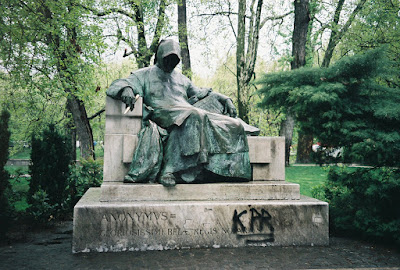
Dear Anonymous,Statue Of Anonymous, Taken by UkieVillain in Budapest, Hungary 5/11/2003

Expectation. Waiting.

Advent is about waiting. Waiting for Christ's birth. Waiting for Christ's return. Waiting for the reconciliation of the world to Christ to come, where justice will be experienced in fullness, and we will no longer deal with the horrors of this world.

As I was looking for audio of one of my favorite Christmas songs that I sang in choir in college, I came across this video. And it really does make me long--even hunger--for the return of Christ. So thank you for this reminder of what I'm waiting for, of what the Lord has done in preparation already, and of why I'm still waiting for salvation.

Lord, protect our lambs from the wolves that roam our world, seeking to devour.

TheUkieVillain
TheUkieVillain


WARNING: The following video is *extremely* graphic in its violence, and the first 1:20 is intentional black-out. (The following example is an anti-war statement but portrays the violent death and horror that accompanies it. Scroll down to hear and view a more traditional approach to caroling!)


This version has the full lyrics, sans violence.


Lyrics:


Riu, riu, chiu
La guarda ribera
Dios guarde el lobo
De nuestra cordera.

El lobo rabioso la quiso morder,
Mas Dios poderoso la supo defender;
Quisole hazer que no pudiesse pecar,
Ni aun original esta Virgen no tuviera.
Riu, riu, chiu...


Este qu'es nascido es el gran monarca,
Cristo patriarca de carne vestido;
Hanos redimido con se hazer chiquito,
Aunqu'era infinito, finito se hizera.
Riu, riu, chiu...


Muchas profecias lo han profetizado,
Y aun en nuestros dias lo hemos alcancado.
A Dios humanado vemos en el suelo
Y al hombre nel cielo porqu'er le quisiera.
Riu, riu, chiu...


Yo vi mil Garzones que andavan cantando,
Por aqui bolando, haciendo mil sones,
Diziendo a gascones Gloria sea en el cielo,
Y paz en el suelo qu'es Jesus nascieta.
Riu, riu, chiu...

Este viene a dar a los muertos vida
Y viene a reparar de todos la caida;
Es la luz del dia aqueste mocuelo;
Este es el cordero que San Juan dixera.
Riu, riu, chiu...


Pues que ya tenemos lo que desseamos,
Todos juntos vamos presentes llevemos;
Todos le daremos nuestra voluntad,
Pues a se igualar con el hombre viniera.
Riu, riu, chiu...


Riu, riu, chiu (nightingale's sounds)
The river bank protects it,
As God kept the wolf
from our lamb.

The rabid wolf tried to bite her,
But God Almighty knew how to defend her,
He wished to create her impervious to sin,
Nor was this maid to embody original sin.
Riu, riu, chiu...

The newborn child is the mightiest monarch,
Christ patriarchal invested with flesh.
He made himself small and so redeemed us:
He who was infinite became finite.
Riu, riu, chiu...

Many prophecies told of his coming,
And now in our days have we seen them fulfilled.
God became man, on earth we behold him,
And see man in heaven because he so willed.
Riu, riu, chiu...

A thousand singing herons I saw passing,
Flying overhead, sounding a thousand voices,
Exulting, "Glory be in the heavens, and peace on Earth, for Jesus has been born."
Riu, riu, chiu...

He comes to give life to the dead,
He comes to redeem the fall of man;
This child is the light of day,
He is the very lamb Saint John prophesied.
Riu, riu, chiu...

Now we have gotten what we were all desiring,
Go we together to bear him gifts:
Let each give his will to the God who was willing
To come down to Earth man's equal to be.
Riu, riu, chiu...**

*Villancico: A lyric form, often set to music, of Spain and Portugal during the 15th and 16th Century Renaissance.
**Another nice translation

Wednesday, June 18, 2008

Jujitsu for Christ

Dear Jack Butler,

Rothrock Café at the Lawson McGhee Library in Knoxville was a poor excuse for a place to sit. It didn’t even have proper vending machines. So I for one was ecstatic when the Friends of the Library decided to put the space to better use. Now, I invent excuses each day to escape my dungeon of an office and drop by the café-turned-used-book store to grab up the latest offcast by some donnish library friend.

So far I’ve snagged a few good ones, Hemingway’s For Whom the Bell Tolls, a nice volume of The Ya-Ya Sisterhood to send to one of my best friends of all time, Camus’ The Stranger, and even a copy of Zora Neale Hurston’s Their Eyes Were Watching God. But today, I smiled broadly when, on the Religious Books shelf I saw your book, slanted and gleaming between, Gigi, a bio about Billy Graham’s daughter, Gigi Graham Tchividjian (Say it three times fast!), and a pock-marked copy of something by Harold Kushner about overcoming disappointments.

It was Jujitsu for Christ. Though it, no doubt, has 200,000 leafs to its credit, this ’86 Penguin paperback was waxed and polished and in near mint condition, with the license plate, ISBN 0 14 01.0374 0.

At any rate, I, as a person born in January with snow boots on, was drawn to the cover of this particular model of Jujitsu that boasted a review from the revered New York Times that promised,

“Anyone who does not like this novel is probably a Brie-chewing Yankee sapsucker who wouldn’t know a lynch mob from a hootenanny.”
But Jack, I love Brie! And hootenanny? By the way another NY Times review, not featured on the cover has said:

"JUJITSU FOR CHRIST, by Jack Butler. This first novel is named after a fictitious studio opened in 1961 by a white martial arts instructor to teach physical and spiritual discipline to blacks in Jackson, Miss. In 1986, Martin Kirby said here that the book is 'an antiracist satire, served up with a lot of sex and some Swiftian scatology.'"

What does Swiftian scatology mean, really?

But, I do have to say, that your book adds to my understanding of the Southern landscape of a time when I was growing up in the Northern landscape and saw certain action only on newsreels, not believing, quite, that what I saw, was happening. I guess everyone back then was off kilter. The times, they, were a changing, and no one likes that.

Well, at any rate, you told me you were working on a new novel, set in other parts of the globe. I'll look forward to going there when it's ready for visitors.

Write!

Betsy

Tuesday, May 06, 2008

To Love or To Be Loved: Musings on The Great Gatsby

Dear Gatsby,

I finally read your book. And I was surprised, for though I had read a number of reviews, articles, etc., I was not prepared for your emotion, your love. I suppose that F. Scott Fitzgerald would lead us to believe that your love was more obsession than love. Poor Gatsby, yes, there was obsession, but obsession is also the dark way of unrequited love.

And your love led me to thinking about a question. "Is it better to love or to be loved?" Of course, one always hopes to have the beautiful combo, to both love and be loved in return, in equal measure. But that is a distant dream, and one that does not always come to pass. And often, even in great loves and wonderful relationships, the scales of love tip one way, and sometimes back and forth, but rarely do they balance steadily over time.

To be loved is like receiving a beautiful gift. It is like an equity, an account that can be drawn upon. How terrific is that? To be truly loved is to know that at any moment you have someone to lean on emotionally, financially, spiritually, socially, in sickness and in health. That is amazing capital. To be loved is, in some ways, to be free of loneliness. It is to have some center where you know your heart will always be welcome, like a home. To be loved is to have available the resources of some other heart, to have access to some other set of perspectives, to have someone whose eyes will never turn away, as yours, Gatsby, never strayed from the green light on the dock across the water. To be loved is to have in this world, two cubic cubits of space (Exodus 30) upon which there is a continual incense burning, raising you to God, seeking your good. (Now, two cubic cubits is not everything, but it is something.) And to continue this analogy, to be loved, is to have someone who would, if need be, once a year, provide the blood for your atonement, or as Jesus put it, would "lay down his life" for you. (John 15) That is what it is like to be loved.

And there is only one thing that is better. That is to love. For to love is to live on the very edge of the precipice of life. Loving another is very risky business. It is betting the entire wad on one horse. To love is to give full rein to another being, come what may. To love is not to gain access, but to give access. It is an extremely involved state of being. Loving is making provision, giving, praying, enjoying, grieving, and accepting. Loving is remaining open in the face of both the open and the closed of another. Loving is patience and kindness and seeing no evil. Loving precludes selfishness and anger and making the other person see your point of view. Loving sometimes has to be pretty invisible to actually be, truly, love. And loving remains even when being loved is gone, hoping and believing. In a way, loving carries a vital eternality that exists no where else, even in being loved.

Why, you may ask, Gatsby, is this better than being loved? I'm not sure why, but it is. It is. Perhaps your love might have been a more successful venture, if you had not demanded the return. If you had accepted the lot of the loving, without the lot of loved. Still, I did appreciate the love that you nurtured, and it was, perhaps, your only true thing.

Betsy

Friday, March 21, 2008

Maundy Thursday


created at TagCrowd.com

Dear Kind Jesus,

It's like any other Thursday, really, except for this, and these songs we sing, and the story we remember, and the sacred act we commemorate by stripping the altars of our lives and draping them with black.


O sacred head, sore wounded,
defiled and put to scorn;
O kingly head surrounded
with mocking crown of thorn: What sorrow mars thy grandeur?
Can death thy bloom deflower?
O countenance whose splendor
the hosts of heaven adore!

Thy beauty, long-desirèd,
hath vanished from our sight; thy power is all expirèd,
and quenched the light of light.
Ah me! for whom thou diest,
hide not so far thy grace:
show me, O Love most highest,
the brightness of thy face.

I pray thee, Jesus, own me,
me, Shepherd good, for thine; who to thy fold hast won me,
and fed with truth divine.
Me guilty, me refuse not,
incline thy face to me,
this comfort that I lose not,
on earth to comfort thee.

In thy most bitter passion
my heart to share doth cry,
with thee for my salvation
upon the cross to die.
Ah, keep my heart thus moved
to stand thy cross beneath,
to mourn thee, well-beloved,
yet thank thee for thy death.

My days are few, O fail not,
with thine immortal power,
to hold me that I quail not
in death's most fearful hour;
that I may fight befriended,
and see in my last strife
to me thine arms extended
upon the cross of life.

Text: Robert Bridges, 1899
Music: Passion Chorale (Herzlich thut mich verlangen), St. Christopher


Ah, holy Jesus, how hast thou offended,
that we to judge thee have in hate pretended?
By foes derided, by thine own rejected,
O most afflicted!

Who was the guilty? Who brought this upon thee?
Alas, my treason, Jesus, hath undone thee!
'Twas I, Lord Jesus, I it was denied thee;
I crucified thee.

Lo, the Good Shepherd for the sheep is offered;
the slave hath sinned, and the Son hath suffered.
For our atonement, while we nothing heeded,
God interceded.

For me, kind Jesus, was thy incarnation,
thy mortal sorrow, and thy life's oblation;
thy death of anguish and thy bitter passion,
for my salvation.

Therefore, kind Jesus, since I cannot pay thee,
I do adore thee, and will ever pray thee,
think on thy pity and thy love unswerving,
not my deserving.

Text: Johann Heermann, 1585-1647; trans. by Robert S. Bridges, 1844-1930
Music: Johann Cruger, 1598-1662
Tune: HERZLIEBSTER JESU


Thanks,

Just me

Tuesday, January 01, 2008

Socrates to Caesar, Then Your Light Came

Note to readers: The following is a thought poem that my sister wrote during this holiday season. I was fascinated by how her thoughts dovetailed so closely with my own, published here, during the advent season.

Dear Deb,

Thanks for sharing these thoughts with me. It is interesting that there continues such a synchronicity in our thinking over the miles, the years, and the experience. Having friends is most wonderful; we are agreed on that I know. Having a sister is amazing!

With my love,

Betsy

Thoughts arising from thinking about the darkness during the intertestamental period and awaiting the Light.

How long ago it was said that the "sun of righteousness will rise with healing in its wings", yet it is still dark.(Malachi 4:2) And so we continue to light our candles behind dark veils not knowing where the Light will come from. One to six we light and chant brave words of freedom, freedom from our captors. And yet one we light and secretly breath words of hope. Hope in the truth of what the ancient prophet Isaiah spoke. Hope of one who would come, and in His very person offer freedom of soul, freedom from the darkness that has invaded our souls and sickened us. The One through Whose wounds we can be healed, the One who would take our infirmities, carry our sorrows and deal with our transgressions. (Isaiah 53:4,5)

And yet we have waited so long, and the poor light of our candle flickers. Long ages ago the prophets voices were stilled by those who preferred their darkness. We seem to wander alone in the dim light of our candles waiting, hoping and fighting our battles against those stronger than we. And always comes the temptation to wonder, do we wait in vain, will the light always be dim, will our sight always be veiled and our way be confused by the darkness.

"Therefore the night will come over you, without visions, and darkness, without divination. The sun will set for the prophets, and the day will go dark for them. The seers will be ashamed and the diviners disgraced. They will cover their faces because there is no answer from God." (Micah 3:6,7)

One night on a hillside all was dark. The shadows were deep and through the increasing darkness the sheep could barely be seen. Then suddenly, without warning, without thoughts or actions being prepared, came The Light shining with greater intensity than could be imagined. Prophet Isaiah's "Light" had come, the glory of the Lord rose upon us. (Isaiah 60:1) The curtain of darkness was torn and we were invited to that Light, that Light that is the Light of men, the One that would shine in the darkness and but the darkness would not understand it. (John 1:4,5)

And so the Light shone with an intensity that certainly was not understood. Once again men tried to put the light out, but they could not. From the darkness on another hill the Light shone cutting through that darkness, ripping it apart. Three days later its kingdom was broken apart and its power to hold us was destroyed. Then something happened that had never happened before, something that the prophets spoke of , but we little understood, and still we little understand. Yet we have partaken of it, that Light, which freed us from the power of the darkness, entered us. The Light took up residence within our spirits. Everything was different , no longer were we alone.

Marching down long ages that Light shines. Through our frail frames the Light shines on, continuing to bring freedom from the darkness that tries, without hope, to quench Him. And we still wait, and sometimes the Light seems dim, and sometimes bright. But now our waiting has a sense of expectancy, because the promises that once were kept continue to ring in our hearts, He came and is coming again! One day we shall look up and the Light will blind our eyes, but our hearts will cry "Come Lord Jesus." We shall see His face, the shining light of the Son.

--Debby Rupe

Tuesday, December 25, 2007

Christmas

Dear John Rutter,

Last night we sat in church as it became Christmas. And our little church choir, which is really quite dedicated and good, sang your Candlelight Carol. It was lovely and I wanted to tell you so.

How do you capture
The wind on the water?
How do you count all the stars in the sky?
How can you measure
The love of a mother
Or how can you write down
A baby’s first cry?

Candlelight, angel-light
Firelight and star glow
Shine on his cradle till breaking of dawn
Gloria, Gloria in excelsis Deo!
Angels are singing
The Christ child is born.

Shepherds and wise men
Will kneel and adore him
Seraphim round him their vigil will keep
Nations proclaim him
Their Lord and their Saviour
But Mary will hold him
And sing him to sleep.

Find him at Bethlehem laid in a manger
Christ our Redeemer asleep in the hay
Godhead incarnate and hope of salvation
A child with his mother
That first Christmas Day.


--John Rutter


And as I sat listening in a little church in Loudon, TN, people all over the world like these singers in London, England, singing your carol in Chinese, were celebrating light and life through the birth of Jesus and what we can see because of the light he brought.

"In Him was life, and that life was the light of humanity. The light shines in the darkness but the darkness has not comprehended it. . . The true light that gives light to everyone has come into the world." John 1.

Merry Christmas
BRD

Sunday, December 23, 2007

Fourth Sunday of Advent

Dear Jesus,

On the First Sunday of Advent we heard these words read in church;
"With each new candle that is lighted, may the flame of Christ's coming grow brighter and brighter so that this Christmas may see a fresh coming of the Lord of Light into each of our hearts and into the whole world."

The Fourth Sunday of Advent we emerge from our awed and horrible silence and begin the celebration. Twelve days of celebration. On Sunday, or maybe we'll wait until Christmas Eve, we light the Christ Candle. The light of the candle at the front of a church in the morning is barely visible.

T.S. Eliot expresses an idea, though. . . and my dark self hears it before I'm swept into the light of Christmas Day. . . we need darkness to reveal the light. If we are to study, not the things that light exposes but the light itself, it must be dark.

Dark reveals the light.

In Eliot's Murder in the Cathedral he puts these words in the voices of a chorus in the last scene while a Te Deum is being sung in the background.

"We praise Thee, O God, for Thy glory displayed in all the creatures of the earth, . . . For all things exist only as seen by Thee, only as known by Thee, all things exist Only in Thy light, and Thy glory is declared even in that which denies Thee; the darkness declares the glory of light."

(For you lovers of Eliot, I know there are many other passages of this flavor that I could quote, but this is the one I found most quickly. Survey: What is your favorite light/dark quote from Eliot?)

Eliot poses a hard idea. It is hard for us scrubbers and sweepers of Canterbury, and Morgantown, and Knoxville, and Chicago, and Cut Off, and Oneonta, whose backs are bent by toil and whose knees are bent under sin, whose hands are to the face under fear. We live in a glow-starved world and we long for the dawn. It is hard to embrace the darkness that you have given us as our gift at Christmas, topped with only a tiny flame of light.


Star of the East, oh Bethlehem star,
Guiding us on to heaven afar
Sorrow and grief and lull'd by the light
Thou hope of each mortal, in death's lonely night

Fearless and tranquil, we look up to Thee
Knowing thou beam'st through eternity
Help us to follow where Thou still dost guide
Pilgrims of earth so wise

Star of the East, thou hope of the soul
While round us here the dark billows roll
Lead us from sin to glory afar
Thou star of the East, thou sweet Bethlehem's star

Star of the East, oh Bethlehem's star,
What tho' the storms of grief gather loud
Faithful and pure thy rays beam to save
And bright o'er the grave

Smile of a Saviour are mirror'd in Thee
Glimpses of Heav'n in thy light we see
Guide us still onward to that blessed shore
After earth toil is o'er

Star of the East, thou hope of the soul
Oh star that leads to God above
Whose rays are peace and joy and love
Watch o'er us still till life hath ceased
Beam on, bright star, sweet Bethlehem star


This is a song that is another of my strong Christmas memories. My mother practiced it once a year, at Christmas, picking out chords and melodies that slightly exceeded her normal-level piano-playing capabilities. And she sang it with whoever would join her in front of the cherry spinet. It is a song that echoes the understandings of Eliot.

"Forgive us, O Lord, we acknowledge ourselves as type of the common person, Of the men and women who shut the door and sit by the fire; Who fear the blessing of God, the loneliness of the night of God, the surrender required, the deprivation inflicted; Who fear the injustice of men less than the justice of God; Who fear the hand at the window, the fire in the thatch, the fist in the tavern, the push into the canal, Less than we fear the love of God. Christ, have mercy upon us."
So, this last Sunday, before the celebration begins, I'm reminded by you and Eliot, and Stanislaus de Lubienietski-1666 artist of the comet, and the unknown composer of an old carol of the darkness that reveals the light. Jesus, have mercy.

Betsy

Saturday, December 15, 2007

Part II--The Third Sunday of Advent--Night Visitors

Dear Gustav Dore, T.S. Eliot, and Gian Carlo Mennotti,

Our imaginations are set in our child's hood by this and that. Christmas, the premier Christian holiday holds much in my mind that is set already by what Dicken's would call Christmas Past. For me that "set" includes a Swedish Lodge, a house and Christmas Eve on 13th St., Rye Bread and Egg Salad. . .

It also includes my grandmother playing an old upright piano and singing carols, including one of my personal favorites, "We Three Kings." I liked that one, maybe because it was more like a ditty than a hymn, transferable in a moment to a ridiculous picture of men with crowns smoking rubber cigars. But it includes more serious settings too.

Gustav, your image is magical, depicting not a lonely troop of three, but a traveling carnival with not three camels, but a cavalry of them. This magic is part of my memory too.


Journey of the Magi
by T.S. Eliot

"A cold coming we had of it,
Just the worst time of the year
For a journey, and such a long journey:
The was deep and the weather sharp,
The very dead of winter."
And the camels galled, sore-footed, refractory,
Lying down in the melting snow.
There were times we regretted
The summer palaces on slopes, the terraces,
And the silken girls bringing sherbet.
Then the camel men cursing and grumbling
And running away, and wanting their liquor and women,
And the night-fires gong out, and the lack of shelters,
And the cities hostile and the towns unfriendly
And the villages dirty, and charging high prices.:
A hard time we had of it.
At the end we preferred to travel all night,
Sleeping in snatches,
With the voices singing in our ears, saying
That this was all folly.

Then at dawn we came down to a temperate valley,
Wet, below the snow line, smelling of vegetation;
With a running stream and a water-mill beating the darkness,
And three trees on the low sky,
And an old white horse galloped away in the meadow.
Then we came to a tavern with vine-leaves over the lintel,
Six hands at an open door dicing for pieces of silver,
And feet kicking the empty wine-skins.
But there was no information, and so we continued
And arrived at evening, not a moment too soon
Finding the place; it was (you may say) satisfactory.

All this was a long time ago, I remember,
And I would do it again, but set down
This set down
This: were we lead all that way for
Birth or Death? There was a Birth, certainly,
We had evidence and no doubt. I have seen birth and death,
But had thought they were different; this Birth was
Hard and bitter agony for us, like Death, our death.
We returned to our places, these Kingdoms,
But no longer at ease here, in the old dispensation,
With an alien people clutching their gods.
I should be glad of another death.


Eliot, your Magi are more like the ones I remember from my first experience of opera. I watched Gian Carlo's classic presentation of Amahl and the Night Visitors on television. I must have seen it around 1955 on a black and white tv with a screen not bigger than a small computer monitor. The enchantment of the story, the singing, and the three kings set my musical ear for a love of opera. Though the clip pictured below (click here) doesn't include the kings, but only Amahl and his mother, it does demonstrate some of the magic of that performance and what for me is a precious and early Christmas remembrance.


Thanks for all these memories.

BRD

Wednesday, December 05, 2007

Second Sunday of Advent

Dear King Wenceslaus,

When is it that a hush falls over the crowd?
In anticipation?

In awe and respect?

In loving recognition that silence is better than noise?

In horror?

Christian liturgy that tells us that in advent it is a time for quiet and waiting. We light candles one by one and the flickering glow should speak for us. We are in joyful anticipation of the Coming. O Come, O Come, Emanuel. And we, in our most childish of spirits, anticipate Christmas and all it's wondrous surprises and kindnesses which spring from the spirit you so beautifully demonstrated in your actions there in Bohemia in the early 900's on the feast of Stephen.

And the incarnation is awe inspiring. Uneducated shepherds, watching their flocks by night knew that much. But does it take a choir of the heavenly host to make us mum, or does the idea alone, that God, the ultimate instigator of existing, would assume human bodily form and could be found on earth in the most primitive of neonatal units, a manger. That should shut us up.

And does the love shown forth in the coming of the progeny of God, who so loved this world full of pitiful creatures that he extended a channel by which our offerings of belief might become eternal, bring us to rightful silence? Does it take the very need for words away? I think so.

Horror, yes, and there is horror hidden in the quiet of advent and horror is part and parcel of all that Christianity is. The horror is at our own inadequacy, sometimes called sin. But, we call it horrible and it leaves us dumbstruck whenever we see it under our own skins. This is perhaps the greatest of the reasons that we wait in quiet for Christmas. This is when the ice of our own goodnesses breaks under the weight of our own lack of pity. We are left shivering in icy horror hoping to find someone whose warm footprints can lead us home.

I think it is horror more than anthing that drives us back to the silent night, that holy night when shepherds and angels and tongue-tied folk like you and me shshed ourselves so the little Lord Jesus could sleep.

May Your Days of Quiet be Blessed,

Betsy

Monday, October 01, 2007

Read Your Bible, Pray Every Day

Dear Son,

Quite a while ago I promised to give you a list of the ten most important things that you should do in your first year of freedom. What is important to do? What is important to know?

I have thought about that for a while and hardly know where to start. I have several unfinished postings that talk about different things, literature, music, justice. But yesterday during the church service that I was attending, I realized where I should begin. You will, perhaps find this to be a repeat of what you have heard over the years, what you have heard from your grandmother. It is, however, the number one thing I have to suggest of all the things I might say.

Let me start with the "New Testament reading of the day" from the 17th Sunday after Pentecost.

1Tim 6:6 (NRSV) Of course, there is great gain in godliness combined with contentment;

7 for we brought nothing into the world, so that we can take nothing out of it;

8 but if we have food and clothing, we will be content with these.

9 But those who want to be rich fall into temptation and are trapped by many senseless and harmful desires that plunge people into ruin and destruction.

10 For the love of money is a root of all kinds of evil, and in their eagerness to be rich some have wandered away from the faith and pierced themselves with many pains.

11 But as for you, man of God, shun all this; pursue righteousness, godliness, faith, love, endurance, gentleness.

12 Fight the good fight of the faith; take hold of the eternal life, to which you were called and for which you made the good confession in the presence of many witnesses.

13 In the presence of God, who gives life to all things, and of Christ Jesus, who in his testimony before Pon'tius Pilate made the good confession, I charge you

14 to keep the commandment without spot or blame until the manifestation of our Lord Jesus Christ,

15 which he will bring about at the right time--he who is the blessed and only Sovereign, the King of kings and Lord of lords.

16 It is he alone who has immortality and dwells in unapproachable light, whom no one has ever seen or can see; to him be honor and eternal dominion. Amen.

17 As for those who in the present age are rich, command them not to be haughty, or to set their hopes on the uncertainty of riches, but rather on God who richly provides us with everything for our enjoyment.

18 They are to do good, to be rich in good works, generous, and ready to share,

19 thus storing up for themselves the treasure of a good foundation for the future, so that they may take hold of the life that really is life.

It was that last phrase, "Life that really is life," that most captured my imagination. Where in our world do we find much active talk about finding life that really is life. Where do we hear teaching about the importance of doing good over the importance of getting rich. All about us from billboards to movies, from sitcoms to malls, from the internet to ball field scoreboards, hucksters are telling us what to buy, what material goods to want, what gusto to grab. Few are the messages that we receive that say, stop. Riches and goods are not the summum bonum.

However, you will find that as regular fare in the Bible. Your palette is whetted with words like, "Be ye kind, one to another."
"I have learned, in whatsoever state I am, therewith to be content."

"Real joy."

"Let him who glories, glory in this, that he understands and knows me, that I am the LORD who practice kindness, justice, and righteousness in the earth."

So #1 on my list of ten things to do this year echos the old children's song, "Read your Bible, pray every day, and you'll grow, grow, grow." You won't grow into some predetermined ideal. You'll grow into you, and the you who is conscious of the life that can be lived above or beyond the surface of a society carefully constructed with Madison Avenue paper mache and glitter. You won't find the answers to every question that will arise in the course of living, but you will find direction and hope and good.

Invest in this discipline.


MOM aka brd
XOX

Wednesday, September 05, 2007

The Tenth Year


Dear Mother Teresa,

I miss you today, ten years after you slipped the surly bonds of earth. But it was more than ten years ago when I stood by a pond and cried, grieving your passing a year or two before you actually did. You had suffered a heart attack that day, from which you recovered. Yet that was when I knew it would not be long until you would be with us no more. And then I cried.


The lines of your pen were as jagged as the lines on your face. And I love both. And the words you wrote and your dear face were beautiful, always.

Here are some more of your words:

Being unwanted, unloved, uncared for, forgotten by everybody, I think
that is a much greater hunger, a much greater poverty than the person
who has nothing to eat.


Each one of them is Jesus in disguise.


Do not think that love, in order to be genuine, has to be extraordinary.
What we need is to love without getting tired.


Keep the joy of loving God in your heart and share this joy with all you meet especially your family.

A sacrifice to be real must cost, must hurt, must empty ourselves. The fruit of silence is prayer, the fruit of prayer is faith, the fruit of faith is love, the fruit of love is service, the fruit of service is peace.

You and I, we are the Church, no? We have to share with our people. Suffering today is because people are hoarding, not giving, not sharing. Jesus made it very clear. Whatever you do to the least of my brethren, you do it to me. Give a glass of water, you give it to me. Receive a little child, you receive me.

It is not how much we do, but how much love we put in the doing.
It is not how much we give, but how much love we put in the giving.


Yesterday is gone.
Tomorrow has not yet come.
We have only today.
Let us begin.


Yes, your words are beautiful, your life was beautiful, your face was beautiful. Oh, how I wish, I looked like you.

Missing you still,

Betsy

Sunday, March 11, 2007

What is The Tao, The Summum Bonum, or The Good?

Dear Clive Staples Lewis,

I didn’t cut my teeth on the tales of Narnia. My first visit was shortly before my own children met the lion, sailed with Caspian, and found themselves faced with the great dilemma of whether to set free the crazy man in the Silver Chair who called upon the name of Aslan.

I do dearly love those stories with the lion that is unashamedly dangerous. I love the talking animals and I love the children who are imperfectly courageous and kind but who have an unremitting sense that something important is going on. I love the Tertullian Spirit that the little Narnian visitors come to see, that “staying alive” is not the Sunum Bonum. They are faced with that ethical question that is so much our own, if not as obvious, “Must we live?” and answer in the negative.

You were a person of your time, and I won’t, here, discuss your mistaken conceptions about women and your female characters, though I may take them up sometime soon in an essay I have in my head entitled, “Why Did Lewis and Faulkner Discount Women?” Is that a little strong? Perhaps, for though you didn’t send Lucy or Susan to battle, you developed them as complete people and not as fools, true heroes of the story whose wisdom and intuition, and ACTION was every bit as integral to the salvation of Narnia as the sword play of the boys.

But I digress, for I am not reading the Narnia series right now. I am reading The Abolition of Man. I am intrigued by the Appendix entitled Illustrations of the Tao. In the book you defined the Tao as “a norm to which the teachers themselves were subject and from which they claimed no liberty to depart.” We post-moderns are struggling with this issue. Not just, what is this Tao, but does it exist?

I explored this subject a little in the early days of my blog in a survey entitled “What is a Characteristic of a Good Person.” It was more than a blog entry, for I had spent a number of months asking that question to many people in my life, from my mother to a waitress in Washington D.C. One of the interesting things about this experience was that most people did have an answer and the answers that I received did fall, to a great degree, within the parameters that are listed in your Appendix on the Tao. I have another interesting factoid about my blog survey, which I have discovered since I applied an analytic to my blog.

I get hits from all over the place. I’m fascinated that people from Caloocan to Wheaton to Calgary come to visit. The one blog entry that is hit regularly from everywhere, week after week, is that entry about the characteristics of a good person. How fascinating, that in a world of sex, violence, and war, people remain curious about goodness. I too am curious. I want to know goodness. I want to be good, in fact, in the face of both evil and my own tendency toward evil.

You say, (A of M, pg. 73), “We have been trying, like Lear, to have it both ways: to lay down our human prerogative and yet at the same time to retain it. It is impossible. Either we are rational spirit obliged for ever to obey the absolute values of the Tao, or else we are mere nature to be kneaded and cut into new shapes for the pleasures of masters who must, by hypothesis, have no motive but their own ‘natural’ impulses. Only the Tao provides a common human law of action which can over-arch rulers and ruled alike. A dogmatic belief in objective value is necessary to the very idea of a rule which is not tyranny or an obedience which is not slavery.”

I remember a middle school history lesson on the importance of the Magna Carta. It was Ms. Ford who I remember, tiny in stature and generally rapid in her movements, stepping to a green chalk board, picking up a piece of chalk neatly poised in an aluminum holder, writing, The Magna Carta, and then briskly returning to the front of the desk, leaning back and looking at us intently. Ms. Ford was more precise than handsome Mr. D’Elia who taught English and wrote on a black board with dusty stubs of chalk, wrote, turned, licked his fingers, and asked our class to write articles for the school newspaper. Ms. Ford’s classes never got as far as World War II. Perhaps, she deliberately avoided reaching that point in more modern history, for she could not imagine teaching about the horrors of the holocaust and a world gone mad. But, oh, she could teach the Magna Carta.

Does Ms. Ford still teach the Tao of the Magna Carta, or has she been replaced by someone younger who aptly grapples with the ideas of Nietzsche and Wittgenstein.

And what would Tertullian say about a philosophy that teaches that there is no Tao, only (what would Nietzsche call it) custom? Is there no longer, and was there never, anything to die for? When, Tertullian called out, “must we live?” should the answer have been, “Yes, for there is nothing greater, nothing holier than life itself, your own life, selfishly hoarded and protected and with nothing else to grant it higher meaning.”

I'm not a philosopher, and I'm not sure that I understand either Nietzsche or Wittgenstein. I think I could confidently say that Wittgenstein would say that all this talk about Tao, and Good, and Ethics is just simile without reference, hence nonsense. He would say, "I must admit it is nonsense to say that they have absolute value." However, even Wittgenstein, ends where many of us without such philosophic wit, more simply begin, that we have "a tendency in the human mind which[we] personally cannot help respecting deeply and [we] would not for [our lives] ridicule it." (Last sentence of 1929 Lecture on Ethics.)

So C.S. I lean toward your thinking here and toward the advice of Puddleglum from The Silver Chair, who said, "Suppose we have only dreamed, or made up, all of those things--trees and grass and sun and moon and stars and Aslan himself. Suppose we have. Then all I can say is that, in that case, the made-up things seem a good deal more important than the real ones." I wonder what other people think?

Betsy DeGeorge

Thursday, March 01, 2007

Ash Wednesday by AnneGG

Dear AnneGG,

Thanks for letting me post this. I am awed by this work.

BRD

Ash Wednesday

Yesterday was Fat Tuesday. At work this afternoon, we all sat around eating leftover fastnachts instead of fasting. “Hey, how come lent is forty days long?” “I think because Jesus fasted forty days in the desert.” We Protestants aren’t big into lent. Fastnachts are like jelly doughnuts with no jelly, just thick clumps of dough deep fried in animal fat. You shall present as an offering by fire to the Lord the fat that covers the entrails . . . I’m thinking of giving up jelly doughnuts for lent.

If you are offering a goat, you shall bring it before the Lord and lay your hand on its head; it shall be slaughtered in the tent of meeting. While Alicia and I were walking today, we saw a dead deer beside the train tracks. At first we couldn’t tell what it was; the flesh was rotted away, leaving only hide and bone, and we could peer into its lungless ribcage. Alicia waited patiently with her back turned as I stared, both repelled and transfixed by the dead carcass. I went a step closer, sniffing the air on purpose for the rancid odor of decay. From dust you came, and to dust you shall return. As we walked back along the tracks, we saw some of its fur lying in clumps, and somebody’s old shoe, and a pair of railroad spikes. Alicia picked up the spikes and commented dryly that she didn’t like how the Old Testament had so many commandments that required slaughtering things. I nodded. I’m thinking of giving up meat for lent.

In fact, maybe I’ll start eating fish every Friday. If I were Catholic, I would attend mass today. I would kneel with the other contrite congregants at the altar, in the dim, smoky light filtering in through stained glass windows, the sickly-sweet odor of incense burning in my nostrils. A priest would daub a cross of ash onto my forehead and pronounce sacred words in muttered Latin: “From dust you came, and to dust you shall return.” On the same walk, Alicia and I discovered a dead skunk, not yet really rotting, but lying stiff on its back. Its legs stuck straight up into the air, and blood trickled from its mouth. For without the shedding of blood there can be no remission of sins. I wonder if animals go to hell.

Like Jesus in the Apostles’ Creed, “He descended into hell.” Hell, the burning lake of fire. Hell, separation from God. Hell, eternal death. Their place will be in the lake that burns with fire and sulfur . . . I’m thinking about giving up hell for lent. Hell is separation -- Ben and I are not on speaking terms these days. His last message is still saved on my answering machine, from the day before we ended it all: “I’m trying. But things always get so hard with us. If you want to play football, we’re meeting at four.” Too close, never close enough – isn’t that the human condition? This is the second death. I’m thinking of giving up breathing for lent.

“Hey, how come lent is forty days long?” “It used to be only a week, just the week of the Passion.” The red, saturated ribcage of a deer. A goat. A lamb. You shall bring it before the Lord, and it shall be slaughtered in the tent of meeting. For God so loved the world that He gave His one and only Son . . . Alicia says when she hears the train’s whistle, she knows it is God saying, “I love you.” I wonder if, when the train made contact, that deer had the same thought as Jesus had when God turned his eyes away from the bloody suffering: “Eloi, Eloi, lema sabachthani?” Death is separation.

Every time they gather together, Catholics participate in the Eucharist. This is my body, broken for you. When the congregation takes the bread and wine, they say that it actually becomes the blood and body of Christ, and Christ becomes part of the participant. Part of their sinews and bones and connective tissue. Part of the force that sustains their life. This is my blood, poured out for the remission of sins. We Protestants don’t believe in transubstantiation. Anne Lamott writes about strewing her best friend’s ashes over the water near the Golden Gate Bridge, about how the ashes stuck to her clothes and hair and fingers. “I licked my friend’s ashes off my hand, to taste them, to taste her, to taste what was left after all that was clean and alive had been consumed.” Anne Lamott must be Catholic.

During lent, a participant may either forgo something or take something up. (Jesus, for example, took up a cross and a pair of railroad spikes.) I’m thinking of taking up transubstantiation. For even we Protestants crave that kind of union with other people, with God. Too close, never close enough – Isn’t that the human condition? And if death is separation, then life is union. During his darkest days, Ben used to pick pieces of my long hair off of my clothes and eat them. “The closest to heaven I’ll ever be,” he’d say. But really he was just trying to thwart death.
O Jesus, you place on my forehead the sign of my sister Death: “Remember you are dust, and to dust you shall return.” God help me, Ben, I miss you so much I can hardly breathe. I miss your smell, tiny particles of you snuffed into my body through my nostrils, becoming part of me just like the rotting stench of the deer. Like the Eucharist on Ash Wednesday, the body and blood, “that whosoever believeth in Him shall not perish.”

Later, Alicia and I saw from a distance a pair of live deer, frolicking in the woods. “They look happy,” Alicia said. I nodded. I’m thinking of taking up immortality for lent.

Copyright 2001 Deborah Harbin All Rights Reserved

Sunday, February 25, 2007

Ash to Ash Wednesday

Dear Anne GG,

I am remembering, this week, that powerful article you wrote, entitled Ash Wednesday. May I post a link to that? (She said "Yes.") I am remembering because it was, last Wednesday, Ash Wednesday.

Growing up Baptist, and even more than that, growing up in the “fundamentalist” tradition, Ash Wednesday lacked symbolic meaning to me. Lent lacked meaning. It fell into the black hole, no, under the skirts of the great whore of the Apocalypse, that we were taught to avoid at all costs. So, it wasn’t until a few years ago and a number of life shapeshifts from then, when I began participating in services at an Episcopal church that I engaged with the idea of Ash Wednesday.

Why indeed should we, every year, forty days (plus Sundays*), before the first Sunday after the full moon that occurs next after the vernal equinox, take on the sign of mourning?

“Ash to ash, dust to dust”, they say, and with two flicks of a thumb the mark of death attaches itself to our foreheads. And we are on our knees saying, “Yes.”

We have taken on a sign of mourning. We are engaging symbolically with our mortality and the mortality that God in Jesus took upon himself.

Now, as my obsession with requiems might signal, I am not one to miss the fact that one day I will die. I fret about it, I embrace it. I am not one who is confused that perhaps I am the one person in the universe who will achieve immortality. So Ash Wednesday fits my personality. I get it. It is time to mourn. It is time to fast, for the Savior of the universe is about to die, and not only that, my own sin, which I engage in actively and deliberately, implicates me in the Lord’s demise.

God knows how we are formed,
Remembering that we are dust.
All flesh is as grass,
Flourishing like a dandelion in the field;
And when the wind picks up and blows over,
It is gone.
And even the dirt that gave birth to it,
Remembers it no more.

You betcha I mourn.
And I’ll fast and pray, hoping for light and life in forty days.

May your month be full of meaning,

BRD aka MOM

*Note: Something I learned from my priest and friend, SuZanne, is that you don’t mourn on Sunday. That day the symbol of resurrection takes precedence over the symbol of mourning.

Saturday, December 30, 2006

The Advent: Nativity by Gustav Doré


Dear David,

Thank you for this nativity scene. It is one of my favorite illustrations from one of my favorite acquisitions of this year, i.e. The Dover production of The Doré Bible Illustrations, the 241 electrotype woodcut plates from La Sainte Bible of 1865. Once again we can thank the French for something of remarkable beauty and memorable magnitude.

And I thank you for finding this wonderful volume for me in the dusty piles of Betty’s Antique Store in Lenoir City (pronounced not as in the French tradition, but as the first half of the way George Strait might call one or the other of two roadies standing, smoking, behind the Yamaha mixer, ”Len or Billy Bob, get that Guild for me, will ya?”) Betty’s is closed now. I’m not sure what happened, no giant sale like the Brown Squirrel runs every couple of months, "Last Chance before Closing!" But she is really out of business, empty windows, empty floor, nothing but the sign to remind us of the treasures that once were available behind the chipped china display around the corner from the pile of old Saturday Evening Posts.

But back to the subject. The wonder of the Doré book for me (and for folks of my age category) is, as stated in the intro to it. “There can be little doubt that these engravings . . . have fixed the iconography of Bible in our minds.” I would say, “my age and tradition” but you are not of my religious tradition, and you recognized it’s classic import right away. The pictures in this black and white volume take me to the remembrances of the stories of the Bible, The Brazen Serpent, David and Goliath (replete with gory decapitation), Daniel in the Den of Lions, Jesus and the Woman Taken in Adultery, Jesus and the Disciples Going to Emmaus, various images of the Crucifixion, and of course this one, The Nativity. I’d say even younger folks have been impacted by the works of this masterpiece from 1865, (Can any good thing come out of the 1860’s?) because so much of the biblically-related artistic imagination of the 20th century found its roots here in the pages of the Doré Bible.

Back to this image of the advent--It is such a nice one. Men and women who are quite authentic in their response to a baby, haloing around the Christ child. Is Joseph napping? The animals are precious too. The little one reminds me of the lamb we had once, Baa-aa-b. You didn’t know us then, but Cate will doubtless remember.

Well, in all my thinking about advent this year, I have enjoyed considering it in light of this image best of all. And I have this image thanks to you. We will have to go antiquing again real soon!!!
May your holiday be wonderful. Hope to see you soon.

Betsy