Showing posts with label Ethics. Show all posts

Friday, August 11, 2006

Scent of a Truth

Dearest Son,

I have been thinking about our last conversation. We, I think, did achieve a level of interaction that is not always attained. I wish we had more time together for such talks without interruption. But even our phones provided interruption for us, now that I think about it. We would say something wholly profound, there would be a pregnant pause, then a tin-man’s voice with news of the disconnection, or worse than that, a period of being unsure and the hopeful but prescient “can you hear me now?”

What is truth and how can we know it? You could study for a degree in philosophy, but I fear that is not how you will find an answer to this question. You will find more good questions and perspectives if you want to do that, but not an answer. For this answer, you do not study; you stalk.

When your grandparents were much younger (I was in third grade), they decided to leave the Lutheran church that they attended. In those days, or should I say, in their lives, leaving this church was like leaving home. They had attended that church since their infancy. Their parents, both sets, were part of that church, brother, friends, aunts, friends of parents. They had sung in the choir, participated in the services, taught Sunday school, led in vacation Bible school. They were respected there, for Pete’s sake. But now, in their soulish stalking, they felt they should leave that church and find a different one.


I don’t remember all the machinations. I do remember the day the trigger was pulled, though even that is vague. A visiting minister came to the pulpit of the church in this conservative old town. He, probably a recent graduate of some forward-looking seminary, was armed with a sermon whose punch line was, “God is a grunt.” I do remember that, not from hearing him say it, but from my parents’ reactions and discussions afterward, for hours, in the foyer of the fellowship hall, not with this visiting wraith, who, I am sure was whisked away for dinner at Taylor’s Restaurant, but with one friend and then another who could not, or could, understand my parents’ sense of the “last straw” in regard to this sermon, and a church that seemed to be slipping away from “sound moorings.”

Little did my parents know, that the young minister was probably not being heretical. I doubt that he was trying to communicate any Nietzchesque thoughts about the non-existence or deadness of God, but was more likely trying to suggest the fallibility of human understanding and our inability to see spiritual truths in any way but obliquely. He may have been trying to point out that language, our greatest human invention, is flawed, and little more than a series of grunts and clicks designed to put outward form, however, inadequate, to our inner lives.

Nonetheless, my parents did leave that church in the heat and ardor of their spiritual pursuit.

When I was in college, studying social work, I had my first experience with a teacher who designed his courses in such a way that everything related to process rather than conclusion. I was adrift. I could not figure this out, quick as I was to excel at learning in a rote and prescribed manner. This was a new thing and I was not ready. “What is the answer?” I wanted to know.

I’m still like that I suppose, and I’m like my mother enough to get angry in the face of those issues that, to me, are the lines in the sand that I will not step over.

But let’s get back to your hunt, for you too, want to know, want to find. I cannot tell you where to find your prey, or how exactly to do it. I will tell you how I began and that you must be ready for this search to be a process, not one with the answers laid out before you. Truth is elusive, not because of the inadequacy of truth, I think, but because of the limitation of the human being and mind. Of course there are truths that are less elusive. 2+2=4 appears to be fairly solid. Falling bodies accelerate at 32 ft per sec/per sec until they reach maximum velocity of about 135 miles per hour for a human body (hopefully equipped with parachute and rip cord to bring that speed down to 12 miles per hour prior to impact.)

But the truths we are talking about. Those that intersect with the spiritual realm are quite vaporous at times. I say vaporous, not non-existent. So you start, where you can start. You go into the woods. And here is how you do that. You set up the presuppositions. You say, “if God exists, then. . .” Later, you say, “if God does not exist, then. . .” As you study the conclusions you match them with your actual observations of the world. Is the world, as you know it more like the world you would expect if there were a God, than if there were not a God?

You know already what I have concluded, generally, as a result of this exercise in my life. But you must pursue these thoughts for yourself, not in a vacuum but as honestly as possible. Not in a vacuum, because you do have many good resources at your disposal. I recommend seeking out the advice of good people. What kind of people are good people? Well, I happen to have a survey available for you to consider if you need to identify their characteristics.

I was listening to an interview with Toni Morrison the other day. On the subject of good and evil she said, “Being good is more complicated an idea than being or doing evil. Evil gets more play, but evil is a sham, screaming like a petulant child.” That is one of the kinds of clues you look for in the course of your search. Look for patterns related to good and truth. Don’t just look to smart people. Smart is a grunt. Look for people who say stupid things but who know how to do good. That is a track. Look for love and lovers and people who can love without reward. That is a fingerprint. Look for that which is not power driven or materialist driven, that is scat, and you just might be onto something; you’re on the trail.

I love you son. Do not tire of this even when it is deeper than you can go and further than you can see.

XOX
MOM

Sunday, June 18, 2006

Wagner's Ring and the Final Contract of the Gods

Dear Fafner,

I wanted to get your perspective on contracts. Sure, there are plenty of lawyers around, but your reputation for getting folks to fulfill their part of the bargain is, well, mythic. Your contract, it seems, was the last of Wotan's great contractual arrangements, his first being with his wife. That and yours and the new order are the things I am thinking about.

Supposedly, marriage was the first great contract. And, it seems to me, the conditions and requirements in Wotan and Fricka's deal were not what I would expect or want. I suppose that's because I'm from the new order. Wotan and Fricka were bound to each other just as were Zeus and Hera. Obviously fidelity was not a part of the obligation, so what were they obligated to do? Were they simply promising to create progeny for the Gods? Perhaps they were promising not to kill each other. Was Valhalla part of that deal too? If Wotan was obligated to provide a home, Valhalla, for Fricka, then the whole schema fits together for me. Wotan sells out love and youth (hence immortality) to fulfill the primary contract.

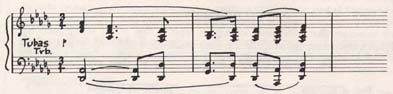
Valhalla Motive

Failing to provide an emotional home for Fricka, he provided a castle in the sky, a materialist's dream of the superlative abode, the golden treasure at the end of the rainbow. Wotan, in utter disregard for real relationship, engages in pretty illicit traffic when he promises to pay for Valhalla with Freia as his currency.

I surely don't want to offend you, but did you know what you were getting? Were you tempted just by Golden Apples or did you really want love with all its demands and tragedy. Poor Fasolt fell in love right away and it was his demise. I don't know if Wotan or Fricka ever really had a clue about the love thing, though Fricka does seem to have at least a sibling style love for Freia. Otherwise, though, she appears to be a true victim/victimizer operating in the patriarchal system, passing on her pain and kicking the dog. But I digress to the issues of feminism here. I really mean to just study the terms of the contracts.

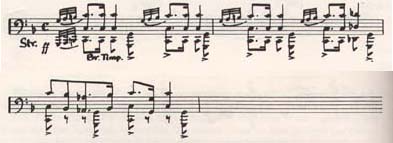
The giants' theme makes me feel that you didn't quite know what was happening. With apologies to the Norns, I hate the word fate because I don't live in the world of the fates. But these notes are so fateful in nature to me.

Giants' Motive

Maybe falling in love is where we touch fingers with the fates. Yes, I recognize that theme from daily life--not every day, thankfully. Oh, but it does take a weighty stack of gold, a penultimate prize, to sell out love. Even Wotan knows he's made a bad deal with the loss of Freia.

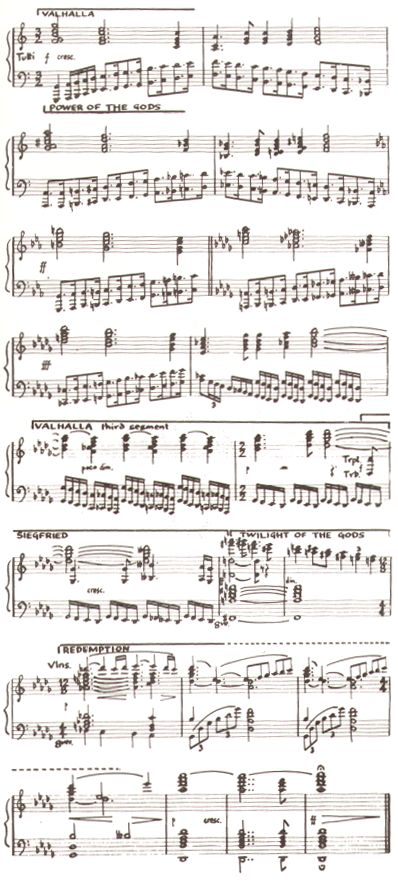
I wanted to ask about one more contract, or broken contract. It is Brunnhilde who dared to break contract with her father, and she ends up in flames. Brunnhilde gives up everything, except her beautiful steed Grane (understandable), for love. She is alone, totally devoid of her deity, no longer daughter of Wotan (heaven) or Erda (earth), but daughter of love, true not to contract but true to love and relationship. I'm not sure Wagner had this all together. I think he is confused about the integrity of love apart from passion/sex. But I do think Brunnhilde has gone on beyond passion to a form of loving that is higher. In that she becomes the final mythic hero.
Redemption through Love Motive

What do you think? Could you put on Tarnhelm one more time and become Erda, the wisest person in the world and tell me if love is the final contract?

Thanks for your thoughts.

Betsy

PS: Most interesting informations at the The Wagner Experience.

Monday, May 29, 2006

Survey I: Characteristics of a Good Person

Read the question and post an answer. One word is acceptable. Several words are great. An answer with an extended explanation is also encouraged.

Question: What is a characteristic of a good person?

Friday, May 26, 2006

Macro vs. Micro Morality or Prelude to a Survey

Dear Son,

I have been doing a survey. I know that you participated at the dinner table sometime, answering my question, “What is a characteristic of a good person.” So far, I've gotten responses to the question from quite a few people of all different ages and shoe sizes.

People occasionally ask me why I ask that question. That is a good question too, so let’s start there. I ask because I’m desperate. I want to know what good looks like. I want to know “good with feet.” By this point in my life I should be more sure of that answer, shouldn’t I? But I am not. Partly I am not sure because I see so many people who have some of the characteristics that I would name as good, who have other characteristics that I would not include on the list.

We talked about some of that last night. These are people who think it’s ok, even good, to go out and get high, to live with a wide range of life practices that I consider bad or, at best, unhealthy. Yet they are good, and struggling with issues of goodness that are, in many ways more critical than the ones being ignored by people who seem to be concerned with good behaviors of the other sort. With my survey, I want to study what that is all about?

Then, of course there is a negative drive in my investigation. I see people, lots of people my age, who have for many years lived a life in which they apparently embraced the “goods” of conservative behavior, who are now disavowing those behaviors and diving headlong into a life of fairly unfettered practices. It is not a pretty sight to see the innards of middle-aged discontent!!! People seem to be able to flippantly trash their lives and families for “wine, women, (or men) and song.” Why is that?

Your dad described a conflict between macro-goodness and micro-goodness. He said that some people seem to embrace a definition of good that is a reaction to global activity, global politics, global philosophy, global intent. Others have a micro-morality that reflects conceptions that rest within the heart and internal conflicts that have implications for daily behaviors, intimate relationships, personal desires, and immediate reactivity. To macro-moral-man, it is a sin to take certain political positions, such as supporting nuclear proliferation or doing things that cause global warming. To micro-moral-man it is a sin to drink alcohol because it could have negative moral implications for relationships with family and friends.

We seem to polarize ourselves though. We are either micro-moralists or macro-moralists, but we aren’t good at being both. Perhaps the weight of it all is too great. If we think too long about global warming, we feel like we just need a good stiff drink. If we look inside ourselves at the moral dirt of our own souls, we are too exhausted to have the energy to get involved in environmental clean-up.

On the surface, Scripture does seem to present a rather micro-picture of morality. The Ten Commandments, after all, don’t include, “Thou shalt recycle” or “Thou shalt not emit noxious fumes into the atmosphere that shalt tear up the ozone layer.” But there is macro stuff there. The Genesis call to tend the “garden” environment, the parables about stewardship, the strong call for justice in Micah and its curse of the “short measure,” “wicked scales,” and “bag of deceptive weights.”

Have you ever been bored reading the Old Testament with its page after page of the machinations of people groups that are hard to understand? I wonder if that is because the descriptions are trying to get us to understand a macro-morality using examples that are out of our sphere. Maybe if the children of Israel were going in to slay the people of Exxon for corrupting the sea or to conquer the land of Haliburton for charging unfair interest to a people devastated by war, we would get it.

But there is something conceptually much more transferable about the teachings of the heart, the micro-moralities that were experienced BC, AD, and now. The wrestlings from the hearts of Jacob to Moses to Deborah to Peter to Priscilla to John carry an immediacy that I understand at first sight. And the commands are pretty clear also. Thou shalt not commit adultery. Do not get drunk with wine for that is dissipation. Even “gird your loins with truth” sounds pretty darn personal.

So, what are we to make of this? I don’t think its simple. I think it is a long hard struggle to understand the interplay between the micro- and macro-moralities. It is the source of much angst in our souls. But that isn’t new either, is it? Micah cried out, “Shall I present my first-born for my rebellious acts, the fruit of my body for the sin of my soul?” Every morning, I start my drive to work with a rather primal scream in my soul to God, “Save me, save me, save me.”

I don’t think that it is an either/or proposition. To embrace one form of morality and eschew the other undermines the whole thing. But to feel the weight of it all is way too much to bear. If we can chunk it someway and feel just the burden of today, assuming the weight of the decisions and moral choices for today only or of our own lives only. Perhaps that is how we can survive successfully.

Reinhold Niebuhr has written a classic work entitled, Moral Man and Immoral Society. I am starting to read it. Supposedly, he says that the morality that a person can experience on an individual level cannot be applied at the global level, because institutions are incapable of running on any level but the politics of power. I think that this is an interesting take on things. Maybe that is why Scripture attends more to the intricacies of the internal morality. It is there that we have some choice, but in the global realm we cannot rely on morality.

bell hooks, a writer who engages subjects from feminism to greed, is more hopeful about moral applications to the public sphere. She says in her book, All About Love, New Visions, “An overall cultural embrace of a love ethic would mean that we would all oppose much of the public policy conservatives condone and support. Society’s collective fear of love must be faced if we are to lay claim to a love ethic that can inspire us and give us the courage to make necessary changes.” She then quotes Eric Fromm who says, “Society must be organized in such a way that man’s social, loving nature is not separated from his social existence, but becomes one with it.”

Obviously, others have and are and will struggle with the questions of morality. It is a very weighty thing. Establishing a true moral compass is not as easy as compiling the right list of behaviors and abiding by it. Those lists serve some purpose, primarily as guides for us when we are blinded by the heat of our passions, I suppose. But they don’t serve well as clubs for beating up others or ourselves for that matter.

I love you honey and am glad that you are the kind of person that you are. I’m sorry that you have to engage in the very painful philosophical struggles. Yet, I have found these struggles to be the very things that make us deep and loving individuals.

With all my love,

MOM
XOX

Thursday, May 25, 2006

For the Women in My Daughter's Class

Dear Marilyn Kallet,

I attended a reading that you sponsored for the aspiring poets in one of your poetry classes. I came, for I love poetry. I came, for I love my daughter and she was in your class, ready to read her work. I enjoyed.

I think I had read my daughter's work prior to the event. I don't quite remember which of her many poems she read that evening. I do remember the work of some of the other women though, for they caused me to think and to wonder and to write my own poem.

For the Women in My Daughter’s Class

I’m fifty years old and I’ve only had sex with one man in my life.
I suppose that sounds naïve to those of you who, at twenty-one
Think of your lovers in a row, or judging from your readings,
In a line-up.

I’m fifty years old and the one man in my life can make me rage.
But not because, after telling me he loved me (or not), he left,
But because he spits his toothpaste in the sink or on the mirror
And never rinses.

I’m fifty years old and could be convinced by you or my own imaginings
That a life of multiple lovers makes lovemaking hotter
And orgasm vitally anticipated, poignant, and quick.
Does that cover it?

And a life of practiced monogamy, me, knowing him, him, knowing me,
Me, sure, him, sure, me, loved, him, loved,
Could be less, I can see, because I’ve propensities too.
But I don’t know, for I’m fifty years old and I’ve only had sex with one man.


Betsy