Showing posts with label Justice. Show all posts

Saturday, August 23, 2008

God Forgive Me! Simon and Garfunkel 101


Voices Of Old People - Simon & Garfunkel


Dear Barack Obama,

This little clip is not the whole of the "Voices of Old People" segment on the Simon and Garfunkel Bookends album. And, it ends, "God forgive me." I think the actual album quote continues, (my memory isn't as good as it used to be) "An old person without money, is pathetic." And oh, yes, how true that is.

But honey, anyone, young or old, without money, without the hope of money, without the power for generating money, is pathetic. That is the plight, that is the fear, that is the demon of the poor.

Let me repeat a little story from one of my favorite Nobel Peace Prize winners, Muhammad Yunus. (Quoted from USA Today on May 21, 2008)


The way he tells the story, every time a new head of the World Bank is named, he calls Yunus. When James Wolfensohn became World Bank president, he welcomed Yunus to lunch and began to quiz him about his recently announced goal for reducing — and ultimately eliminating — poverty.

"I understand you intend to lift 100 million people out of poverty," Wolfensohn said.

"That's right," Yunus told him.

"Don't you think that's a little overly ambitious?" asked Wolfensohn.

"No," said Yunus. "We've looked at the numbers and we think we can do it. But," Yunus went on, "if you think it's too ambitious, what do you think is a better number?"

When Wolfensohn didn't answer, Yunus offered a number.

"10 million?"

Wolfensohn shook his head. Too low.

"20 million?" Yunus offered.

From Wolfensohn's reaction it was clear that number was still too low.

"How about 50 million?" Yunus asked.

Wolfensohn seemed pleased by that number.

"That sounds about right, " he said.

"OK," Yunus told him, "you do 50 million and I'll do 100 million."

And that's how you win the Nobel Peace Prize: by making peace with the powers-that-be, the keepers of the status quo, rather than by declaring war on them.

Next week, Barack, as you accept the Democratic nomination for President of the United States, and as you talk about change, talk about this. Talk about changing the capitalist system that so empowers the already rich, the fat businesses, the oil monopolies, the "haves", and so disempowers the poor, the poor, the poor, the "have nots". Tell us that the United States will join with the World Bank and Muhammad Yunus, and say: "We'll work on our 36 million." They are ours. We'll take care of them." I don't want to hear about what we can't do Barack, because, we are spending so much on war. I want to hear how we can end poverty for our 36 million.

Anything less, is pathetic.

BRD

PS If you are at a loss for ideas on how to do this, call Muhammad Yunus.

PPS Biden? My husband is pleased.

Thursday, December 20, 2007

A New Carol for an Old City

Christmas 2007
by Jim Burklo


O little town of Bethlehem
A wall thee now divides
Above thy concertina wire
The silent stars go by
Beyond the wall the soldiers
Aim rifles toward the sky
Militias roaming streets inside
Ignore the baby's cry


The settlements and suicides
Injustice, greed and hate,
O little town, you seem to drown
In tears for your hapless fate
But hear the choir of angels
Their great glad tidings tell
O come to us, abide with us,
Our Lord Emmanuel!


Dead dogma burdens Bethlehem
With grudges from the past
Muslims, Jews, and Christians, too
Say their claims are the last
Yet in thy dark streets shineth
The everlasting light
The hopes and fears of all the years
Are met in thee tonight.


The baby's voice is calling us
To Bethlehem again,
Where walls divide may grace abide
Forgiveness enter in
The morning stars together
Proclaim the holy birth
And praises ring, for Love we sing
And peace to all on earth!

Friday, September 28, 2007

Petitions Requesting Intervention and Change

http://www.colorofchange.org/jena/

Dear Governor Blanco,

I am writing to request your intervention into a situation of great injustice taking place in Jena, LA.

Dear District Attorney Reed Walters,

It is your duty to enforce the law fairly and equally. Your handling of the case of "the Jena Six," your disinterest in pursuing the multiple instances of white-on-black violence that preceded the beating of Justin Barker, and your threats to Black students protesting the presence of nooses on their campus, have been neither fair nor equal.

BRD

P.S.

http://www.colorofchange.org/jena/

is a site for petitions to Governor Blanco and District Attorney Reed Walters. The site is supported by Color of Change, an organization set up in the wake of the Katrina disaster. There are other petitions around including one suggested by Collateral News on YouTube, where there is a rather good video from last summer to summarize the case up to that point.

Here is the latest from Collateral News.


Notice that this footage ends, not in Jena, but in Philadelphia, PA, (the skyline and murals of that city) and with the reminder that this is not a Southern issue. This is a national issue. It is time we make our national institutions: schools, courts, and workplaces, safe for our young black men and women.

Jena 6 Defense Committee
PO Box 2798,
Jena, LA 71342
jena6defense@gmail.com

Tuesday, September 25, 2007

Free the Jena 6


Jena 6, a photo story © Michael David Murphy, 2007
This video was made with audio, video, photographs, and scans of court documents on June 25, 2007, in Jena, Louisiana

Dear United States of America,

A boy remains in jail today:

Bell remains in jail pending a possible appeal by prosecutors, a situation that activist Rev. Al Sharpton hopes will be addressed in a scheduled meeting Wednesday with Louisiana Gov. Kathleen Blanco.

The world is watching:

More than 20,000 people converged on the small town of Jena last week to protest the case, and Sharpton said those non-violent protests may increase if Bell is not released quickly.
"We started with a mass demonstration, and then next step would be non-violent civil disobedience," Sharpton said.

The issue is equal justice under the law:

"We are not fighting for black kids that beat up white kids. We're talking about the disparity in how the law works," the New York-based activist said, adding that he still expects the local county prosecutor who brought the charges to be called to testify before Congress.

My thoughts:

Our system of justice must be tended, guarded, protected, from injustice, hatred, and racism. Incidents like these cannot be allowed to slide by. For the sake of future, our peace and our moral selves, we must not allow Jena, LA, or Decatur, TN, (where there is still a sign in the local diner that says, "We have the right to serve whoever we choose") to step outside the bounds of civil rights laws that have been won with the blood of some of the finest and bravest human beings of our collective memory.

Let's not forget.

brd

Sunday, September 09, 2007

Beloved Israel

Dear Josh,

In a recent post comment you raised a good question for those of us who live in a place where we cannot see Israel with our own eyes and for those of us who are very much in favor of a place for Israel on our globe. Those of us who hate oppression of any kind, I think, have warm and tender feelings for the people group which has, through history, received the most cruel treatment—the children of Israel.

I would not, for a minute, wish ill for the nation of Israel. In fact, it is for that very reason that I responded when my Jewish friends who are involved in the organization Women in Black asked me to join them in weekly "protests" calling for peace with justice in Palestine. One of those Jewish friends recently tried to visit Israel and Palestine, but she was refused entrance because, on her itinerary, it stated that she wished to visit areas in the West Bank that are in crisis. These areas have come to be known as "occupied areas." The Longstreths, a husband/wife medical team from San Diego did make that visit this past summer. The following link takes you to a description of what they observed.
http://www.counterpunch.org/longstreth09012007.html

Here is another piece written by Seth Freedman in the Jerusalem Post.

When I say that I wish no ill for Israel, that does include my belief that the worst ill is doing evil, not being the recipient of evil. It is terrible to be oppressed. It is worse to be an oppressor. It is terrible to be victimized. It is worse to be a victimizer.

Palestinians include both Christian and Muslim individuals. Most of the Palestinians I know here in Knoxville are Christians. Some are Muslim. Both groups are equally oppressed in Palestine. Jewish, Christian, and Muslim women here are working together for the same goal. Peace with Justice in Palestine.

As I think of this, my mind randomly jumps to two things. One is Psalm 137. It is not the words of this Psalm that are "dead on," but the emotion.

By the waters of Babylon,
there we sat down and wept,
when we remembered Zion.
On the willows there
we hung up our lyres.
For there our captors required of us songs,
and our tormentors, mirth, saying,
"Sing us one of the songs of Zion!"
How shall we sing the Lord's song
in a foreign land?

Palestinian, Jew, American, Muslim, Josh, Betsy--we all can sing this song when we are tormented or far from home. Humans understand this sentiment.

I am reminded, too, of the book I finished last night. The End by Lemony Snicket. Yes, I have finished the last book of the Series of Unfortunate Events, the sad tale of the Baudelaire children. I am fascinated by this study of good and evil written for the 12 year old crowd. As this book points out, the world is a complicated place and one does not do noble things without doing a fair share of treacherous ones. That is certainly happening in Israel. I pray that the leaders of the government there will become more self aware, introspective, and realize that they are investing in too much treachery and too little nobility in relation to the Palestinian population. If they do not, they will find that though they are in The Lord's land, the timbre of the lyres will be sour indeed.

Betsy

Saturday, September 08, 2007

Haleh Esfandiari: There and Back Again

Dear Haleh,

Glad to hear that you are back on U.S. soil. I know that it might be inaccurate to say you are home again, because home to you includes that space where your 93-year-old mother resides, and that is Iran. But that home is not a safe place. Not safe for you and perhaps not safe for very many women. Certainly it is not safe for women who think and then speak, even if in a velvet whisper.

I had written to you at the time of your imprisonment. Now, I am glad your ordeal is over. I do appreciate the time line that Woodrow Wilson Center put together tracking your ordeal.

The Washington Post gave a good account of your recent release, I thought.

Bless you. And sleep well tonight.

Betsy

Thursday, July 19, 2007

White Girl Reads Black Boy

Dear Richard Wright,

Well for some time I have been reading Black Boy. I started with an abridged version, then fascinated went to the whole of what I have discovered is a two part piece that was published separately, as Black Boy and American Hunger.

You are not very soft and fuzzy. I knew that, for I have read Native Son. But you are revealing and as you were forceful in pointing out, you live in the world of emotions and you reveal emotions. They are not warm and fuzzy emotions, but they are emotions. Black Boy was particularly moving to me as an offering of the psychological makeup of an afro-american male growing up in the deep south of the early part of the 20th century.

I was interested in the two concepts that you play with throughout the two books.

1. Fear
2. Hunger

Are those the drivers of the life of the intellectual? Does fear drive us (us?) in and does hunger make us come out? Is it fear that makes us stand, shaking and then psychologically crawl to the underbrush of our personalities, spooking around for shelter. I use that phrase "spooking" because my father used to use it. He would come to our home for a visit. Then he would get bored and curious and say, "I'm going to go out and spook around." I wonder where he got that? What would you say, Richard? That word has a nasty underbelly, doesn't it? His surface meaning was that he wanted to float about and find the local haunts. In this case I think he meant nothing else.

But we float about inside ourselves looking for a steady base that can be counted on, from which we can begin to build an intellectual framework. Is it possible to retreat and find that place inside ourselves without the fear? White girl here did not grow up in fear. My fears have come late and with age and the various kickings around of life. My fears have come with rejections and incompletions and incapabilities. And hunger? I have not known physical hunger at all. Yet I cannot be satiated, now. I hunger for ideas and paths of thinking, and I hunger for relationships that feed. (You longingly mentioned a lack of friendship in your book. Did you ever find that? I hope so.)

Oh, how I wish I had enough to fill the empty belly of my brain.

I'm glad that, as hard as some of your information is to digest, you are clear that you are dealing in the realm of emotion. I think that moderns, though very emotionally driven, are slow to use the term. I, too, live in that realm and work from that gut place. But productivity isn't driven by emotion or the intersection of fear and the internal man or woman, do you think? It demands a return to the world of the other and the work of scavenging for sustenance. And it demands a common cupboard of some kind. Your work displays a very particular cupboard that has been helpful for me to see.

Well, let me go eat breakfast.

brd

Wednesday, July 11, 2007

True Democracy and Economic Wealth

Dear Thomas Jefferson,

These are some definitions:
Democracy

Government by the people, exercised either directly or through elected representatives — The American Heritage Dictionary

a state of society characterized by formal equality of rights and privileges

political or social equality; democratic spirit

the common people of a community as distinguished from any privileged class; the common people with respect to their political power — Dictionary.com
If those definitions are anywhere close to reality, then a true form of democracy would not allow for the perpetuation of unlimited control, by one set of individuals, of our most valuable life resources. The American form of democracy is failing, slowly but surely, and tumbling into some form of post-modern classed aristocracy because of an untoward and malignant commitment to private property. We are beset as a nation by an underlying and pervasive notion that those who own property are graced with some form of the Divine Right of Kings to hold that property and pass it on as royalty to, not just the third and fourth generation, but ad infinitum.

Our nation is peppered with individuals who swear allegiance to democracy and then wrap themselved in a motto like that of the British monarchy, "Dieu et mon droit." We might say, "Terre et ma droite."

Thomas, here are some statistics you might find interesting. Look at them and then tell me what you think. It's not me who's the crazy one here is it? (Full data)

The top 10% of Americans control 68.8% of the wealth. The top 20% control 81.6% of the wealth. The average wealth of the top 1% of the nation is over 10 million dollars. The average wealth of the bottom 20% of the nation is almost NEGATIVE 10 thousand dollars. A fellow named David Chandler developed this little "L Curve" to demonstrate how skewed the control of resources in the United States has become. It wasn't like that when you were thinking about democracy was it?


Here is my simple recommendation, based on the principles of democracy. Wealth must be redistributed. That redistribution need not be done during the lifetime of the earner. Certainly, people deserve to experience the fruit of their labor. They should also be able to pass on a reasonable amount to their children. However, there should be limits to the amount of money that can be passed from generation to generation. OK, you heard me say it and I wanted to say it to you first.

Well, I've got to go to work now. My pile of money lies along the space in the middle of the football field, so I must spend my time working hard. But then, that is what makes democracy great. Work is a great gift. I just think that the descendents of the very wealthy deserve to engage in the American democratic struggle, just like the rest of us.

Betsy

P.S. I don't think you've heard the last from me on this. I have some thoughts on Social Security Tax that I'd like to run by you.

Wednesday, June 20, 2007

Carter on US Policy on Palestinians

Dear President Carter,

Thank you for speaking out clearly and strongly on this subject. Did I ever tell you that you are the reason I became a registered Democrat. I must admit, I'm not dyed-in-the-wool and that if I were to describe myself politically I would probably say I'm a socialist, but I'd still vote for you. Will you run?

As a Woman in Black I have stood with the women in this photo in front of the Duncan federal building on Tuesdays here in Knoxville, TN. We have a silent presence that raises a persistent request to the federal government. Please, act for peace in Palestine. (I must note here with respect and appreciation. Our congressman Jimmy Duncan--son of Duncan of federal building fame--was one of the few Republican legislators, one of the few legislators on either side of the aisle who voted against the war of aggression in Iraq. Thank you Congressman Duncan!)

The Irish Times stated, "President Carter, a Nobel Peace Prize winner who was addressing a human rights conference in Croke Park, also said the Bush administration's refusal to accept Hamas' 2006 election victory was 'criminal.'" This is not the first time the US leadership has moved into the realm of what could be described as criminal, also immoral, war-mongering, disrespectful for humanity, insane. . .

I could rant on. But I want to thank you again, and ask you to continue working, using your voice and the well deserved influence that you possess, for reasonable peace in Israel, Palestine, and our world.

Respectfully,

Betsy DeGeorge

Thursday, May 10, 2007

Women in Black Knoxville Year 5

Dear Women in Black,

Thank you!


Women in Black members have stood silently (or almost silently) in front of the Duncan Federal Building in Knoxville, TN, every Tuesday since April 8, 2002, to mourn the deaths caused by violence between Palestinians and Israelis. The group calls for an end to what it considers Israel's illegal occupation of the West Bank and Gaza.

Composed of Christian, Muslim and Jewish women, as well as women from other faiths, the group is part of an international movement started in 1988 by Israeli women.

A poem with hope for peace and understanding.

Wandering Around an Albuquerque Airport Terminal

by Naomi Shihab Nye


After learning my flight was detained 4 hours, I heard the announcement:
If anyone in the vicinity of gate 4-A understands any Arabic, Please come to the gate immediately Well -- one pauses these days. Gate 4-A was my own gate. I went there.
An older woman in full traditional Palestinian dress, Just like my grandma wore, was crumpled to the floor, wailing loudly.
Help, said the flight service person. Talk to her.
What is her
Problem? we told her the flight was going to be four hours late and she Did this.

I put my arm around her and spoke to her haltingly.
Shu dow-a, shu- biduck habibti, stani stani schway, min fadlick, Sho bit se-wee?

The minute she heard any words she knew -- however poorly used - She stopped crying.

She thought our flight had been cancelled entirely.
She needed to be in El Paso for some major medical treatment the Following day. I said no, no, we're fine, you'll get there, just late,

Who is picking you up? Let's call him and tell him.
We called her son and I spoke with him in English.
I told him I would stay with his mother till we got on the plane and Would ride next to her -- southwest.

She talked to him. Then we called her other sons just for the fun of it.

Then we called my dad and he and she spoke for a while in Arabic and Found out of course they had ten shared friends.

Then I thought just for the heck of it why not call some Palestinian Poets I know and let them chat with her. This all took up about 2 hours.

She was laughing a lot by then. Telling about her life. Answering Questions.

She had pulled a sack of homemade mamool cookies -- little powdered Sugar crumbly mounds stuffed with dates and nuts -- out of her bag -- And was offering them to all the women at the gate.

To my amazement, not a single woman declined one. It was like a Sacrament. The traveler from Argentina, the traveler from California, The lovely woman from Laredo -- we were all covered with the same Powdered sugar. And smiling. There is no better cookies.

And then the airline broke out the free beverages from huge coolers -- Non-alcoholic -- and the two little girls for our flight, one African

American, one Mexican American -- ran around serving us all apple juice And lemonade and they were covered with powdered sugar too.

And I noticed my new best friend -- by now we were holding hands --

Had a potted plant poking out of her bag, some

medicinal thing,

With green furry leaves. Such an old country traveling tradition. Always Carry a plant. Always stay rooted to somewhere.

And I looked around that gate of late and weary ones and thought, This is the world I want to live in. The shared world.
Not a single person in this gate -- once the crying of confusion stopped
-- has seemed apprehensive about any other person.

They took the cookies. I wanted to hug all those other women too.
This can still happen anywhere.

Not everything is lost.

Tuesday, August 15, 2006

Wishing to be Counted Among the Just

Dear Sylvia Tennebaum,

Thank you for your thoughts.

Betsy

Friday, August 11, 2006

Online Petition Requesting UN to Work for Ceasefire

Dear Ricken Patel of the Ceasefire Campaign,

In accordance with your request, I am posting this link to my blog.

"As the awful civilian death toll rises above 1000 in Lebanon and Israel, people around the world are seeking a place to voice their frustration and concern. Over the last 4 days, 200,000 people from 148 countries have signed the ceasefire petition. At this rate, we could soon be the largest global online petition in history."

Online Ceasefire Petition

With hope (almost),

Betsy

Saturday, July 29, 2006

Must Toni Morrison Crusade

Dear Toni Morrison,

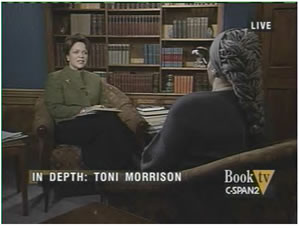
Somewhere near the end of three hours of interview with Toni Morrison on C-Span's In Depth, I identified your answer to the question I have been asking authors. Must the author crusade?


Ok. That is not exactly how Sam Saleem asked his question, but it was close and followed some other interesting discussion on morality and the necessity of negotiating rather than dictating a moral position.

Sam asked, "How have you been able to balance the role of spokesperson on racial issues on the one hand and an artist on the other."

You said, "Those two go together for me. I don't find them different at all. I think that art should be political, representative, and absolutely and irrevocably beautiful at the same time."

There it is, I said in my mind. Meanwhile, I tucked away my own personal 15 minutes of fame in my file box. My 15 took place today as I basked in the limelight of being on the cover of the Knoxville Voice, along with my Women in Black cohorts under a headline that, well, didn't make any sense at all. This time, though, I wasn't the editor so it wasn't my fault, I was, instead, one of the cover girls (and guys).


We may not be absolutely and irrevocably beautiful, but we are political, representative and speaking for a just peace.

Thanks for your thoughts. I will write to you later about your comments on morality. The discussion was fascinating.

Betsy

Monday, July 10, 2006

Must Richard Wright Crusade

Dear Richard Wright,

I have written Eudora Welty about her position expressed in the essay, Must the Novelist Crusade. I contradicted her, for though she doesn’t wear a banner across her gingham, I believe her to be a crusader for truth as she sees it. I guess I see all artists as crusaders for meaning, and though Eudora doesn’t like the word crusade, for it smacks of something blatant and lacking in the artistry of the subtle, I think she crusades too.

On the other hand, you, Richard, talk about the underpinnings of truth in Blueprint for Negro Writing, “Here are those vital beginnings of a recognition of value in life as it is lived, a recognition that marks the emergence of a new culture in the shell of the old. And at the moment this process starts, at the moment when a people begin to realize a meaning in their suffering, the civilization that engenders that suffering is doomed.” The operative word here is “meaning.” Truth, whatever it is actually, is approached through the shadow of meaning. Writing artists live in that shadow whether they admit it or not. They do not own truth any more than painters own beauty, but they live in its shadow.

In the section of your essay called The Problem of Perspective, you say, “they feel with some measure of justification that another commitment means only another disillusionment. But anyone destitute of a theory about the meaning, structure and direction of modern society is a lost victim in a world he cannot understand or control.” In embracing the strength that is found in each of our unique and powerful perspectives, we can engage existentially in the “crusade” for the cultural emergence of something new, something that seeks to achieve a life that is more just, more true, more beautiful.

If Welty doesn’t like the word “crusade,” you don’t like the word “preach.” You don’t want to be a “salesman” or a “prostitute.” These concerns are quite similar. It seems that you don’t deny the danger and the fearful nature of what the writer is doing. You embrace it. “This is the moment,” you say, “. . . When Negro writers think they have arrived at something which smacks of truth. . .”

I have finished reading Native Son. It is one of those books of which I wouldn’t say, “I like that,” but I would say, “I’m glad I read that.” It is a book that reveals a perspective, and one that I need. I am neither black nor poor. I have been poor, but I have never been black. I have been poor, but I have never lived in poverty. There is such a difference. Being poor certainly gives one an appreciation for poverty that is less available to the wealthy, but poverty is so much broader than just being poor, that saying you understand poverty because you’ve been poor would be like saying you understand the problems of Africa because you went on a safari in Kenya.

I feel like I am more ready for your work than I ever have been. I know that if I am to understand the world and culture of the United States, I must try to come to an understanding of the cultures that make it up, especially the black culture. I guess I am ready to some degree because I’ve made an effort to at least desensitize myself to the elements present in your novels that my naïve self, which is still very present in me, revolts against.

Yet, as much as I agree with you and the need for the crusade, I was put off, as I read the last third of Native Son, for it seemed that it became a sermon. The lawyer for the Bigger’s defense, Boris Max, climbed upon the soapbox and preached. He preached about important things, but it was preaching and that, I would think, is a prostitution of the craft. In my reaction to the book, I come to understand Welty’s concern that we not become mere clerics presenting the doctrines of whatever isms we ascribe to.

Perhaps you can tell me where you think the artist must draw his/her lines? Perhaps I draw mine somewhere between yours and Eudora’s.

Hoping to learn more.

Betsy

Thursday, June 01, 2006

Demonstrating and the Art of Changing Society

Dear Robert Moses,


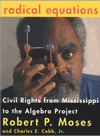
While reading through the trilogy of the civil rights movement during the King years by Taylor Branch I became a Bob Moses fan. Your thoughts and actions helped form a movement and likewise a new way of thinking and being in the United States. More recently, I checked out one of your books from the library about the Algebra project. So now you teach math to the children of Mississippi? I would call it a strange contrast if it didn't make perfect sense in respect to the stuff that goes on in one's heart and mind while struggling to find meaning in relation to political action, social justice, and the desire to be involved with real societal change.

One of my "blog reads" has entered into a little discussion about the experiences of demonstrating [Defn: establishing a physical presence to express a socio/political position.] There is frustration and embarrassment in carrying placards and walking or standing. But most of all the difficulty is in becoming part of a group, some of whom you agree with, some of whom you don't, some of which are cool, some not, some with whom you would bare your very soul, some to whom you would give the time only to get them to the march promptly. Yet in this act of demonstrating you become one, you marry on a theme, and this wedding, for better or worse, seems, almost immediately, worse.

This marriage would be worth it, if only we could realize social change. But all of our standing, marching, chanting or silence, placards, persistence, and so forth seem to fade like a chimera into the din of, not rifle response, water hoses, and paddy wagons, but normal traffic, a Spring shower, and the tipped cap of the Tuesday patrolman.

So we come back to the math classroom, don't we. And we find, there, the front lines of demonstration. And there, maybe, without folderol or display, is the core of social improvement, our last best hope for engaging-ment [thanks gbs] and changing the way we live.

With deepest respect,

Betsy DeGeorge

Tuesday, May 23, 2006

I Must Crusade

Dear Women in Black,

You are my friends, in a narrow way. I don't know many of you well, but we stand together once a week on the same narrow strip of ground. And we have stood here in Knoxville, now, for four years.

We stand in mourning. So last week when we celebrated four years of standing together, we were celebrating a mourning. How odd.

Together we heard these words:

{All Things Not Considered
by Naomi Shahib Nye
(from 19 Varieties of Gazelle: Poems of the Middle East)}

"You cannot stitch the breath back into this boy

A brother and sister were playing with toys when their room exploded.

In what language
is this holy?

The Jewish boys killed in the cave
were skipping school, having an adventure.

Asel Asleh, Palestinian, age 17, believed in the field
beyond right and wrong where people
come together.

to talk. He kneeled to help someone else
stand up before he was shot.

If this is holy, could we have some new religions please?"

And more words, but it wasn't the words. It rarely is. And I knelt and touched the names of Israeli children and Palestinian children written on a piece of paper. And I wondered why people tend to be more distraught when it is children who die. Is it because we hope that they held within them more potential for peace than the rest of us? Or is it just that we feel that we should have died first.

We Women in Black stand in front of a federal building each week in some kind of protest. It is a crusade of sorts, one in which Jewish women, Muslim women, Christian women, women of no religious commitment, join together on a narrow strip of sidewalk and crusade for peace.

Betsy DeGeorge

Monday, May 22, 2006

Eudora Welty Must Crusade

Dear Eudora Welty,

I have read something. Two things really. First I read a critique. Then I read the real thing. That is backwards I know, but I found the real thing through the critique, so perhaps the procedure is forgivable. “The thing” is your essay entitled “Must the Novelist Crusade?” You wrote it, from what I can tell around 1965. I must say that the essay helped me put together some other ideas that have arisen in my head while reading some of your other work.

May I vent? Then let me ask questions.

Truth is an elusive thing. It is absolute and unchangeable before fading into the mists and transmogrifying into an apparition. Beauty is seductive. It is appealing and glorifying before eroding into silence and transforming into an ogre.

Yet truth and beauty are constants, coming and going in the human heart. And we know they are, without knowing what they are precisely. The writer and the artist are caught in the webs spun by truth and beauty, fated to look upon the captors that enslave and finally consume them.

The artist, speaking here of painter or musician, is lured by beauty, and though truth may suck some of the blood out of them, it is beauty that drains them I think. The writer on the other hand is enticed by truth and though beauty takes its toll, it is truth that bankrupts them.

So how is it that a writer might deny that liability? Or how might a musician deny the light that inspires? Perhaps the writing technician might, the fellow who plots means of filling pages for purposes of selling toothpaste or describing irregularities on the surface of granite. Or maybe the musical practitioner could, the woman who creates the chord structure that lazily leans behind the action of a soap opera or increases the tempo to chase the coordinated end of a sentence in a TV drama, but not the artist.

So what is it that might drive you, Eudora Welty, to deny your muse? Do you fear the very power that you command? Do you wish to play with the angels and demons of truth and believe that you are not tempting eternal glory or damnation?

But I think that you are (terribly) responsible for the glories and damnations that you create. It is that very heaviness, the very weight of your authority over the written word to compel truth that makes you great. You are doomed no matter how vociferously you may try to deny it.

Oh, dear. Surely I have offended you. And I must stop for now. I will write again, and perhaps ask questions that can actually be answered and that may eventually shed some light on our disagreement on this philosophical point. I intend to correspond with Richard Wright on this subject also.

Sincerely,

Betsy