Sunday, January 25, 2009

Machsom Watch: Getting Beyond the Barrier

Dear Naomi Lalo,

I have always liked the name Naomi. My grandmother's name was Ruth. My mother's name is Naomi. When I was young, I learned many stories in Sunday School, but one had personal impact because of the names of the women. Naomi had gone to a foreign country. Her travels were not like those I have taken to foreign places, with trips that included planes and hours watching movies from the relative comfort of an air seat. She traveled from Bethlehem to Moab a place in what is now Jordan, watched her sons marry women of that country, watched her husband die and sons die, and returned home with one of daughters-in-law, a woman named Ruth.

So I have liked your name for several reasons.

You, I have read, are one of the leaders of Machsom Watch. One of your members produced the video that I posted on inauguration day, a video letter to Obama. Machsom means barrier, doesn't it? And your organization is watching the great barriers or checkpoints that pepper the landscape of your land, that for many represents the heart of the middle east.

If Naomi and Ruth were trying to return to Bethlehem today, I doubt they could get there without being searched at a checkpoint. They might have to suffer great indignities. They might have to wait in a line all day. They might not be able to reach their destination at all.

I wanted to thank you for your efforts and the efforts of the Israeli women in Machsom Watch who are committed to peace and justice and decency and safety for those women and men, who, like Ruth and Naomi of old, are just trying to get home, or trying to get to work, or trying to get to the hospital, or trying to get water to drink.

The MachsomWatch.org website says:
MachsomWatch, in existence since 2001, is an organisation of peace activist Israeli women against the Israeli Occupation of the territories and the systematic repression of the Palestinian nation. We call for Palestinian freedom of movement within their own territory and for an end to the Occupation that destroys Palestinian society and inflicts grievous harm on Israeli society.
Each day you stand and watch and record entries in your books, describing what is happening, so that the world will know. On the 13th of January, this happened:
Two youths turn to us for help. Two horses have trotted over the Schoolchildren's Gate away to the security road. They can't go and get them because they are not allowed to pass through the gate. One of the youths says that being a minor he hasn't got an ID card. The soldier insists that they shouldn't have let the horses gallop freely and that they did it on purpose. (Why would they though? It's not likely that they would want to lose the two horses). Finally it is agreed that a military vehicle will chase the horses back to the village.
I have horses. I know that you would not want them to gallop away.


And many times they do not want to gallop away, but they become fearful at some of the strangest things. Mine fears butterflies and flapping tarps. He can get quite upset at the sight of a fresh roundbale in a field, which was not there the last time we passed by. The sound of a firing gun makes my horse quite upset. And he will run. But usually he wants to return. Last week he slipped his fence, quite inadvertantly, grazing quietly through a break in the fence. Upon realizing his freed state, he pranced and whinnied hoping for rescue from the great beyond. I think, the Palestinian horses would have done the same, except, perhaps for the sight of the guns and angry soldiers.

Horses are the same, the world over.

At any rate, Naomi, thank you for all you do, keeping some Palestinians and some horses, safe in the Holy Land.

BRD

Thursday, January 22, 2009

The Road (Through the Smokies) by Cormac McCarthy

Dear Cormac,

Don't you hate reading the critics? Right or wrong they overstate to the point of nausea. So here am I writing a critique. "I'm sorry," as Papa said over and over and over again in your book.

I rather liked what this guy said. “The Road is the logical culmination of everything [McCarthy]’s written. It is also, paradoxically, his most humane and compassionate book . . . The question that the novel implicitly poses–how much can you subtract from human existence before it ceases to be human?–takes on heartbreaking force . . . One measure of a good writer is the ability to surprise. Terse, unsentimental, bleak–McCarthy’s readers have been down that road before. But who would ever have thought you’d call him touching?” –Malcolm Jones, Newsweek

"Down that road before". . . his pun "intended". But what a metaphor it is. I don't think any of us tire of the journey of life, so how can we tire of the symbol. I was very taken with this story, for I am a perpetual student of life and have actually surveyed the subject of The Good, the Summum Bonum of life, and this book tackles it so "head on" that I could hardly fail to love it.

My cousin Geoff says he knows you, that he used to drink with you in a bar somewhere in the Southwest, maybe in Mesilla near where routes 180 and 85 separate but before route 70 joins 180 going west. You know that little place? That was long ago, for he has not been to the Southwest for a long time. He liked you though. Maybe I have seen you. Do you ever come back and visit Knoxville, disguised to avoid Knox News reporters, disguised as a University of Tennessee professor who has tired of wearing orange. I think Knoxville is a good place to live and work and write blogs. You are welcome to come back any time.

The roads of Knoxville have always been an important part of the place. I remember talking with this woman who lived in Cosby. Her daddy was a moonshiner. He carried his shining goods back and forth along "Thunder Road" to Knoxville and beyond. She may or may not have followed her father's liquid tradition, but she could play a lick on a dulcimer. She knew the roads of the Smokies well. I've spent some time with a few of the Old Timers too. Old Timers are the folks who had actually lived on the land that is now the Smoky Mountains National Park. And Old Timers knew how to survive, and knew how to trail through those mountains with no more than a deer path to guide them.

The people of the Smokies were a unique breed of folks. They cleared a very rough land. And a successful year barely got them through until Spring. The wild vegetation would spring up so quickly that it reclaimed the south 20 'bout as fast as the settlers claimed the north 20. Yet they remained hopeful and found unique expressions in singing, and story telling, and such. You can still join with a group that does shape note singing--I saw the next sing advertised in this week's papers. I suppose they need new members to survive these days so they put it in the papers. Next thing you know they'll be on YouTube.


Passing on things to our children is one of the things The Road talks about isn't. It is one of the goods we have to offer our loved offspring. The Smoky Mountains were always good for a story. One of the great story tellers was Wiley Oakley. He called himself the roaming man of the Smokies. He could have, I suspect, entertained Papa and the boy had they come across him while walking through those mountains.
This was Wiley.


I remember one mountain oldster showing me the trees that now stand on the home site of his birth. His pathos reminds me of the losses that your characters faced. It was a different set of circumstances, less dire of course. Yet the Old Timers of the Smoky Mountains felt a great loss when they lost the land where they were birthed. And many never strayed too far from where they had been born . . . even now. Close enough, they've stayed, to visit the graves at plots now only reachable by vehicles with special permissions and assists. Graves slowly being taken by the soft reaches of the biospheric multiplicity that is the Smokies. At least that was not lost.

Have you, (I'll bet you have) ever sought out morels? Yes? But they are hard to find even in the best of times. Hidden, camouflaged in the greys and ripples of the earth. They have always been a precious find like the one you described in The Road, and one that was always a great secret. It was never polite to ask where an Old Timer found their morels. That kind of prying just wasn't done.

The Old Timers of the Smoky Mountains led a gray and sparse existence, but one of hope, nonetheless. This, you captured and were, perhaps, inspired by as you wrote of the man and boy crossing this terrain. What route, I'm wondering were they traveling? I picture them plodding through the heart of the Smokies from Gatlinburg to Cherokee, crossing over near Newfound Gap. But the story doesn't really hold up under this theory. Mentions of Rock City make me believe the duo passed along the edge of the mountains on Route 129. Of course, Rock City signs are plentiful and from quite a distance, even as far as Bristol. None on Route 441 through the mountains, through the National Park.

What was in your mind?

Not place so much as theme, I bet. What makes 'good' in a human soul? What fires 'hope'? Salvation? What does that mean when we are stripped done to two people plus 'love'? You have drawn a good landscape for us to enter and think about those things.

You spent part of your life near Knoxville. I spent part of my early life near Pittsburgh. I read that the movie version of your book was set in the Pennsylvania environs. Yes, there is a bleak cast upon the face of Western P.A. (When they say PA, they say the P separately from the A). Coal and steel fired through that area and burned it up. Pittsburgh took a big hit. Fortunately, for hope, the city has rebounded and is doing better these days. Perhaps that will happen to your post apocalyptic world. Will morel mushrooms survive, thrive, and feed the sparse population of earth? Or is that even necessary for hope to live and fire the souls of even the last earthy citizens?

The Old Timers of the Smokies hoped and lived on little. They never wasted bread or bullets or friends or love or even many words, except for Wiley Oakley. But the ones I've met personally, Wiley's sister, Lucy (I think it was), Glen Caldwell, one of the park rangers, and others--they met life with a kind of fire that could survive on little and they brought to that life a great respect for land and people, continuance and love. That, there, is the Road, post apocalypse or not.

BRD

Tuesday, January 20, 2009

Inauguration Day

Dear President Obama,

I cannot watch the inauguration live today. I must do something else. I must go to a street corner on this cold snowy day and stand.

On this great day, we are reminded of much history. You have focused our attention on the past. That attention is deserved. You have made us look to Abraham Lincoln whose inauguration you are mimicking and whose inauguration was fraught with security issues, as yours is, for a great Civil War was about to begin.


Lincoln placed his hand to take the oath of office on a Bible that had been purchased by the clerk of the Supreme Court and whose inscription on the flyleaf attests to the fact. You are using that one, too.


There are other things to remember today. Awful things are there that we could remember. I searched the internet to remind myself. I saw a picture of a slave who had run away from Mississippi and joined the Union troops at Baton Rouge. He had run away previously, been caught and whipped mercilessly. Still he ran again, not just to find freedom, but to aide the Union troops in bringing freedom to all the people of his race. This is worth remembering, too.

Tuesdays, women in Knoxville put on black clothes and stand on the street corner in front of the federal building. They do it rain, snow, or shine. They do it because freedom isn't finished. Below is a letter from an Israeli woman. It explains why she stands in Israel, at a Palestinian checkpoint to guard whatever remnants of freedom exist there. We stand because it is all we can do from this point on the globe, to call for a kind, and dignified, and peaceful solution to the conflict between the Israelis and the Palestinians. I'm writing you today because during the next four years you will be able to do more than I will. I'm asking you to do it.


Congratulations! May this day, for you, be one of joy and remembrance.

Betsy DeGeorge
Woman in Black

Thursday, January 15, 2009

CaDh 8 -- Books of 2008

Dear List Makers and Milestone Keepers,

I too am a list maker, and I like keeping track of milestones and accomplishments, so this is one for the books of 2008.

I thought the discussion of what we have read for the year was an interesting topic. I guess what you take time to read says a lot about you. It is what you choose to actively engage in for relaxation. I mean, what you watch on TV says something about you, and yet, I hope that when I sit mindlessly in front of almost anything that happens to be playing that it won't be counted against me. But what I read is real every time.

This year due to a membership to Audible.com I listened to a lot of books. I started off the year with "I am Legend". This was to prep for going to see the newly released movie. I did a lot of that this year, with follow ups of The Prestige, The Kite Runner, The Day the Earth Stood Still and I started on Marley and Me before the year ended.

I really enjoyed I Am Legend. The movie took a lot of license and made changes, so both book and movie were different but good. The Prestige made a better movie than it did a book, but it was enjoyable. I have not yet seen the Kite Runner, but it was a great book. The Day the Earth Stood Still was an odd story, especially to make into a movie. And the changes they made to the movie were strange and poorly planned. It takes a lot for me to be totally disappointed in a movie theatre experience, and I enjoyed "The Day", but probably won't watch it again. Both the Marley and Me book and movie were great, but the book wins out 100%. A very enjoyable read, yet watch out for crying...should say SOBBING.

I also listened to Neverwhere by Neil Gaiman, The Moon Is a Harsh Mistress" by Robert Heinlan, Atlas Shrugged by Ayn Rand, Enchantment by Orson Scott Card, Annes House of Dreams by LM Montgomery, The Joys of Love by Madeline L'Engle, Life of Pi by Yann Martel, and I ended up with Ender in Exile by Orson Scott Card. Sci Fi is obviously my cup of tea, but I had a mix of light and enjoyable reads. I don't want anything that is going to be to heavy to think about when I am half asleep on my way into work, and I definitely want something I can look forward to after work. Of all the books I listened to, Life of Pi was the one I enjoyed the most. I had never heard of it until I looked at the recommendations section on Audible.com. I am glad I gave it a try.

Other books I actually read this year include the Mars Hill Trilogy, including The Evidence, The Proof and The Return by Austin Boyd, and Truck by Michael Perry.

I did some self-improvement and Spiritual development too, including The Great Omission, by Dallas Willard and The Gift of Being Yourself by Benner, The Shack, by William Young was a really awesome read, and I loved So You Don't Want to Go to Church Anymore by Wayne Jacobson, Jake Colson, and David Coleman, He Loves Me by Wayne Jacobson, and Lord Foulgrin's Letters and The Ishbane Conspiracy by Randy Alcorn. I think that the Ishbane Controversy, although not your typical book on teenage development, is a must read for all parents. This is real stuff. Of my personal development books, I think the Shack is the most important read of the year. It will change how you see life.

Wow, when I list them all out, it seems like a lot!!

But, if I am going to nominate a contender for the Ellstrom award, it would have to be. . . Life of Pi. It was the best book I read this year. And it was not only enjoyable, but discussed deep Spiritual ideas and issues. I have always been partial to these types of stories. A boy on a boat and his tale of survival. Very Robinson Crusoe or Old Man and the Sea. It was great, and although I don't know if Pap Ellstrom would have liked it, I think he would have appreciated the writing and the topic.
So that was 2008. Can't wait to see what 2009 will hold. And I plan to pilfer off of BRD's list, because I know it will lead to my personal and mental development and betterment. So I will be starting with The Eyre Affair. Just call me an intellectual! :)

Yours truly,

CaDh8

Books and Music 2009

Dear Lovers of Books and Music,

This year, as last, I've decided to keep a record of books I've read and significant pieces of music that I have listened to.

I am not a fast reader, so this list won't grow quickly. However, I like keeping a record. Perhaps, this year, I will add brief reviews as I build the list.

I'm rather committed to keeping most of my reading on a classic level. By that I mean that I am way behind in my reading of the best literature in all the world, so I am trying to catch up. Plus, I really do prefer books that have a lot of substance, even when I miss some of the points, which I often do.

Other readers sometimes help me understand, and for their insights I am grateful. Regrettably, I don't have too many musician friends to help me with my musical passion, save Elizabeth who occasionally helps to keep me on my operatic track.

Note: It will be from this listing that the Ellstrom Award for Literature 2010 will be chosen. The 2009 award is soon to be announced. (See 2008.)

Books

Seraph on the Suwanee by Zora Neale Hurston
The Eyre Affair by Jasper Fforde
So You Don't Want to Go to Church Anymore by Wayne Jacobsen and Dave Coleman
Portrait of the Artist as a Young Man by James Joyce
Falling Man by Don DeLillo
Voices from Chernobyl: The Oral History of a Nuclear Disaster by Svetlana Alexievich
20th Century American Fiction (Part II) by Arnold Weinstein
20th Century American Fiction (Part III) by Arnold Weinstein
Omon Ra by Victor Pelevin
Jude the Obscure by Thomas Hardy
Blink by Malcolm Gladwell
20th Century American Fiction (Part IV) by Arnold Weinstein
Lost in a Good Book by Jasper Fforde
Madame Bovary by Gustave Flaubert
The Scarlet Letter by Nathaniel Hawthorne
Glory by Vladimir Nabokov
King Lear by William Shakespeare
The Well of Lost Plots by Jasper Fforde
The Grapes of Wrath by John Steinbeck
Henry James' Portrait of a Lady - Lecture series by Elliot Engel
Beowulf by ?? but Translated by Francis B. Gummere
The Hamlet by William Faulkner
The Shipping News by E. Annie Proulx.
Nostromo by Joseph Conrad
Shiloh by Shelby Foote
Slaughterhouse Five or the Children's Crusade a Duty Dance with Death by Kurt Vonnegut
The Autobiography of an Ex-Colored Man by James Weldon Johnson
My Day by Jean Rhys
The Lemon Tree: An Arab, a Jew, and the Heart of the Middle East by Sandy Tolan
The Little Prince by Antoine de Saint-Exupery
The Hammer of God by Arthur C. Clarke
The Death of Ivan Ilych by Leo Tolstoy
Breakfast of Champions or Goodbye Blue Monday by Kurt Vonnegut
The Quest of the Silver Fleece by W.E.B. DuBois
Miss Liberty? by John Digby
The Rabbi's Cat by Joann Sfar
Sister Carrie by Theodore Dreiser
Labyrinths by Jorge Luis Borges
Bayou by Jeremy Love
A Day of Pleasant Bread by David Grayson
Giving Up: The Last Days of Sylvia Plath by Jillian Becker
The Bell Jar by Sylvia Plath
The Brothers Karamazov by Fyodor Dostoyevsky
The Thirteenth Tale by Diane Setterfield
Everyman by Philip Roth
Mother Courage by Bertolt Brecht
The Curious Case of Benjamin Button and Other Jazz Age Stories by F. Scott Fitzgerald
Winter's Gift by Jane Monroe Donovan
My Cousin Rachel by Daphne Du Maurier
The Birds' Christmas Carol by Kate Douglas Wiggin
The Story of the Other Wise Man by Henry Van Dyke
Maus a Survivors Tale: My Father Bleeds History Vol I by Art Spiegelman


Music
Barber: Prayers of Kierkegaard/Bartok: Cantata profanna/Vaughan Williams: Dona nobis pacem by Samuel Barber, Bela Bartok, and Ralph Vaughan Williams
La Rondine by Giacomo Puccini - This live in HD broadcast from the Metropolitan Opera was most beautiful with a stellar cast, both the lead singers Angela Gheorghiu and Roberto Alagna, but also the comic secondaries Lisette Oropesa and Marius Brenciu with Samuel Ramey as the not too wicked foil to boot. The best know aria of the opera is sung by Gheorghiu here-Chi il bel sogno di Doretta.
Erwartung by Arnold Schoenberg with Jessye Norman
Lucia di Lammermoor by Gaetano Donizetti
La Cenerentola by Gioachino Rossini (Take a listen: http://www.metoperafamily.org/metopera/season/audio_pop.aspx?id=253)
The Saint of Bleecker Street by Gian Carlo Menotti
Christmas Oratorio (L’Enfance du Christ) by Hector Berlioz

Friday, January 09, 2009

Ljubljana, Slovenia

Dear Reader(s) from Ljubljana, Slovenia

I noticed, today, a flurry of readership during December from your neck of the woods. I find Google Analytics to be a fascinating source of entertainment. This little piece of code tells me all kinds of things, like the fact that in the middle of December you visited me quite a few times.

What are the folks in Slovenia, I wonder, interested in--Christmas Carols? Peace? or perhaps both. Your visits spanned postings on Spanish carols and Israeli refuseniks. Whatever your interest, welcome.

I know little about Slovenia. Just that it is nestled there near the top of the boot of Italy, there near where Atlas' left pinky finger might rest if pulling the boot onto his foot. Browsing around I found this picture of your hometown and I was quite charmed.

May I come for a visit? Not just a virtual visit, but one that includes a little mountaineering?

As far as peace goes, I've read that the official Slovenian position on Palestine and Israel is:

Slovenia supports political dialogue and the fostering of good relations with the Palestinian representatives who meet international requirements and are committed to peaceful efforts in resolving the conflict with Israel.
Slovenia also supports the Palestinians' legitimate efforts to reach a sustainable and fair solution of the Palestinian issue by political means, as well as the emergence of an independent, democratic Palestinian state, the Foreign Ministry said.

I agree. I wish so much that dialogue would take place. It seems to me that any talking that does get done is more like a series of monologues than dialogue. Oh, that someone would begin to listen.

Meanwhile the US Congress offhandedly passes resolutions supporting Israel's recent offensive in bi-partisan unanimity. Am I the one who is crazy? I certainly am not in favor of Hamas violence, but the complexity of the situation in Palestine in no way calls for such lock-step and unreflective politicking. My friends from Women in Black are holding vigils and prayer services, but even we know that the path to peace must be a two sided affair and one that recognizes the need for aggressive peacemaking, not aggressive retaliations. Oh dear, oh dear. Though you are far away from Knoxville, TN, would you like to join us in prayer tomorrow? We will be here:

An Interfaith Gathering of Reflection and Prayer Regarding the Middle East will be held on Sunday, January 11, 2009 at 4:00 p.m. at Westminster Presbyterian Church, located in Knoxville at 6500 Northshore Drive at the intersection of Lyons Bend. Prayers for peace from the Christian, Jewish, and Muslim traditions will be offered. There will be time for silent reflection and meditation. Musical offerings for peace will be included. The public is invited to attend this approximately one-hour service that welcomes all peoples and all traditions in the spirit of peace.

Will you join us in prayer. I think it's at 10 PM your time.

BRD

Saturday, January 03, 2009

The Dead or The Not Dead Yet

Dear James Joyce,

I have squeaked through yet another Yule season, I think. It is Saturday and tomorrow is the last Sunday of Epiphany. So I am near.

The book jacket of Dubliners talks about your use of the negative epiphany. I suppose this year hinted at a bit of that, but as far as that goes, I have not quite concluded my revery, like Gabriel in The Dead, deciding whether to turn my back to the window and the falling snow, or face it, since the snow is so general.

What is it that these holiday times reveal in a burst of laughter, in a slice of goose, in a stamp of galoshed feet? And what makes us turn, if we do, to the Gabriels of our better selves and speak with a kinder word than we had intended, to seek that something which may take us, well, through another year?

If the catholicism of Ireland was the gayly wrapped vocabulary you received beneath the Christmas pines of your youth, then mine is the talk of fundamental protestantism. For you, the Trappists tucked at night in their coffins held mythic content. For me, not so much.

I listened to my mother chat with my friend M., mom quite unable to gain the revelation that M. might indeed be seeking authentic spirituality.
"I went on a silent retreat. No one talks, except if they choose to enter a speaking room."
"Why would they do that?"
"We retreat from the confusion and sensory overload of our world."
"Oh."
Later she explained to me, "When I think about spiritual things, I have to talk with someone about it."
No epiphany, negative or otherwise, here.

Yet there were moments of light, father watching the birds and the river from the panel of glass in our kitchen rather than the "dog grooming channel" on television. There were glimmers of the new, a fresh, 17 day baby in my arms, resting, resting, unaware of the either the the palaver or hullabaloo. There were mentions of the old, reverently, as you say, "and if they are gone beyond recall let us hope, at least, that in gatherings such as this we shall still speak of them with pride and affection, still cherish in our hearts the memory of those dead and gone great ones whose fame the world will not willingly let die." For me the great ones are those who taught me to fix rye bread and pickled herring, who began the tradition of gift tags that make us laugh. (Who would have thought that Blue Man Group would remember my husband with such a nice gift this year?)

And you, James, set the back drop for the end of my year, with the stories of the good folks from Dublin. Enough for more than one epiphany.

Now, another year, and I am glad I'm not dead. Not yet. Nor am I paralyzed, I hope, either by tradition or cold. Not paralyzed by past or tradition, but very grateful for them and waiting with anticipation for more.

BRD

Friday, December 19, 2008

Ah Quand Reviendras le Temps Bergere by Julien Tiersot

Dear Julien Tiersot,

It has been a bit difficult for me, in sparse free time to find out anything about you. Answers.com says this, but Wikipedia's entry is in French (which I could barely parse and certainly not authoritatively).
b Bourgen-Bresse, 5 July 1857; d Paris, 10 Aug 1936). French musicologist and folklorist. A pupil of Massenet (composition) and Franck (organ) at the Paris conservatoire, he became head of the library there, president of the Société Française de Musicologie and active on behalf of early and contemporary music; meanwhile he wrote books on French Revolutionary music, on music in Molière's comedies and on Rousseau. His chief importance lies in his work as a folklorist, especially in the classic collection Mélodies populaires des provinces de France (10 vols., 1888-1928).
Still, this wonderful carol is the one I chose to represent, this advent week, the spirit of the shepherds. Oh, how beautiful it is.


Translation (I'm sure there is a better one out there, somewhere, but I couldn't find it.)

Ah! When will return the time, shepherdess
Ah! When will return the time?
Where, by one evening full of such a pure mystery
Upon slopes, woods, and fields,
In Bethlehem towards the thatched cottage
Came down from heaven an angel of light
Ah!

Ah! When will return the time, shepherdess?
Ah! When will return the time?
What sweet harmonies echoed in the clear night
The voice in chorusand the instruments!
Were there ever on our earth,
More beautiful tunes
And a more beautiful sanctuary?
Ah!

Ah! When will return the time, shepherdess?
Ah! When will return the time?
What hopes, what a sincere love filled our beating hearts?
How we ran, full of light mood
Through valleys and mounts
To see the Virgin Mother!
Ah!

Sung by the choirs des Petit Chanteurs à la Croix de Bois

The good people at ScribD have posted this beautiful version of another of your works. Isn't technology wonderful.


You were best known as a folklorist, but this carol is magnifique!

BRD

Wednesday, December 17, 2008

And in a Little Prison Near Bethlehem

Dear Friends who are still concerned about babies in Bethlehem,


As Tamar Katz, a 19-year-old Israeli woman was being arrested, she said, "I am not willing to become one of those holding the gun pointed indiscriminately at Palestinian civilians, and I do not believe that such actions could bring any change except ever more antagonism and violence in our region."

She is what is known as one of the Shministim or a refusnik. When she refused to put on the Israeli military uniform, she was put in solitary confinement. No phone calls, no contact, not even access to the most basic hygiene.

Today, December 18, is Shministim Day of Action. Could you support these courageous young people in their stand for morality and justice? You, just have to sign a letter.

For more information on Omer Goldman see this article by Ed Asner (Huffington Post).

BRD

Sunday, December 14, 2008

Es ist ein Ros entsprungen or Lo, How a Rose Eer Blooming for the Third Sunday of Advent

Liebe Freunde,

This series of musical musings is the way I am celebrating advent. The music that I've chosen is not necessarily advent music, but rather Christmas music if you want to get technical. And many people in liturgical circles are not content to be anything but technical. No, they do not let themselves sing the carols they want to sing, because they are Christmas carols, not advent songs. How do we tell these dear Episcopal friends and other followers of higher forms of liturgy in worship that it is, well, ok?

Sigh. I want to tell them to relax, but they cannot.

This is an advent song, appropriate, to this third week of Advent, the shepherd's week with it's pink candle. Why pink? Some people say for the joy of it. And that is nearly a good enough reason for me. But there is a little more and it is depicted in the beautiful carol, Lo, How a Rose Eer Blooming. Sung here in German, slowly, we are drawn to see the special beauty of a rose, a pink one, springing up out of season. And the beauty to our sight and the fragrance in a night half spent, does, indeed, give us great joy.

The original carol has 23 stanzas, much more than the translation below.


This is the translation that was offered with this piece on YouTube and is said to be a literal rendering of the German. The carol "sprung up" in the 15th century in Germany and reflects prophetic scriptures from the Old Testament:

Song of Solomon, 2:1,
"I am a rose of Sharon, a lily of the valleys."

and Isaiah 11:1,
"There shall come forth a shoot
from the stump of Jesse,
and a branch shall grow out of his roots."


A rose has sprung up,
from a tender root.
As to us the men of old have sung,
Its lineage was from Jesse.
And it has brought forth a little blossom
In the middle of the cold winter
When the night was half spent.
Of which Isaiah spoke
Is Mary, the pure one,
Who has brought to us the little blossom.
According to Gods eternal counsel,
She has borne a child
When the night was half spent.
The little blossom, so small

That smells so sweet to us
With its very great light
Dispels the darkness.
True man and true God!
It helps us in all trouble,
Saves from sin and death.


Lo, How a Rose Eer Blooming is my husband's favorite Christmas Carol, and I do understand why.

Blessings,

BRD

Friday, December 12, 2008

Riu, Riu, Chiu (Anonymous Spanish Villancico*)

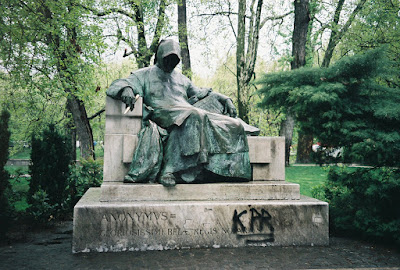
Dear Anonymous,Statue Of Anonymous, Taken by UkieVillain in Budapest, Hungary 5/11/2003

Expectation. Waiting.

Advent is about waiting. Waiting for Christ's birth. Waiting for Christ's return. Waiting for the reconciliation of the world to Christ to come, where justice will be experienced in fullness, and we will no longer deal with the horrors of this world.

As I was looking for audio of one of my favorite Christmas songs that I sang in choir in college, I came across this video. And it really does make me long--even hunger--for the return of Christ. So thank you for this reminder of what I'm waiting for, of what the Lord has done in preparation already, and of why I'm still waiting for salvation.

Lord, protect our lambs from the wolves that roam our world, seeking to devour.

TheUkieVillain
TheUkieVillain


WARNING: The following video is *extremely* graphic in its violence, and the first 1:20 is intentional black-out. (The following example is an anti-war statement but portrays the violent death and horror that accompanies it. Scroll down to hear and view a more traditional approach to caroling!)


This version has the full lyrics, sans violence.


Lyrics:


Riu, riu, chiu
La guarda ribera
Dios guarde el lobo
De nuestra cordera.

El lobo rabioso la quiso morder,
Mas Dios poderoso la supo defender;
Quisole hazer que no pudiesse pecar,
Ni aun original esta Virgen no tuviera.
Riu, riu, chiu...


Este qu'es nascido es el gran monarca,
Cristo patriarca de carne vestido;
Hanos redimido con se hazer chiquito,
Aunqu'era infinito, finito se hizera.
Riu, riu, chiu...


Muchas profecias lo han profetizado,
Y aun en nuestros dias lo hemos alcancado.
A Dios humanado vemos en el suelo
Y al hombre nel cielo porqu'er le quisiera.
Riu, riu, chiu...


Yo vi mil Garzones que andavan cantando,
Por aqui bolando, haciendo mil sones,
Diziendo a gascones Gloria sea en el cielo,
Y paz en el suelo qu'es Jesus nascieta.
Riu, riu, chiu...

Este viene a dar a los muertos vida
Y viene a reparar de todos la caida;
Es la luz del dia aqueste mocuelo;
Este es el cordero que San Juan dixera.
Riu, riu, chiu...


Pues que ya tenemos lo que desseamos,
Todos juntos vamos presentes llevemos;
Todos le daremos nuestra voluntad,
Pues a se igualar con el hombre viniera.
Riu, riu, chiu...


Riu, riu, chiu (nightingale's sounds)
The river bank protects it,
As God kept the wolf
from our lamb.

The rabid wolf tried to bite her,
But God Almighty knew how to defend her,
He wished to create her impervious to sin,
Nor was this maid to embody original sin.
Riu, riu, chiu...

The newborn child is the mightiest monarch,
Christ patriarchal invested with flesh.
He made himself small and so redeemed us:
He who was infinite became finite.
Riu, riu, chiu...

Many prophecies told of his coming,
And now in our days have we seen them fulfilled.
God became man, on earth we behold him,
And see man in heaven because he so willed.
Riu, riu, chiu...

A thousand singing herons I saw passing,
Flying overhead, sounding a thousand voices,
Exulting, "Glory be in the heavens, and peace on Earth, for Jesus has been born."
Riu, riu, chiu...

He comes to give life to the dead,
He comes to redeem the fall of man;
This child is the light of day,
He is the very lamb Saint John prophesied.
Riu, riu, chiu...

Now we have gotten what we were all desiring,
Go we together to bear him gifts:
Let each give his will to the God who was willing
To come down to Earth man's equal to be.
Riu, riu, chiu...**

*Villancico: A lyric form, often set to music, of Spain and Portugal during the 15th and 16th Century Renaissance.
**Another nice translation

Wednesday, December 10, 2008

Tomorrow Shall Be My Dancing Day

Dear Choirboys,

I love what you have done with this little English carol, though the video itself is a bit fuzzy. You have captured, I think, the joyous paradox of this song by John Gardner with the militaristic thruming of the tom-tom and the lovely lyrical sound of boys' voices.

Merry Christmas.

BRD


Tomorrow shall be my dancing day I would my true love did so chance To see the legend of my play To call my true love to my dance.
Chorus: Sing, oh! my love, oh! my love, my love, my love This have I done for my true love.

Then was I born of a virgin pure Of her I took fleshly substance Thus was I knit to man's nature To call my true love to my dance.
Chorus: Sing, oh! my love, oh! my love, my love, my love This have I done for my true love.

In a manger laid, and wrapped I was So very poor, this was my chance Betwixt an ox and a silly poor ass To call my true love to my dance.
Chorus: Sing, oh! my love, oh! my love, my love, my love This have I done for my true love.

Then afterwards baptized I was The Holy Ghost on me did glance My Father's voice heard from above To call my true love to my dance.
Chorus: Sing, oh! my love, oh! my love, my love, my love This have I done for my true love.

Into the desert I was led Where I fasted without substance The Devil bade me make stones my bread To have me break my true love's dance.
Chorus: Sing, oh! my love, oh! my love, my love, my love This have I done for my true love.

The Jews on me they made great suit And with me made great variance Because they loved darkness rather than light To call my true love to my dance.
Chorus: Sing, oh! my love, oh! my love, my love, my love This have I done for my true love.

For thirty pence Judas me sold His covetousness for to advance Mark whom I kiss, the same do hold The same is he shall lead the dance.
Chorus: Sing, oh! my love, oh! my love, my love, my love This have I done for my true love.

Before Pilate the Jews me brought Where Barabbas had deliverance They scourged me and set me at nought Judged me to die to lead the dance.
Chorus: Sing, oh! my love, oh! my love, my love, my love This have I done for my true love.

Then on the cross hanged I was Where a spear my heart did glance There issued forth both water and blood To call my true love to my dance.
Chorus: Sing, oh! my love, oh! my love, my love, my love This have I done for my true love.

Then down to hell I took my way For my true love's deliverance And rose again on the third day Up to my true love and the dance.
Chorus: Sing, oh! my love, oh! my love, my love, my love This have I done for my true love.

Then up to heaven I did ascend Where now I dwell in sure substance On the right hand of God, that man May come unto the general dance.
Chorus: Sing, oh! my love, oh! my love, my love, my love This have I done for my true love.

Saturday, December 06, 2008

A Northern Carol - Koppångeçen

Dear Moraeus Gang,

I had not heard this beautiful Swedish "carol" until this year. The Christmas Album by Anne Sofie von Otter says that it was composed by Pereric Moraeus. Then I found this beautiful rendition by Anne Moraeus on YouTube. Are you related? Whether or not, you two have wonderful synchronicity.

Koppångeçen
Composed by Pereric Moraeus


There is silence around me in this peaceful winter night.
From the church down in the valley I can see the candlelight.
And I stopped for a moment in this winter paradise,
When I heard a choir singing through the darkness and the ice.

And the rays of lights behind the window's vaulted frames
Have united the souls in hope that something great is waiting.
And I know that those who have left us here had the same thoughts as I,
We're like flames in the darkness and stars up in the sky.

And I see how they sparkle and they fade before my eyes
And the truth is coming closer like a wonder in disguise.
We are caught here for a moment like an imprint of a hand
On an old and frosted window or a footprint in the sand.

For a while I'm eternal - that's the only thing I know,
I am here and we share our dreams about our destination.
It is cold out here, the snow is white but I'm warm deep inside.
I am warm 'cause I know that my faith will be my guide.


There are additional beautiful renditions of this piece on YouTube. I loved this one:
Helen Sjöholm

And Anne Sofie von Otter's version of Koppångeçen is a delight in both English and Swedish.

Thank you, and God Jul.

brd

Friday, December 05, 2008

For the Joy of the Advent Season

Dear Readers of Letters and Surveys,

May your advent season be filled with joy and beauty.

Traditional Catalonian Carol: Fum, Fum, Fum


English Translation

On December five and twenty,
Foom, foom, foom!
On December five and twenty,
Foom, foom, foom!
For the love of us is giv'n The holy Infant,
Son of Heav'n,
Of the Virgin, Joseph's bride,
To all the earth good will be tiding,
Foom, foom, foom!

Little birds from out the forest,
Foom, foom, foom!
Little birds from out the forest,
Foom, foom, foom!
All your fledglings leave behind,
And seek the infant Savior kind.
Come, and build a downy nest
To warm the lovely Baby blessed,
Foom, foom, foom!

Little stars up in the heavens,
Foom, foom, foom!
Little stars up in the heavens,
Foom, foom, foom!
If you see the Baby cry,
O, do not answer with a sigh!
Rather, lighten up the sky
With Heav'ns beams of radiant brightness,
Foom, foom, foom!


Spanish

Veintecinco de diciembre,
Fum, fum, fum!
Veinticinco de diciembre,
Fum, fum, fum!
Nacido ha por nuestro amor,
El Nino Dios,
Hoy de la virgen MariaEn
esta noche tan fria,
Fum, fum, fum!

Pajaritos del los bosques,
Fum, fum, fum!
Pajaritos de los bosques,
Fum, fum, fum!
Vuestros hijos de coral
Abandonad, abandonad,
Y formad un muelle nido
A Jesus recien nacido,
Fum, fum, fum!

Estrellitas de los cielos,
Fum, fum, fum!
Estrellitas de los cielos,
Fum, fum, fum!
Que a Jesu mirais llorar
Y no llordis, y no llordis,
Alumbrad la noche ascura
Con vuestra luz clara y pura,
Fum, fum, fum!

Happy Holidays,

BRD

Wednesday, December 03, 2008

Anna Netrebko: Meine Lippen sie Kussen so heiss

Dear Anna Netrebko,

Well, you have done it, breathtakingly, again.


(My Lips Kiss with Such Fire)

If anyone. . . any singer that is. . . today, could make the world fall in love with opera, it is you. Your energy and verve captures the audience in every way. You have even courted the cameraman.

What I love about this presentation is your joy. I laughed as I watched you jumping up and down at the end. I think that is what everyone in the audience wanted to do too.

Bravo!

Betsy

{Note: Sorry I have been so absent. I plan to pepper the world with letters in the next few days. Plus it is advent! Time for whispered celebration!}

Thursday, November 13, 2008

Redefining (Black/White) Masculinity

(Letter from Ukie Villain)

Dear Byron Hurt and Tyler Durden,

Thank you for your commentaries on masculinity.

Byron, you compare Curtis Jackson (aka 50 Cent) with Barack Obama, drawing upon the themes that their power and prominence make each of them, in their own way, figures of masculinity in American culture. Recent years have given us the impression that the only strong, virile black men out there were the thugs--the ones who could take the women, the money, the drugs, and the jail-time without flinching. Those who relied on their intellect instead of their muscle were seen as selling out to the 'white' culture. As you say, it's a repainting of post-Civil War painting of the black man as a Buck.

Barack has changed that. By winning against long odds to become the nation's first Black President (assuming all goes well between now and January 20), he has shown that a man can be brainy, calm, and black. He hasn't left his culture, but rather has embraced it, and has still shown that with hands-in-pockets, sleeves-rolled-up, and basketball-shooting-proficiency, he can still command authority, demand respect, and achieve power.


Despite the differences between the Rapper and the President-Elect, there is a commonality here. "These are black men that are playing in a game that was not designed for them; they are playing in a way that has allowed them to be successful against great odds." (Video above, 9:07) Both of these men took what they wanted, but they did so in very different ways. Which is the more masculine of the two, and will Barack's rise to prominence and power lead more young black men to emulate him?

Tyler, you speak to masculinity beyond race, although it seems your message is targeted most directly at white men like me. White men don't have rap stars to provide role models--we have TV sitcoms.

Homer Simpson and Ray RomanoAnd we see all the time that the archetypal man in our society--violent, stupid, and lazy--is not exactly someone worthy of emulation.


Likewise, those who are shown as powerful in business or politics are shown as ultra-consumers: those who have all the money and power they want, and are filling their lives with so much stuff, defining themselves by their Ikea-catalog-lives or their $2000 suits. You seem to believe that neither of these options is acceptable as a true measure of masculinity, although that is what society proposes as the only two options for white men these days.


I'm sad that you had to turn to violence to express your manhood, though I understand the need to violently shake off the expectations of a society that highlights consumerism or slobbery as the path to self-expression of manhood. Ever seen Complex Magazine? It's enough to make me want to hit someone, in any case.


But I find it ironic that at the same time that black men see a role model in Barack that allows them to leave violence and thuggism behind, white men are looking at consumerism, violence, stupidity, and/or laziness as their preferred methods of expressing masculinity. This seems to be going in the wrong direction.

I say that we should define masculinity in a way that neither requires self-definition as a function of what we own or the size of our bank accounts, nor the necessity to take by thuggish force! Rather, masculinity could be defined by work ethic, ability to care and provide for others (even with the knowledge that femininity does NOT require being taken care of or provided for), and genuine expression of self through physicality and emotionality.

In any case, I thank both of you for your thoughts on masculinity, and hope that men in this nation can actually behave as such.

TheUkieVillain
TheUkieVillain

PS. Thanks to NPR for giving the heads up on Byron's short documentary, and spurring my thoughts.

Wednesday, November 12, 2008

The Variation to End All Variations on a Theme by Paganini

Dear Sergei,

I have been spending quite a bit of my travel time these last few days reviewing your music. Did I ever tell you that I have a very long commute to work? Sigh, yes, but my car has a nice sound system. I say reviewing, because I have been a long time fan. My earliest forays into classical music were in the shadows of your moving concertos. I travel to Knoxville, Tennessee, each day. (That is where you performed your final concert isn't it.)

But it has not been your concertos that have enamored me of late, but that glorious rhapsody on the ever enduring theme of Paganini. Why was that simple theme such an inspiration to so many. It is hard to say?

Did you know that YouTube provides renditions of you, Sergei, playing the whole of this work in three sections?
Part 1
Part 2
Part 3

I guess that somehow this theme carries with it a spirit of the quintessential life flow that moves us through our various existences. It has inspired composers and in that, it has inspired all of us to life. You, of course, do not fail to remind us in places throughout your set of variations of the ever-present threat of death. A number of times I heard that fixed idea, the one you tap into throughout your many works, the dias irae theme. (I do not forget that. It is always a sub-theme isn't it. You Russians never let us forget. Remember that stirring work by Shostakovich, the 14th, that used the poetry of, among others, Rilke?
All-powerful is death.
It keeps watch
even in the hour of happiness.
At moments of higher life it suffers within us,
awaits us and thirsts for us -
and weeps within us.
No, we can't forget. It weeps within us, even during your variations on the theme by Paganini, that points us to the best of life.) And so you whisper reminders in variations 7 and 10 and, at the end. But death, though ever-present in life is not what it's about. It is just there, isn't it? And it's there with all the failures (variation 12?) and successes (variation 14?).

But it is life, full life, that continues through your rhapsodic variations on Paganini's lively theme. And what is life without love? Death is not the main sub-theme of life, but love certainly is. It must be. And you, my romantic friend, are the best one to state it fully in variation 18, and in D minor (like your most beautiful concerto and as Patrick Piggott* says--"in the key of sunset and romance").

In variation 16 you take us into a melody so delicately alluring that our tightening throats and not just our ears tell us it can be leading only one place, to the dearest recesses of the heart. So variation 16 with interwoven phrases for oboe, horn, harp, is harbinger of the wonder of love and intercourse. I enjoy the way you use this figure, here in the original A minor, shift it to B flat minor in 16, and then through variation 17 modulate to the erotic variation 18. (Listen to Part 2 above from 2:24 to the end.)

When I first listened to this rhapsody, I found variation 18 to be somewhat of a jolt. Too much, I thought. Out of character with the rest of the piece. But as I listened more, and especially in relation to the seduction of 16, I realized that the orgasmic strains were a deliberate expression of the richest of intercourse between the orchestra and piano. The beauty of description rivals that of the overture to Tristan and Isolde and it's conclusion leaves the chords that enveloped the notes of the Paganini motif inverted and panting on the staff.

I love this interpretation of the 18th variation done by Artur Rubenstein. He was a wonderful interpretor of your work, wasn't he?


So, I think of all the composers who have played with this group of notes first uttered by Paganini, it is you who have brought it to it's most full expression.

Thank you for these beauties.

BRD

*Rachmaninov Orchestral Music by Patrick Piggott (BBC Music Guides) 1974

Tuesday, November 11, 2008

Variation on a Variation by Benny Goodman

Dear Benny Goodman,

So you liked this caprice by Paganini also! It is so interesting and appropriate to the jazz takeoff, because jazz is about life, gutsy life, and this piece as far as I can think is about life, a high-pitched, rough and tumble, well experienced life. That is the conclusion I'm coming to as I listen to the tune and to the variations that it has inspired.

I like your interpretation, but even moreso, and I think you, too, would be delighted, I like this snappy encore, a variation on your variation performed by Gregor Pierce.


BRD

Friday, November 07, 2008

The Tune That Drove Composers Wild

Dear Niccolo Paganini,

You certainly did it with this one. As a young girl said to me yesterday, "That is smokin' hot!" I won't try here to explain wikipedia, but it lists 30 compositions written by the likes of Brahms, Liszt, Rachmaninov, and even Andrew Webber and Benny Goodman, just based on this Caprice.

Listen to Jascha Heifetz. Don't he make you proud?


Fred Flaxman, who does a public radio show, Compact Discoveries said, "These capricci, which explore virtually every aspect of violin technique, are still the supreme test of the abilities of any violinist." He's the one who said that this Caprice drove the composers wild!

If you, yourself, played like this, that guy who said your virtuosity was, "enough to make the greater part of the fiddling tribe commit suicide," was probably right.

So here is my question? (Consider this a survey question.) What is it about this tune that has brought so much musical light into this world? I'm thinking about that.

Bless you.

BRD

Monday, November 03, 2008

Post Election Perspective

CaDh8 and I (BRD) have just about burned out on election commentary. Luckily, just in time, TheUkieVillain, straight from the Ukrainian Village section of Chicago has stepped up to wrap up our issue debates. As we curl up to watch election returns, we are glad to hear some good reminders about the realities of the situation.

Hopefully, we will all move forward from this election with a renewed spirit of vision and willingness to appreciate the talents and value of the winning candidate.

Welcome to Letters-and-Surveys, UkieVillain!


Dear Self, Post-Election Day,

I hope you get some sleep Election Night, and don't stay up too late to watch the election results trickle in.

I'm writing to remind you of a few things from this side of election day, when hopes run high on all sides: the hope of change with one candidate, or the still-clinging-to-hope of the other.

Reminder 1: Whatever the outcome, God is still in control. We have just voted to elect the President. As my pastor said this week, Jesus is still Lord and Messiah, whoever may be on the throne at the head of our country. God will still be in control of the nation, of the economy, of the war, of the unborn, of the world. He can still change hearts and minds regarding policy. And HE is the one who raises kings up and deposes them.

Reminder 2: If the guy you want to win ends up losing, it does not imply fraud. While the voting process itself is increasingly under scrutiny, what with hanging chads, and e-voting mishaps, the voice of the people is still the voice of the people. Our representative democracy is still based on the concept that our representatives are elected each year. So go out, vote, and resign yourself to the results, for better or worse. I'm all for honesty and transparency, but given the system we've got, my opinion is that it'd be better to get the next guy in office instead of drawing out election night for 30+ days the way we did in 2000. That just leads to further resentment and rancor among the people.

Reminder 3: Your influence in government didn't end when you left the voting booth Yes, that's right! Despite what you may think, your representatives DO care what you have to say. Call the offices of your Representative and/or Senator and/or the President, both on the state (I guess they're called governors on the state level, huh?) and federal level (they treat that as representative of 10 of their constituents). Better yet, take the time to write a pen-and-paper letter expressing your opinions (that gets counted as 50 people!).

Or, if you think the government is bunk and can't get the job done, work on getting things better without them! Join a community group that supports actions in your neighborhood, city, or state. Join up with a cause that you believe in. Volunteer at a soup kitchen.

And, don't limit yourself to talking about politics and important issues on your blog (guilty of this myself) or with close friends and relatives. Blogs are likely to be read only by people who already agree with you, and its likely that you will hold similar opinions as many of your friends and family (although that's not always the case).

By encouraging reasonable discourse in the public square, you're helping bring back civility to our political realm, and helping understand those who are different than you, which is the start of changing yourself and the world.

Reminder 4: Read and remember! Make yourself more knowledgeable about the things you care about. That way, the next time you vote (local elections in 12 months, congressional elections in 2 years, presidential campaigns start in 3…hours?), you'll have the knowledge to back up and defend your positions and influence those around you with the truth.

So, Self, remember these things, and don't despair about whatever happens in this election or the seeming futility of politics sometimes!

Remember these things!

Sincerely,

TheUkieVillain

Saturday, November 01, 2008

Powaqqatsi: Life in Transformation

Dear Garimpeiros*,

I recently watched the movie Powaqqatsi, part 2 of a trilogy of film collaborations by Godfrey Reggio and Philip Glass. Though not as powerful as part 1, Koyaanisqatsi, it was, nonetheless, a beautiful and intriguing piece--particularly to you garimpeiros, I would think.

One of the images that recurs throughout the film Powaqqatsi is that of humans carrying burdens and carrying them, particularly, on or with their heads. And that is how we see you in the beginning sequence of the film. That scene is undoubtedly the most moving of the entire production. There you are in Serra Pelada**, sometime before the 1990's when this ant hill of production closed down, 40,000 of you, struggling up from the depths of a great pit under great burdens of rock and mud.


Godfrey Reggio recounts that the filming in the mine was taking place as planned, when a man was accidentally hit on the head with a rock. The camera person asked if he should stop filming and help. Reggio maintained that their efforts to help would be unwanted and so they filmed instead. The image of two garimpeiros carrying another up the rough trail impresses the viewer as a video version of the Pieta. Pity him. Pity them. Pity us all for the burdens we must carry.

This piece of video art, Reggio says, is an attempt to use the medium to question the medium. I'm not totally sure what he means. Supposedly he traveled broadly across the southern hemisphere to capture images from life that show the effect of industry and technology on the world. I would have to say that the work doesn't hold together in the same way that Koyaanisqatsi did, but it is beautiful and the music of Philip Glass is, as always, wonderful (if you love Glass) or repetitive to the point of a scream (if you don't).

"The computer is the highest magic in the world and something that we are all in adoration of. And that's what these films are about," Godrey says. But the word powaqqatsi is from the Hopi language and means "sorcerer life" or an entity or way of life that consumes the life forces of other beings in order to further its own life. The context of the film is this technological order. It studies the impact of progress. There is the implication in the film that technology is eating up the native cultures of the world, but that implication doesn't imply violence as much as complicity of these cultures. Powaqqi may be a black magician, but if he/she is, it operates through allurement. If the Southern world is being subsumed by progress, it is submitting willingly.

The language of the music is consonant with the language of the film. Apparently Glass followed Reggio around the southern hemisphere, but didn't always travel with him. He visited some of the same places. His hope was to explore the universe of this discourse, where the great conundrum of our age is the most immediately puzzling. "We are," they say, "already cooking in the stew of this technological age." This is the great burden that we are carrying around on our heads.


One of my favorite scenes of the film is one captured by the camera playing games with the depth of field. A woman walks, impressively carrying on her head a basket, while what appears to be a modern group of marathon runners stride up upon her slowly. The effect is breathtaking.

Powaqqatsi displays for us this great burden, embodied by those, like you, who still walk with bared feet in the mud and through the dust.

I read that Colossus Minerals of Toronto is now developing plans along with a group of garimpeiros represented by Coomigasp to core drill for gold at Serra Pelada. Pity.

BRD

*Brazilian Gold Searchers
**Serra Pelada - Very Famous Gold Open Pit Mine in the west of Brazil