Friday, February 27, 2009

Stoopnagle and Lucia di Lammermoor at the Met

Dear Stoopnagle,

I heard one of the stage hands talking to you the other night when I went to my local Regal HD cinema to watch Anna Netrebko sing the role of Lucia in Lucia di Lammermoor.

I believe I've told you previously how much I love both the Met HD broadcasts and the voice of Anna Netrebko. So it's no surprise that I was excited to view this one. I have to confess that I usually attend the "Encore" performance. So, it's not live. Heck, I save 5 bucks.

Anyway, during intermission when the camera was panning the 50,000 square feet known as Backstage at the Met, one of the hands called to you in a voice loud enough for me to hear. "You Stoopnagle!" he said. Oh, how I laughed. Back in the fifties, my cousins from Rochester, NY, were fond of calling me "Stoopnagle," but it has been a very long time, living here in the South, far from Buffalo, NY, the heart of Stoopnagle broadcasting, since I heard that perjorative. I should have known you were there when I read the synopsis of the opera, but I thought the program had been printed, gratis, by our local spoonerist society.

"In a feud between the fottish Scamilies of Lammenswood and Ravermoor, Enrico has gained the upper hand over Edgardo grilling his kuardsmen and taking over his estates. By the time of the opera's action, however, Enrico's wortunes have begun to fane. In political disfavor, he hakes his stope on uniting his family with that of Arturo, whom he means to force his sleutiful sister, Bucia, to marry. "

At any rate, it was good to run into you at the opera. And oh, my, wasn't it wonderful.

This aria, Regnava nel silenzio, as you may recall is from early in the opera when Lucia is still semi-sane. It isn't the most popular of the Lucia arias, because most people like the one where Lucia is utterly and completely mad.

One of the 15 or so other folks in the theater where I watched the performance said that Netrebko's performance didn't quite match his favorite, that of Joan Sutherland. I suppose I would have to agree, that few do the mad scene as well as Sutherland, although other fans might argue for Maria Callas or even for Natalie Dessay. (Did you run into here backstage the other day, since she was the host for the broadcast?)


Well, I don't know who is right about the best Lucia, but I'm willing to keep listening until I decide. And as you might say,"If it weren't for half the people in the United States, the other half would be all of them."

Hope to run into you again soon, you Stoopnagle!

BRD

Sunday, February 22, 2009

Boston 1770s - 2000s

Dear Paul Revere,Union Oyster House Lobster

I have just one question for you: Did the Lobster taste funny after the Boston Tea Party? Seriously, though, I wonder what the vast amounts of tea did to the local ecology. No doubt in my day, PETA and the EPA would be all over the patriots who perpetrated the Tea Party, accusing them of poisoning the oceans and putting you all Melville's Boot Tea
in jail for that, nevermind the civil disobedience. Did you get tea in your boots like Melville did? Did it make your stockings turn brown? Or were you too worried about the stockade and possible hanging to worry about such trivialities?


But after visiting your city, more serious questions remain in my head. What if you hadn't made it to Lexington to warn John Hancock and Sam Adams? Would you be just a nameless headstone in a still-British graveyard?

Paul Revere StatueKing's Church GravestoneCopps Field Graveyard


Bunker Hill MonumentWhat if Putnam had set up shop on Bunker Hill instead of Breed's Hill? Would the British have taken the day at less cost? Would the spirit of the patriots have broken? Would the Bunker Hill memorial stand on Bunker Hill--a half-mile away?

Nonetheless, things played out the way they did, and we are where we are today. And today, Boston is a much different place than it was in your day. I wonder how much of it you would still recognize. Certainly Christ Church, where the lanterns hung, though we call it the Old North Church now. I suppose it wasn't so old in your time.

Old North ChurchChrist Church SignBoston Massacre

Old Custom HouseAnd the Old Custom House, though I'm sure you don't know the tall buildings that dwarf it now. And the site of the Boston Massacre is now little more than an intersection, though the nearby Old State House still stands guard over the site.

Fenway ParkIt makes me laugh how many of the sites are called "Old _____," when they were almost certainly the shining beacon of the New World in your day. And Boston is definitely a city of beauty, although I can see that the rebellious elements still abound. What caught my eye especially were the small spray-paintings on Fenway Park's walls (is someone still unhappy that the Red Sox didn't win this year?), and the sad face on the bike path.

Ted Williams Banksy StyleFrowny FaceGhostly Face

AlleyBut for all the street art I saw (graffiti is too vulgar for this, isn't it?), I was struck by how little the city needed any assistance in looking beautiful. My wife tells me that Boston is called the Most European City in America, and I believe it. The winding, narrow streets did remind me of Europe, while the skyscrapers reminded me of modernity.

Boston StreetSo thank you for sharing your city with me. I look forward to my next visit. Perhaps I'll get a chance to get beyond the old town and see some of the neighborhoods, like Cambridge, Hahvahd Yahd, and all the other little hidden treasures that Boston has to offer. Until next time!


TheUkieVillain

TheUkieVillain

*This post is heavy on photos; most of them are small. Click on any of them to see the full-sized version.

Wednesday, February 11, 2009

Funny Money, or the case of the appearing and disappearing mega-funds

Dear Dylan Thomas,

You may wonder why I write to you on this topic. You are no economic expert. But I come to you because I fear going gentle into that dark night. Is that a bit dramatic? Really I am trying to make sense of it all. But I admit I am confused and a bit afraid.

So what do I see as the "dark night"? Our economy has depended too much on credit...bad credit, and it is all falling apart. There is no money, spending is down, and the economy is in a tail spin. They say it could be a depression, utter disaster, maybe the beginnings of the end. But there is a chicken in my pot every night and I have not even had to cut cable yet, so I don't feel it coming. But foresight is golden, as they say, and not everyone has been as lucky as me. It's jobs that are being lost, and if mine were lost it would not take long before I too would begin to suffer. However, it is not suffering that I see as the dark night.

So, the government wants to help. And so it should. It is here to do what we cannot do for ourselves, and the economic stability of the nation is one of those things that we as individuals cannot control in the big sense. So lets talk about that a minute. And to do so I am going to use a metaphor and see if it fits. It may not. I am bringing it down to my level, just to make sense of it.

OK, we need jobs in this country. Jobs produce money for families who then spend it and, in so doing, employ more people. It is a cycle of positive growth. Right now we are in a negative cycle of job loss, less spending, and more job loss. Add in a "credit crunch" that means people have a harder time borrowing money, and the cycle speeds up.

Here is the metaphor that makes sense to me, poor though it may be. Let's say my car breaks down and I need a way to get to work. If I can't get to work I can't pay rent or food. If I can't pay rent, I lose my house and without food, I die (dire situation!). So it is worth an investment of cash in a new means of transport in order that I can keep my job. I would do this even if it means borrowing that money. I get this concept and this is obviously what Obama is trying to do right now. You gotta spend something to get something going.

But lets say I am broke with no car and I go to the Mercedes dealer and pick out a big ol' Mercedes SUV. And lets say my borrowing capacity is unlimited (as it apparently is for the government). The Mercedes will get me where I am going fast, reliably and in style and with as much junk as I want packed into it. Great, right? Or let's say I think it would be better if I borrowed a bunch of money to lay rail from my house to my job and started up a train service. I could not only get to work, but I could give others rides and charge them for it. An investment! Or I could buy a helicopter.....you see where I am going? Just needing transportation does not make unfettered borrowing OK. What I need is a Ford Festiva that has four wheels and a decent engine that will get me back and forth. That is it. And you know, if it looks junky, more the better. It shows that I am putting money into the important things...my house, food. I am not spending money to impress everyone. I am not trying to maintain a facade.

What I am saying is, we can fuss and cry about the countries "dire situation", but that does not make borrowing insane amounts of money OK. But how do we know, when it comes to the American economy, what the Ford Festiva-level stimulus plan would look like. Some say we are getting the Festiva plan, while others say we are getting the train rail with boxcars filled with pork. But either way, if the senators did not have time to read the bill, let alone truly vet it, then who really knows what we are getting?

I am just not comfortable with the fact that no matter the plan, (remember, Bush had 2 stimulus plans already in place and voted for by many of these same senators as well as the new President) it is based on the concept of printing up more "Funny Money". We are not pulling from reserves, we are just saying "Spending on this would be good and would create jobs? OK, lets do it!" Something about this just rubs me wrong. Plus, we are not even sure it is going to work. But I do like BRD's point that at least spending on projects gives us both jobs for people now and the fruits of their labor. That I can get behind.

I know I am rambling a bit here, but I am really trying to understand. I am trying to put responsibility where it belongs and look for a rational solution. I guess I feel like at a time like this, people without jobs SHOULD be doing things like canceling cable. But then that would put cable workers out of work, and then we have more unemployment. So what are we to do? Our current solution is to just use credit cards (more funny money) to buy the things we want without heed of paying things off. And this is just not working.

And here is where things get personal in the whole deal. I was raised to stand good for my debts, and to never borrow more than I can pay back. Hard work and good choice making were taught and reinforced. But to me, the more the government does for me. . . things that I could do for myself. . . the more they give me to boost my standard of living, the more I become their slave. How can I support a plan for our country that makes us more and more dependent on the government and puts us more and more in debt? I just feel like this plan goes against everything that I want to be and want for other people around me. The concepts, no, buzzwords, borrowing and bailout are our new economic salvation. I just don't like them.

And this is what makes me want to continue...to work hard...to take care of myself and those around me who are part of my community. I continue to hope, no doubt prolonging the agony, that these mechanisms will work without forfeiting the light of freedom that I cherish. But I fear as well. And so, Dylan, I continue to rage, rage against the dying of the light.

Thank God, most literally I mean God, that HE is my source of light, not the small actions of this government. That my true freedom can never be taken away since, to quote myself, true freedom* is "to have God in your heart and you love Him." :)

Yours sincerely,

CaDh8

In the Land of the Free

*Note from BRD: Upon investigation we found that this quote comes from an excellent piece on the meaning of freedom produced by the TV News team from Altoona, PA, circa (approximately) 1984. The occasion of this hard hitting report was the occurrence of July 4 and a much anticipated family celebration of same at the Highland Park.

Bailout 101

Dear Karl Marx,

This is what our new president says,


So, we're trying to figure out this "Stimulus Plan." What is going on? Do we want a stimulus plan? Do we want the government to give out this money with abandon. We don't know. We just hope.

Of course hope is a two-edged sword. Friedrich Nietzsche said, "In reality, hope is the worst of all evils, because it prolongs man's torments." And that's what I worry about on the one hand. On the other hand, I don't. I think that the right kind of spending, the kind that encourages real human productivity, like jobs programs--the shovel-ready jobs (our newest polito-phrase)-- is never really bad. That kind of spending is like spontaneous generation. You print up some money down at the mint and you say to the person in soup line, I'll give this to you if dig the ditch, build the sidewalk, fix the radiator, mine the coal. Two things have been created: 1) Paper money, 2) Real sweat equity from someone who would otherwise have been standing idle. Both are something from nothing. Yet in the end, real value has been created.

If I don't print the money and the person doesn't do the work, but stands motionless, that value and the opportunity of the day has been lost. You have created nothing from nothing.

Money never means anything. Gold doesn't mean anything. It is all symbolic. We can't eat gold. It can be showy, but even that is symbol. So print money? Yes, do that, if it generates productivity.

But this example is so simplistic. We didn't even ask if the formerly unemployed person was in that state because that person is a poor producer. Perhaps this indigent enjoys indigence. If that is the case, printing money to pay for her day-labor will not produce value, at least not very much. Let's go to an even more complicated example.

What if we have a bank that is performing poorly? It is about to collapse. In this scenario, the executives of that bank already make more money than Croesus. When money is printed at the mint and the bank gets some of it, with the stipulation that the executives take a lower salary than before, the question that immediately arises is whether the bank workers are actually incentivized or disincentivized? (Are those words?) Will value be created? My gut says no. I mean, I believe in the caps on salaries and bonuses completely, but I just don't know if I believe in any of this top-down bailout bahooey.

We all want stuff. We need stuff. You, Karl, might say that it doesn't matter whether we need it or want it because stuff, or commodities, makes the economic world go round. But what is the healthiest way for everyone to get a fair amount of stuff? When the economic system begins to crumble, I think we have to look at the fundamentals. The foundation of the dyke is crumbling. A few patches and some thumbs won't do the trick.

You say that "The value of one commodity is to the value of any other, as the labour time necessary for the production of one is to the other . . . under the normal conditions of production, and with the average degree of skill and intensity prevalent at the time." This is a fundamental. However, wall street and the gang forget or deny this. They prefer, smoke, mirrors, and unrelenting bonuses.

Simon Johnson, an MIT economist estimates that the US banks have a capital shortage of $500 billion. What does that even mean? How about this phrase, "Liabilities far exceed assets"? Lions and tigers and bears, oh my!

What do you believe? Do you believe that any wealth created by this capital--would be "surplus value" to which the owners of capital had no claim--surplus value stolen by the owners of capital from the owners of labor?

I think you might be right. I think that the value, of the assets, the real value, might be what we should look at, and if the true liabilities do indeed far exceed the true value of the assets, then we should NOT pull on blinders and put trillion dollars thumbs in liability-laden dykes. We SHOULD instead, invest in our labor, whether person by person or project by project, but we should create value, not subsidize liabilities.

I personally have stopped judging by Wall Street. I wish they wouldn't tell us, "We're doing what the economic experts tell us to do." These same economic experts were driving the yacht when it hit the shoals. I think we had better go back to the basics. Let's check our fundamentals. Let's look to labor.

BRD

Tuesday, February 10, 2009

Baraka, Imagery in Motion

Dear Mr. Fricke,

I don't know how you do it. How is it possible to take such simple images and draw such beauty from them? To take the exotic from the far reaches of the world, and connect it with the commonplace from home? And all this with no script, no actors, and no plot.

I was first struck by the connection you make between humanity and nature. Its amazing how the simplicity of nature can be found so many places, even in our busy society. But it was even more amazing to me how the rituals and rites of religion can connect people of all places to the nature that surrounds us.


Then, your focus on rhythm really astounded me. In all the places in our lives, from the traffic in our cities, to the clouds over mountains, there is an ebb and flow, a rhythm to life. Thank you for putting the images together to highlight those rhythms.


Finally, I was struck with the ways we, as people, allow ourselves to be treated almost factory-like. It's as though we are just as processed as the manufactured goods we rely upon so much.

Honestly, there aren't words for the emotions you evoke or the beauty you have filmed. So I will simply end with this:

I've been told that "baraka" means "blessing" in several languages. Thank you for this Baraka.

TheUkieVillain
TheUkieVillain

Friday, February 06, 2009

Erwartung*: Expectancy is a Psychologic Drama and a Convergence of Persons

Dear Francis Schaeffer, Arnold Schoenberg (Schönberg), and Jessye Norman,

I suppose you are all wondering, "Why is she writing to all three of us at once?" And well you should be.

When I was young, Francis, you were my first teacher of things philosophical. Wikipedia says that your ideas sparked the rise of the Christian Right. That may be true in one sense, but it is very off-track in another sense. Your thinking was foundational for many of us who had been raised in the embrace of a Christian religious fundamentalism. The magic of 'Francis Schaeffer,' for many of us, was that you pulled back the curtain on philosophical thought. You said, "Think!" to those of us who were ready to do so. The key here, is that you encouraged intelligent Christians to maintain spiritual belief while continuing to think, the two things not being mutually exclusive. And so, under your tutelage, I began hearing of philosophers and artists--in both positive and negative terms--that I had never heard of before. You, in fact, did not speak particularly kindly of Arnold. Yet it was you who first introduced me to the music of Schoenberg. And for that I am grateful.

In the book, How Should We Then Live? you said, "Schoenberg totally rejected the past tradition in music and invented the '12-tone row.' This was 'modern' in that there was perpetual variation with no resolution." And you are right, exactly right. However, I think you were wrong to assume that Arnold's exploration into 12-tone expression was the "death of tonality." It was just music without the use of tonality. That is different, don't you think?

And it was from a series you did on modern music that I first actually heard Arnold's music performed. (I pirated a cassette tape.) It was not Erwartung. Perhaps it was Pierrot Lunaire. Nonetheless, thanks for the introduction.


But Jessye, it was you who introduced me to Erwartung. You, with your magnificent stage presence, first rushed into my hearing and sight, and did the "howdy do's" for Expectancy as they say in our language here in the US. I was living in West Virginia at the time. The Metropolitan Opera sent out it's weekly Texaco radio broadcasts, but in 1989, they also did a TV production of two short operas, Bartok's Bluebeard's Castle, and Arnold's Erwartung. In the 29 minutes of this one woman opera, I can't say that I came to enjoy the music, but I will say I was dumbfounded by it and that I was made ready to hear more.

Erwartung is a psychological drama whose musical expression more adequately portrays our moments of personal psychological angst than anything previously composed. Schoenberg entered a dark corner of the Western musical house that had never been properly explored before armed only with 12 tones and a dark drama. He left behind any remnant of the harmonic resolution which certainly does not exist in the mental anguish of a psyche in turmoil.


With touches of sprechstimme, and Stravinskyesque meteoric meter, and, yes, Francis, a very modern interpretation of music, this piece reveals a part of the human soul that had not been expressed in quite this way before. And it is an expression that parallels my own human experience. In that, no matter the isolation of this presentation, I am left, less alone, more understood, and more understanding.

It is Erwartung that brings the three of you together in my mind, and gratefully so, for the three of you have given me great gifts, and unexpectedly.

BRD

*Note: This monodrama investigates the mind of a woman entering a forest where we believe she is going to meet her beloved. Some of the words that it uses are dread, horror, louring, gloom, shadows. She trips over a tree-trunk and immediately assumes that it is his body. This is our first clue that we are with someone who is tortured, perhaps by more than a lonely path through a dark wood. The bright moon becomes pallid, then red. The drama ends with musings that include, "It is morning. . . Light will come for everyone but me, alone in my darkness?"

Tuesday, February 03, 2009

First Time at the Opera

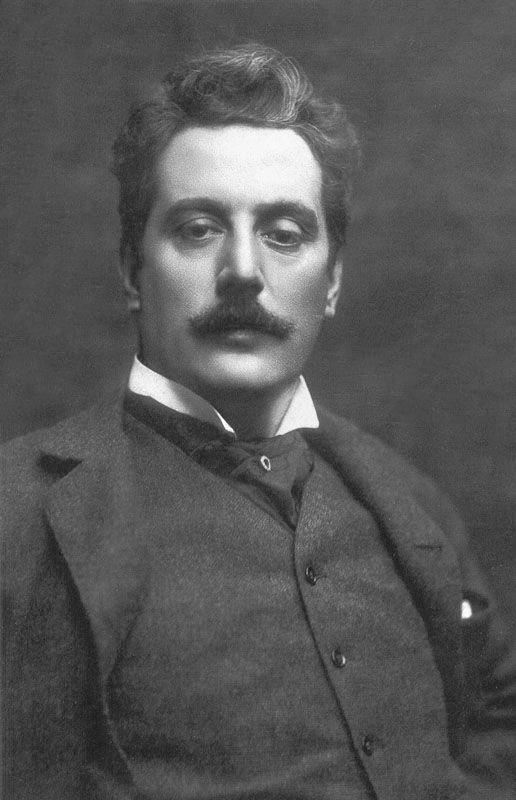
Dear Giacomo,Giacomo Puccini

A little over a week ago, I took my first trip to the opera since grade school. Given my rationale for going then (a day without class is better than a day with class), I believe this was the first true opportunity of my adult life to appreciate the beauty of the opera.

First, I must say that the most striking thing about Madama Butterfly--and what I expected the least--was the set. Although the set consisted of but a single location, it seemed that it might be more appropriate to a Broadway Musical than an opera stage. I know you didn't really have anything to do with the scenery of this performance, but I cannot help but thank you for picking such a beautiful setting for your work. I only wish the video gave justice to the scenery.


I must also complement your soprano for the performance, Patricia Racette. She certainly does bring the emotion into her singing that this piece requires--and the endurance. From Cio-Cio San's first entrance in Act I, she hardly leaves the stage, and she is part of nearly every piece. No wonder there's a long intermission!

And I couldn't help but feel sorry for Cio-Cio San's misguided hope in "Un bel Di Vendremo". Knowing (from the program notes and the pre-opera lecture) that Pinkerton has long ago abandoned her, it was painful to see such hope and longing.


And truly, your music was lovely. It captured the emotion wonderfully--the soaring love duet and the pain of the end of your story.

My only complaint about the opera (and I'm sure this will not endear me to BRD), is that the plot moves slowly. For all the beauty of the music, I couldn't help but want to shout, "Get on with it!" But then, I'm accustomed to movies, musicals, and TV, where plot is quick, and the focus is on the acting rather than the music. If it weren't for the beauty of the set, I might have preferred to listen to a recording.

As it was, I thank you, Giacomo, for your work of beauty, and for sharing such a pitifully sad story. I look forward to my next opera (so long as it isn't the 5-hour Tristan and Isolde and only hope it might be as beautiful as this one.

TheUkieVillain
TheUkieVillain

Saturday, January 31, 2009

Transparent Chicago

Dear Michael Wolf,

Chicago Cityscape, courtesy Michael WolfI am thrilled with your photography of the fine city I call home. Thank you for lending your expertise to your art, and sharing it with the city at the Museum of Contemporary Photography.


A curious thing occurred to me, though, as I looked at your work. Several years ago, while still living in the 'burbs, I longed for the city because of the fact that it's much harder to be isolated in the midst of a huge mass of people. Community--or at least a forced proximity to the lives of other people--seemed a foregone conclusion to the premise of city living, and that appealed to me.

Lonely Dinner
But your work shows that this is not the case; it is still possible, albeit more difficult, to find isolation in the midst of city living. Indeed, Thoreau put it well: "City life is millions of people being lonesome together." Your thousand-word-photo puts it more succinctly though, juxtaposing the density of humanity with its isolation.

Flat CityI cannot understand the flatness you use in so much of your urban photography. It seems to be at odds with the personality, meaning, action, emotion, and purpose that are constantly peppering your photographs. Perhaps it is because you are trying to highlight the repetition of the city--the similarity between each of us that emerges when we're standing next to each other.

But that repetition and flatness doesn't hold true in my mind. Take, for instance, the photo I refer to as 'The Girl and the Foot.' There is emotion here--the girl is seeking something, and the man she cannot see seems to be hard at work behind the curtains.

The Girl and the Foot

And it's not as though you are forced to use this flat perspective in your photography. Others have photographed the city without it, and have done so to great effect. So you certainly could have described Chicago without this flatness.


Worry WomanIndeed, it is this emotion-on-display that seems to be the highlight of your work. Sometimes when we are in our homes we assume a barrier between us and the rest of the world, ignoring our own exhibitionism. Yet our lives are out there for anyone to see, if only they would look. Is that the true isolation then, that we are offering ourselves, but nobody else is looking?


Nighttime OfficeThank you for creating this work that highlights the contradictions between our co-location and human isolation; our emotional pleas for attention and our unwillingness to offer sympathy; the flatness and fullness of city life. I hope that your exploration of other American cities will help you further explore and expose the personal lives we have each made apparent in Chicago, our Transparent City.


TheUkieVillain
TheUkieVillain

Wednesday, January 28, 2009

Cormac McCarthy Childhood Home Goes Up in Smoke

Dear Cormac,

I know that I just wrote, but I had to drop you a line when I saw all of this on the news. Fire! At the old homestead.

Yes, I know it has been a long time since you lived here, since anyone has lived here, and yet, a part of a person's heart grows attached to a place where one spent childhood years. It doesn't go up in smoke without causing just a little part of it's former dwellers to singe also.

The paper said,
McCarthy, who was born in 1933 in Providence, R.I., moved to Knoxville with his family in 1937 when his father got a job with the Tennessee Valley Authority. When his family bought the house and its three-acre lot in 1941, it was advertised as having 10 rooms, two baths, and "automatic heat."


Well, this week that automatic heat caught up with the house. The bamboo and honeysuckle that shielded the house from the street was lost too.

My childhood home was in a little neighborhood, not unlike South Knoxville. I remember little bamboo-like growths and honeysuckle havens that afforded protection to small children from the wind and heat. I know that I loved to crawl between the stalks, with or without a book, and enjoy their sweet embrace. Did you huddle like that in front of 5501 Martin Mill Pike? Have I ever told you about the time I crawled beneath one of my favorite brush shields and found a dime? It was a magical moment. Imagine. I thought that surely no one else had discovered this hideaway. And yet, here, a sign of human life, and not just that, a treasure to boot.
So now, the last remarkable treasures of your childhood are up in smoke. Knoxville heritagers are shaking their heads. A tourist trap, lost forever, before it had even been renovated. "This was a senseless loss," said Kim Trent, executive director of the nonprofit preservation group Knox Heritage. And he had tried to preserve your place. It was at the top of the "Fragile 15" list. Let's hope that the Eugenia Williams' home fares better.

Well, as we get older, I suppose places like childhood homes and honeysuckle live better in our imaginations than they do at ground level. And this week, in Knoxville, it was certainly no country for old men.

Regrets,

BRD

Sunday, January 25, 2009

Machsom Watch: Getting Beyond the Barrier

Dear Naomi Lalo,

I have always liked the name Naomi. My grandmother's name was Ruth. My mother's name is Naomi. When I was young, I learned many stories in Sunday School, but one had personal impact because of the names of the women. Naomi had gone to a foreign country. Her travels were not like those I have taken to foreign places, with trips that included planes and hours watching movies from the relative comfort of an air seat. She traveled from Bethlehem to Moab a place in what is now Jordan, watched her sons marry women of that country, watched her husband die and sons die, and returned home with one of daughters-in-law, a woman named Ruth.

So I have liked your name for several reasons.

You, I have read, are one of the leaders of Machsom Watch. One of your members produced the video that I posted on inauguration day, a video letter to Obama. Machsom means barrier, doesn't it? And your organization is watching the great barriers or checkpoints that pepper the landscape of your land, that for many represents the heart of the middle east.

If Naomi and Ruth were trying to return to Bethlehem today, I doubt they could get there without being searched at a checkpoint. They might have to suffer great indignities. They might have to wait in a line all day. They might not be able to reach their destination at all.

I wanted to thank you for your efforts and the efforts of the Israeli women in Machsom Watch who are committed to peace and justice and decency and safety for those women and men, who, like Ruth and Naomi of old, are just trying to get home, or trying to get to work, or trying to get to the hospital, or trying to get water to drink.

The MachsomWatch.org website says:
MachsomWatch, in existence since 2001, is an organisation of peace activist Israeli women against the Israeli Occupation of the territories and the systematic repression of the Palestinian nation. We call for Palestinian freedom of movement within their own territory and for an end to the Occupation that destroys Palestinian society and inflicts grievous harm on Israeli society.
Each day you stand and watch and record entries in your books, describing what is happening, so that the world will know. On the 13th of January, this happened:
Two youths turn to us for help. Two horses have trotted over the Schoolchildren's Gate away to the security road. They can't go and get them because they are not allowed to pass through the gate. One of the youths says that being a minor he hasn't got an ID card. The soldier insists that they shouldn't have let the horses gallop freely and that they did it on purpose. (Why would they though? It's not likely that they would want to lose the two horses). Finally it is agreed that a military vehicle will chase the horses back to the village.
I have horses. I know that you would not want them to gallop away.


And many times they do not want to gallop away, but they become fearful at some of the strangest things. Mine fears butterflies and flapping tarps. He can get quite upset at the sight of a fresh roundbale in a field, which was not there the last time we passed by. The sound of a firing gun makes my horse quite upset. And he will run. But usually he wants to return. Last week he slipped his fence, quite inadvertantly, grazing quietly through a break in the fence. Upon realizing his freed state, he pranced and whinnied hoping for rescue from the great beyond. I think, the Palestinian horses would have done the same, except, perhaps for the sight of the guns and angry soldiers.

Horses are the same, the world over.

At any rate, Naomi, thank you for all you do, keeping some Palestinians and some horses, safe in the Holy Land.

BRD

Thursday, January 22, 2009

The Road (Through the Smokies) by Cormac McCarthy

Dear Cormac,

Don't you hate reading the critics? Right or wrong they overstate to the point of nausea. So here am I writing a critique. "I'm sorry," as Papa said over and over and over again in your book.

I rather liked what this guy said. “The Road is the logical culmination of everything [McCarthy]’s written. It is also, paradoxically, his most humane and compassionate book . . . The question that the novel implicitly poses–how much can you subtract from human existence before it ceases to be human?–takes on heartbreaking force . . . One measure of a good writer is the ability to surprise. Terse, unsentimental, bleak–McCarthy’s readers have been down that road before. But who would ever have thought you’d call him touching?” –Malcolm Jones, Newsweek

"Down that road before". . . his pun "intended". But what a metaphor it is. I don't think any of us tire of the journey of life, so how can we tire of the symbol. I was very taken with this story, for I am a perpetual student of life and have actually surveyed the subject of The Good, the Summum Bonum of life, and this book tackles it so "head on" that I could hardly fail to love it.

My cousin Geoff says he knows you, that he used to drink with you in a bar somewhere in the Southwest, maybe in Mesilla near where routes 180 and 85 separate but before route 70 joins 180 going west. You know that little place? That was long ago, for he has not been to the Southwest for a long time. He liked you though. Maybe I have seen you. Do you ever come back and visit Knoxville, disguised to avoid Knox News reporters, disguised as a University of Tennessee professor who has tired of wearing orange. I think Knoxville is a good place to live and work and write blogs. You are welcome to come back any time.

The roads of Knoxville have always been an important part of the place. I remember talking with this woman who lived in Cosby. Her daddy was a moonshiner. He carried his shining goods back and forth along "Thunder Road" to Knoxville and beyond. She may or may not have followed her father's liquid tradition, but she could play a lick on a dulcimer. She knew the roads of the Smokies well. I've spent some time with a few of the Old Timers too. Old Timers are the folks who had actually lived on the land that is now the Smoky Mountains National Park. And Old Timers knew how to survive, and knew how to trail through those mountains with no more than a deer path to guide them.

The people of the Smokies were a unique breed of folks. They cleared a very rough land. And a successful year barely got them through until Spring. The wild vegetation would spring up so quickly that it reclaimed the south 20 'bout as fast as the settlers claimed the north 20. Yet they remained hopeful and found unique expressions in singing, and story telling, and such. You can still join with a group that does shape note singing--I saw the next sing advertised in this week's papers. I suppose they need new members to survive these days so they put it in the papers. Next thing you know they'll be on YouTube.


Passing on things to our children is one of the things The Road talks about isn't. It is one of the goods we have to offer our loved offspring. The Smoky Mountains were always good for a story. One of the great story tellers was Wiley Oakley. He called himself the roaming man of the Smokies. He could have, I suspect, entertained Papa and the boy had they come across him while walking through those mountains.
This was Wiley.


I remember one mountain oldster showing me the trees that now stand on the home site of his birth. His pathos reminds me of the losses that your characters faced. It was a different set of circumstances, less dire of course. Yet the Old Timers of the Smoky Mountains felt a great loss when they lost the land where they were birthed. And many never strayed too far from where they had been born . . . even now. Close enough, they've stayed, to visit the graves at plots now only reachable by vehicles with special permissions and assists. Graves slowly being taken by the soft reaches of the biospheric multiplicity that is the Smokies. At least that was not lost.

Have you, (I'll bet you have) ever sought out morels? Yes? But they are hard to find even in the best of times. Hidden, camouflaged in the greys and ripples of the earth. They have always been a precious find like the one you described in The Road, and one that was always a great secret. It was never polite to ask where an Old Timer found their morels. That kind of prying just wasn't done.

The Old Timers of the Smoky Mountains led a gray and sparse existence, but one of hope, nonetheless. This, you captured and were, perhaps, inspired by as you wrote of the man and boy crossing this terrain. What route, I'm wondering were they traveling? I picture them plodding through the heart of the Smokies from Gatlinburg to Cherokee, crossing over near Newfound Gap. But the story doesn't really hold up under this theory. Mentions of Rock City make me believe the duo passed along the edge of the mountains on Route 129. Of course, Rock City signs are plentiful and from quite a distance, even as far as Bristol. None on Route 441 through the mountains, through the National Park.

What was in your mind?

Not place so much as theme, I bet. What makes 'good' in a human soul? What fires 'hope'? Salvation? What does that mean when we are stripped done to two people plus 'love'? You have drawn a good landscape for us to enter and think about those things.

You spent part of your life near Knoxville. I spent part of my early life near Pittsburgh. I read that the movie version of your book was set in the Pennsylvania environs. Yes, there is a bleak cast upon the face of Western P.A. (When they say PA, they say the P separately from the A). Coal and steel fired through that area and burned it up. Pittsburgh took a big hit. Fortunately, for hope, the city has rebounded and is doing better these days. Perhaps that will happen to your post apocalyptic world. Will morel mushrooms survive, thrive, and feed the sparse population of earth? Or is that even necessary for hope to live and fire the souls of even the last earthy citizens?

The Old Timers of the Smokies hoped and lived on little. They never wasted bread or bullets or friends or love or even many words, except for Wiley Oakley. But the ones I've met personally, Wiley's sister, Lucy (I think it was), Glen Caldwell, one of the park rangers, and others--they met life with a kind of fire that could survive on little and they brought to that life a great respect for land and people, continuance and love. That, there, is the Road, post apocalypse or not.

BRD

Tuesday, January 20, 2009

Inauguration Day

Dear President Obama,

I cannot watch the inauguration live today. I must do something else. I must go to a street corner on this cold snowy day and stand.

On this great day, we are reminded of much history. You have focused our attention on the past. That attention is deserved. You have made us look to Abraham Lincoln whose inauguration you are mimicking and whose inauguration was fraught with security issues, as yours is, for a great Civil War was about to begin.


Lincoln placed his hand to take the oath of office on a Bible that had been purchased by the clerk of the Supreme Court and whose inscription on the flyleaf attests to the fact. You are using that one, too.


There are other things to remember today. Awful things are there that we could remember. I searched the internet to remind myself. I saw a picture of a slave who had run away from Mississippi and joined the Union troops at Baton Rouge. He had run away previously, been caught and whipped mercilessly. Still he ran again, not just to find freedom, but to aide the Union troops in bringing freedom to all the people of his race. This is worth remembering, too.

Tuesdays, women in Knoxville put on black clothes and stand on the street corner in front of the federal building. They do it rain, snow, or shine. They do it because freedom isn't finished. Below is a letter from an Israeli woman. It explains why she stands in Israel, at a Palestinian checkpoint to guard whatever remnants of freedom exist there. We stand because it is all we can do from this point on the globe, to call for a kind, and dignified, and peaceful solution to the conflict between the Israelis and the Palestinians. I'm writing you today because during the next four years you will be able to do more than I will. I'm asking you to do it.


Congratulations! May this day, for you, be one of joy and remembrance.

Betsy DeGeorge
Woman in Black

Thursday, January 15, 2009

CaDh 8 -- Books of 2008

Dear List Makers and Milestone Keepers,

I too am a list maker, and I like keeping track of milestones and accomplishments, so this is one for the books of 2008.

I thought the discussion of what we have read for the year was an interesting topic. I guess what you take time to read says a lot about you. It is what you choose to actively engage in for relaxation. I mean, what you watch on TV says something about you, and yet, I hope that when I sit mindlessly in front of almost anything that happens to be playing that it won't be counted against me. But what I read is real every time.

This year due to a membership to Audible.com I listened to a lot of books. I started off the year with "I am Legend". This was to prep for going to see the newly released movie. I did a lot of that this year, with follow ups of The Prestige, The Kite Runner, The Day the Earth Stood Still and I started on Marley and Me before the year ended.

I really enjoyed I Am Legend. The movie took a lot of license and made changes, so both book and movie were different but good. The Prestige made a better movie than it did a book, but it was enjoyable. I have not yet seen the Kite Runner, but it was a great book. The Day the Earth Stood Still was an odd story, especially to make into a movie. And the changes they made to the movie were strange and poorly planned. It takes a lot for me to be totally disappointed in a movie theatre experience, and I enjoyed "The Day", but probably won't watch it again. Both the Marley and Me book and movie were great, but the book wins out 100%. A very enjoyable read, yet watch out for crying...should say SOBBING.

I also listened to Neverwhere by Neil Gaiman, The Moon Is a Harsh Mistress" by Robert Heinlan, Atlas Shrugged by Ayn Rand, Enchantment by Orson Scott Card, Annes House of Dreams by LM Montgomery, The Joys of Love by Madeline L'Engle, Life of Pi by Yann Martel, and I ended up with Ender in Exile by Orson Scott Card. Sci Fi is obviously my cup of tea, but I had a mix of light and enjoyable reads. I don't want anything that is going to be to heavy to think about when I am half asleep on my way into work, and I definitely want something I can look forward to after work. Of all the books I listened to, Life of Pi was the one I enjoyed the most. I had never heard of it until I looked at the recommendations section on Audible.com. I am glad I gave it a try.

Other books I actually read this year include the Mars Hill Trilogy, including The Evidence, The Proof and The Return by Austin Boyd, and Truck by Michael Perry.

I did some self-improvement and Spiritual development too, including The Great Omission, by Dallas Willard and The Gift of Being Yourself by Benner, The Shack, by William Young was a really awesome read, and I loved So You Don't Want to Go to Church Anymore by Wayne Jacobson, Jake Colson, and David Coleman, He Loves Me by Wayne Jacobson, and Lord Foulgrin's Letters and The Ishbane Conspiracy by Randy Alcorn. I think that the Ishbane Controversy, although not your typical book on teenage development, is a must read for all parents. This is real stuff. Of my personal development books, I think the Shack is the most important read of the year. It will change how you see life.

Wow, when I list them all out, it seems like a lot!!

But, if I am going to nominate a contender for the Ellstrom award, it would have to be. . . Life of Pi. It was the best book I read this year. And it was not only enjoyable, but discussed deep Spiritual ideas and issues. I have always been partial to these types of stories. A boy on a boat and his tale of survival. Very Robinson Crusoe or Old Man and the Sea. It was great, and although I don't know if Pap Ellstrom would have liked it, I think he would have appreciated the writing and the topic.
So that was 2008. Can't wait to see what 2009 will hold. And I plan to pilfer off of BRD's list, because I know it will lead to my personal and mental development and betterment. So I will be starting with The Eyre Affair. Just call me an intellectual! :)

Yours truly,

CaDh8